Brief daily functional strength training to improve functional performance in older adults with mobility disability: A randomized trial
Smita Dandekar, Jordan Kurth, Yimeng Shang, Jonathan G. Stine, Matthew A. Ladwig, David E. Conroy, Kathryn H. Schmitz, Liza S. Rovniak, Matthew Silvis, Margaret Danilovich, Noel Ballentine, Natalia Pierwola-Gawin, Shouhao Zhou, Christopher Sciamanna, Leonardo Roever

TL;DR
A short, daily strength training program improved mobility in older adults with walking difficulties, showing better performance in functional tests.
Contribution
A brief, home-based functional strength training program was shown to be effective and feasible for older adults with mobility issues.
Findings
The FAST-2 intervention reduced the time for the Five-Times Sit-to-Stand test by 2.3 seconds.
Participants in the intervention group increased their One-Legged Stance Test time by 3.6 seconds.
The program improved the number of chair stands by 4.2 repetitions in 12 weeks.
Abstract
Mobility disability is associated with functional decline in older adults. Resistance training (RT) improves mobility disability, but adherence to national RT guidelines is poor. We evaluated the effects of a 12-week brief, home-based functional RT program, FAST (Functional Activity Strength Training)-2, on adherence and functional impairment in older, inactive adults ≥ 65 years of age, with pre-existing walking difficulty. Eligible older adults were randomized using stratified assignment based on biological sex and age (65−72 and 73+) to either the FAST-2 intervention involving a 4-minute daily workout of four exercises lasting 30 seconds each or the delayed treatment control condition. Video coaching at baseline and at weeks 2, 4 and 8, provided feedback on exercise form, modifications and progression. Daily email reminders were sent for workout completion, and to report exercise…
Genes, proteins, chemicals, diseases, species, mutations and cell lines named across the full text — each resolved to its canonical identifier and authoritative record.
Click any figure to enlarge with its caption.
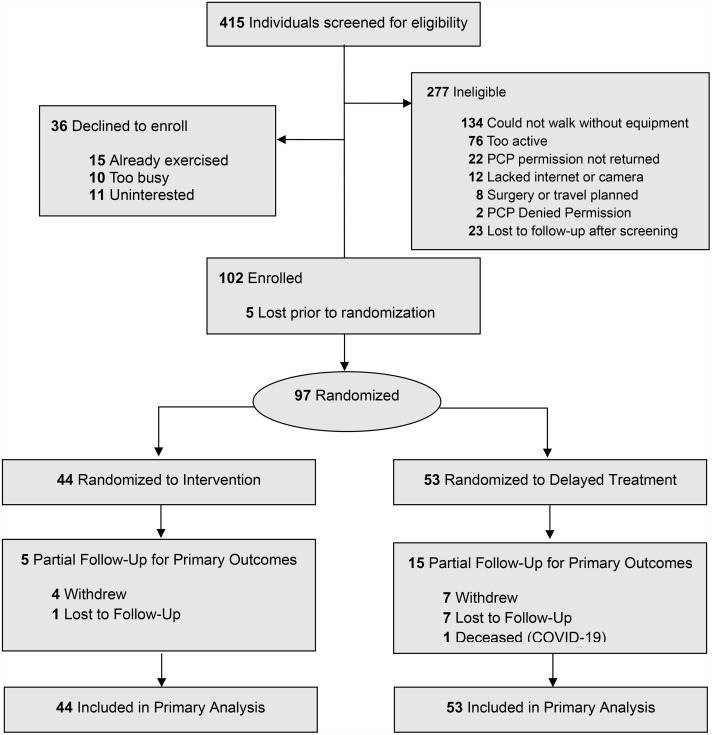 Figure 1
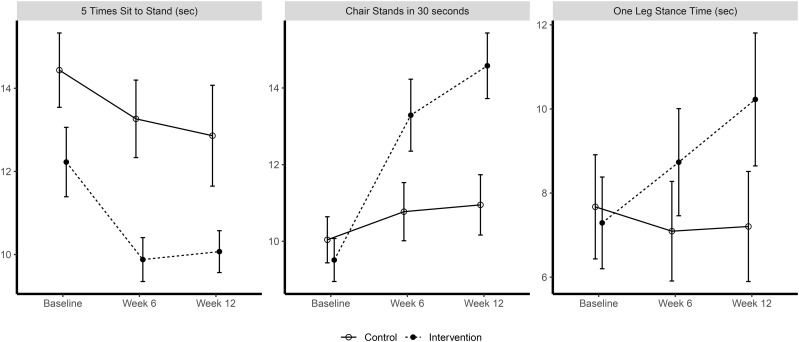 Figure 2
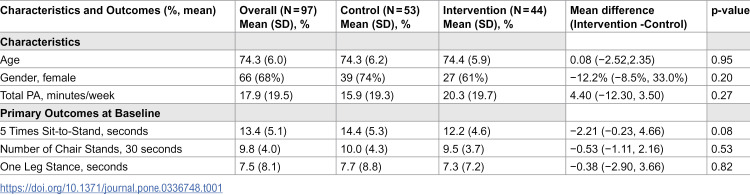 Figure 3
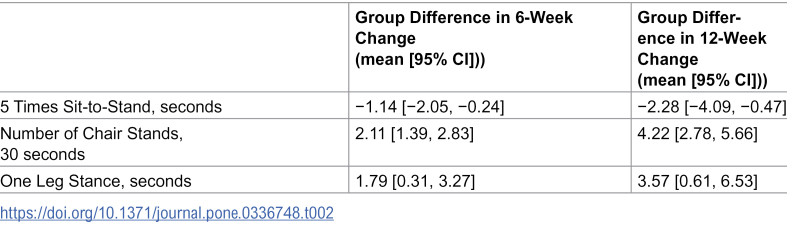 Figure 4
Peer Reviews
No public reviews on file for this paper yet. If you reviewed it on a platform where reviews are public (OpenReview, ICLR, NeurIPS, ICML), you can paste yours below so the community can read it here.
Videos
No videos yet. Explain this paper in a talk, walkthrough, or lecture? Add one.
Taxonomy
TopicsBalance, Gait, and Falls Prevention · Cerebral Palsy and Movement Disorders · Stroke Rehabilitation and Recovery