Large Language Model–Based Agents for Physical Activity and Cognitive Training: Scoping Review
Alessandro Silacci, Benedetta Giachetti, Leonardo Angelini, Nicola Francesco Lopomo, Giuseppe Andreoni, Elena Mugellini, Mauro Cherubini, Maurizio Caon

TL;DR
This scoping review maps the use of large language model-based agents for physical activity and cognitive training, highlighting early promise and key challenges in their design and evaluation.
Contribution
The first systematic mapping of LLM-based agents in physical activity and cognitive training domains, identifying design practices and methodological gaps.
Findings
LLM-based agents are primarily used in coaching roles for physical activity and companion roles for cognitive training.
Proprietary models like GPT-3.5 and GPT-4 dominate, with limited use of open-weight models and inconsistent prompt documentation.
Outcomes focus on user perception rather than behavioral changes, indicating a need for more rigorous evaluation methods.
Abstract
Large language model (LLM)–based conversational agents have been increasingly used in digital health interventions. However, their specific application to physical activity (PA) and cognitive training—two critical well-being domains—has not been systematically mapped. In fact, these domains share an important need for personalized, adaptive support and conversational engagement, making them relevant targets for examining how LLM-based agents are currently conceptualized and deployed. This scoping review aimed to map the extent, characteristics, and design practices of LLM-based conversational agents supporting PA or cognitive training, specifically analyzing their application contexts, social roles, and technological features. Following PRISMA-ScR (Preferred Reporting Items for Systematic Reviews and Meta-Analyses extension for Scoping Reviews) guidelines, we searched Web of Science,…
Genes, proteins, chemicals, diseases, species, mutations and cell lines named across the full text — each resolved to its canonical identifier and authoritative record.
Click any figure to enlarge with its caption.
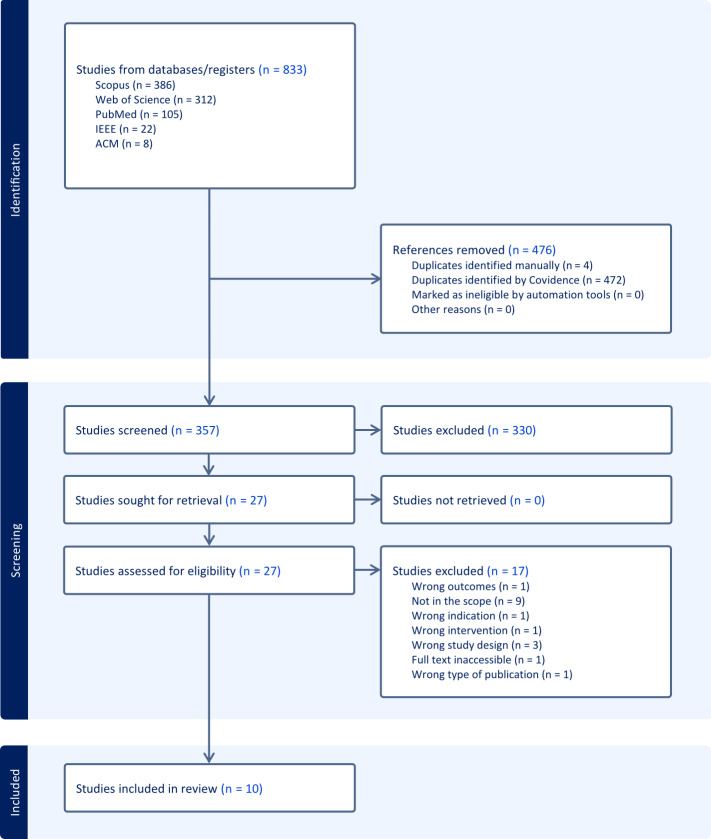 Figure 1
Peer Reviews
No public reviews on file for this paper yet. If you reviewed it on a platform where reviews are public (OpenReview, ICLR, NeurIPS, ICML), you can paste yours below so the community can read it here.
Videos
No videos yet. Explain this paper in a talk, walkthrough, or lecture? Add one.
Taxonomy
TopicsArtificial Intelligence in Healthcare and Education · Mental Health via Writing · Machine Learning in Healthcare