Impact of Secondary Prevention on Mortality in the Building Trades National Medical Screening Program: Effectiveness of Occupational High‐Risk Management
Knut Ringen, John M. Dement, Marianne Cloeren, Sammy Almashat, William Grier, Stella Hines, Laura S. Welch, Kim Cranford, Scott Haas, Patricia Quinn, Anna Chen, Miles Fisher

TL;DR
A medical screening program for construction workers significantly reduced mortality risks, showing that ongoing health surveillance is effective in high-risk occupational groups.
Contribution
The study demonstrates the effectiveness of secondary prevention through medical exams in reducing mortality in high-risk occupational populations.
Findings
Participants who completed medical exams had up to 53% lower mortality risk for colorectal cancer.
Continued surveillance beyond retirement age was found to be important for reducing mortality.
The program added an average of 1.5 years of life per participant at a cost of $2757 per year of life saved.
Abstract
Since 1997 the Building Trades National Medical Screening Program (BTMed) has offered medical exams to construction workers employed in US nuclear weapons facilities. The process consists of two steps: (1) a detailed work history interview; and (2) a medical exam. Some participants only completed the work history interview, and we compared their mortality experience to those who also completed medical exams. We compared the mortality of 3470 work‐history‐only participants to 23,452 participants who completed both the work history interview and medical exams and, of these, 1720 who additionally participated in lung cancer screening. We used Cox proportional hazard and Poisson regression models to estimate hazard ratios and risk ratios while controlling for potential confounders. Medical exam participants experienced a reduction in mortality risk of 28% for all causes combined; 27% for…
Genes, proteins, chemicals, diseases, species, mutations and cell lines named across the full text — each resolved to its canonical identifier and authoritative record.
Click any figure to enlarge with its caption.
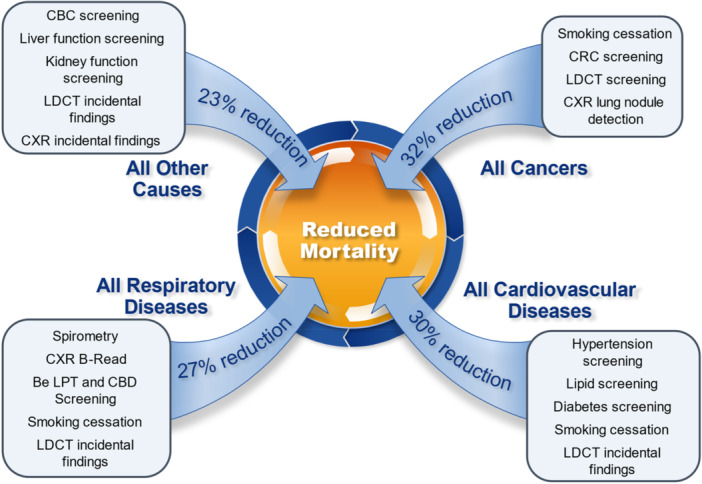 Figure 1
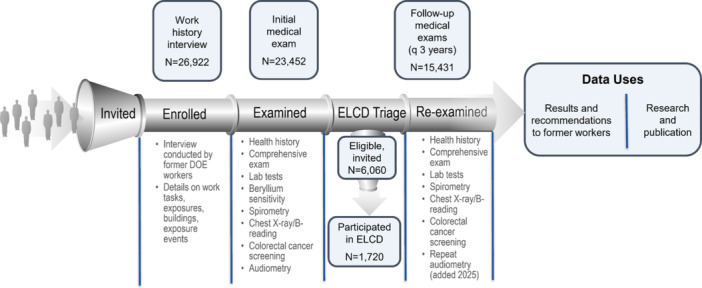 Figure 2
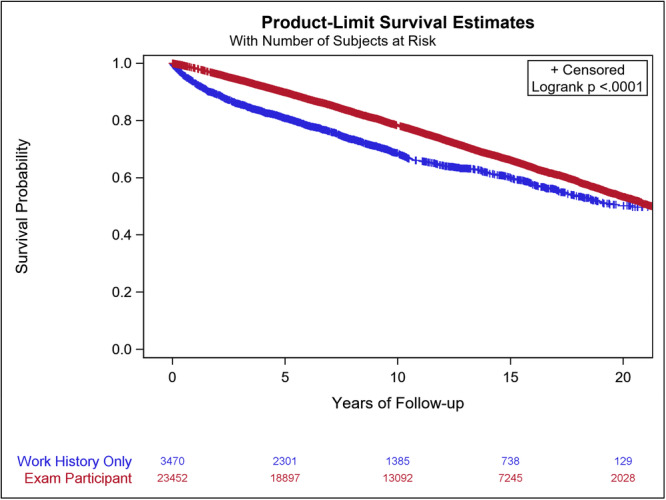 Figure 3
Peer Reviews
No public reviews on file for this paper yet. If you reviewed it on a platform where reviews are public (OpenReview, ICLR, NeurIPS, ICML), you can paste yours below so the community can read it here.
Videos
No videos yet. Explain this paper in a talk, walkthrough, or lecture? Add one.
Taxonomy
TopicsRadiation Dose and Imaging · Occupational Health and Performance · Nuclear Issues and Defense