Metagenome-assembled genomes from oxygenic photogranules obtained from photobioreactors treating synthetic wastewater
Oriane Della-Negra, Rémi Servien, Kim Milferstedt, Jérôme Hamelin, Christophe Klopp, Claire Hoede

TL;DR
Scientists identified 25 high-quality genomes from photogranules used to treat wastewater, dominated by a cyanobacterium and supporting nitrogen and oxygen cycling.
Contribution
Recovery and analysis of 25 MAGs from photogranules reveals key metabolic roles in wastewater treatment.
Findings
Twenty-five high-quality MAGs were recovered from photogranules.
Cyanobacterial MAGs encoded photosynthesis and nitrogen fixation pathways.
Heterotrophic MAGs contributed to nitrogen removal in wastewater treatment.
Abstract
Twenty-five high-quality metagenome-assembled genomes (MAGs) were recovered from photogranules to treat synthetic wastewater. They were dominated by Leptolyngbya boryana. Cyanobacterial MAGs encoded photosynthesis and nitrogen fixation pathways, supporting internal oxygen and nitrogen cycling. Most heterotrophic MAGs contributed to nitrogen removal, highlighting the metabolic complementarity within photogranules studied for wastewater treatment.
Genes, proteins, chemicals, diseases, species, mutations and cell lines named across the full text — each resolved to its canonical identifier and authoritative record.
Click any figure to enlarge with its caption.
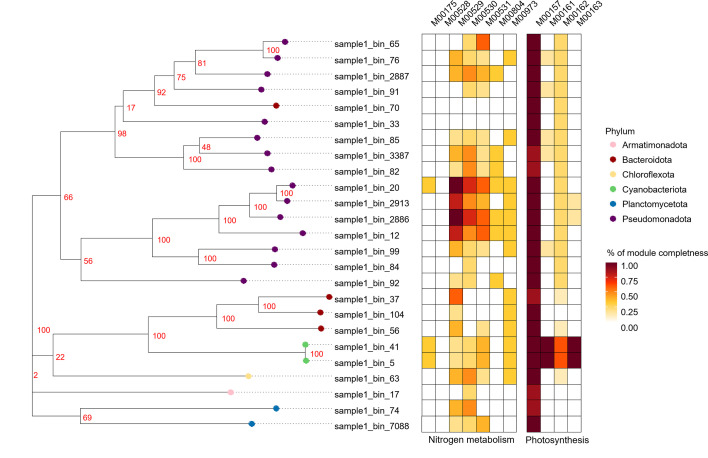 Figure 1
Peer Reviews
No public reviews on file for this paper yet. If you reviewed it on a platform where reviews are public (OpenReview, ICLR, NeurIPS, ICML), you can paste yours below so the community can read it here.
Videos
No videos yet. Explain this paper in a talk, walkthrough, or lecture? Add one.
Taxonomy
TopicsAlgal biology and biofuel production · Photosynthetic Processes and Mechanisms · Microbial Fuel Cells and Bioremediation