Metagenomes and metagenome-assembled genomes from a nutrient removal plant at Los Angeles County Sanitation Districts (LACSD) that transitioned from high to low dissolved oxygen
Blaise M. Enuh, Kevin S. Myers, Phil Ackman, Thomas Weiland, Natalie Beach, Michelle Young, Timothy J. Donohue, Daniel R. Noguera

TL;DR
This paper presents metagenomic data from a wastewater treatment plant that transitioned to low oxygen conditions to reduce energy use.
Contribution
The study provides new metagenomic datasets and assembled genomes from a wastewater plant under low dissolved oxygen conditions.
Findings
Five metagenomes and 492 MAGs were obtained from the Pomona plant before and after DO reduction.
The dataset captures microbial community changes during a transition to low DO conditions.
Abstract
Operating biological nutrient removal (BNR) wastewater treatment plants with low dissolved oxygen (DO) conditions can reduce energy costs. We report on five metagenomes and 492 metagenome-assembled genomes (MAGs) obtained from samples collected at the Pomona water reclamation plant before and after a DO reduction from 3.5 to 0.7 mg/L.
Genes, proteins, chemicals, diseases, species, mutations and cell lines named across the full text — each resolved to its canonical identifier and authoritative record.
Click any figure to enlarge with its caption.
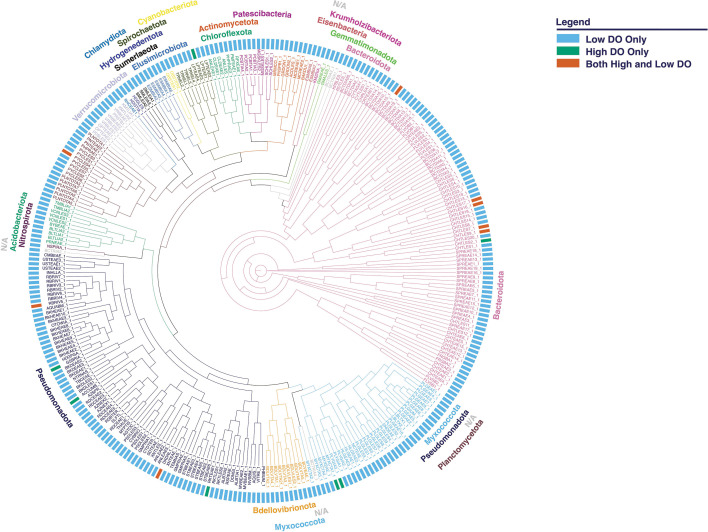 Figure 1
Peer Reviews
No public reviews on file for this paper yet. If you reviewed it on a platform where reviews are public (OpenReview, ICLR, NeurIPS, ICML), you can paste yours below so the community can read it here.
Videos
No videos yet. Explain this paper in a talk, walkthrough, or lecture? Add one.
Taxonomy
TopicsWastewater Treatment and Nitrogen Removal · Genomics and Phylogenetic Studies · Microbial Community Ecology and Physiology