Microbiota composition of Drosophila and their environments in Utah, USA, orchards
Amanda Morrison, Aubrey Cluff, Sarah Gottfredson Morgan, Emma K. Davis, Connor Hough, John M. Chaston

TL;DR
This study examines the gut and environmental microbes of fruit flies collected from Utah orchards, showing how factors like fly species and environment influence microbial communities.
Contribution
The study provides new insights into how fly species, sex, and environmental factors shape microbiota composition in wild Drosophila populations.
Findings
Microbiota composition varies with fly species, sex, and starvation status.
Environmental factors such as fruit and soil influence microbial communities.
Collections across a latitudinal gradient reveal patterns of microbiota covariation.
Abstract
We present a marker gene analysis of the microbiota of Drosophila and their fruit and soil environments, collected across a latitudinal gradient in Utah, USA. Collections varied according to fly species, sex, and starvation condition, providing a snapshot of the covariation of these variables with microbiota composition in the wild.
Genes, proteins, chemicals, diseases, species, mutations and cell lines named across the full text — each resolved to its canonical identifier and authoritative record.
Click any figure to enlarge with its caption.
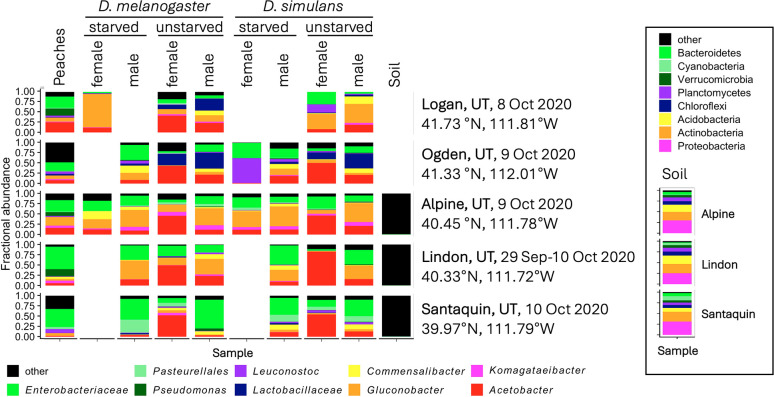 Figure 1
Peer Reviews
No public reviews on file for this paper yet. If you reviewed it on a platform where reviews are public (OpenReview, ICLR, NeurIPS, ICML), you can paste yours below so the community can read it here.
Videos
No videos yet. Explain this paper in a talk, walkthrough, or lecture? Add one.
Taxonomy
TopicsInvertebrate Immune Response Mechanisms · Insect behavior and control techniques · Insect Utilization and Effects