Topology Outweighs Stiffness: Self-Reinforced Cell Mechanotransduction via Multiaxial Curvature Engineering of Ultrasoft Hydrogels
Yong Hou, Xinhao Hu, Cheng Qian, Wenyan Xie, Linjie Ma, Luyao Zhang, Xiaomei Han, Youhua Tan, Yuan Lin, Chao Fang, Zhiqin Chu

TL;DR
Researchers show that curved surfaces on soft materials can strongly influence cell behavior, even more than material stiffness.
Contribution
A new method creates stable curvatures on ultrasoft hydrogels to study how topology affects cell mechanosensing.
Findings
Curved hydrogels induce focal adhesion maturation and cytoskeletal changes in stem cells.
Curvature enhances osteogenesis and nuclear mechanosensing like rigid substrates.
Curvature-driven mechanosensing works in 3D microgels, independent of stiffness.
Abstract
Geometric curvature critically regulates cellular behavior in soft tissue microenvironments, yet its role in mechanotransduction is underexplored due to stiffness-centric paradigms and challenges in creating stable curvatures on ultrasoft materials. We developed a solvent-induced buckling strategy to engineer multiaxial curvatures on ultrasoft hydrogels (500–750 Pa), recapitulating the anisotropic topologies of natural tissues such as cerebral gyri and breast lobules. Human mesenchymal stem cells on these surfaces exhibit robust focal adhesion maturation, cytoskeletal reorganization, nuclear mechanosensing (e.g., elevated Lamin A/C), and enhanced osteogenesisphenotypes typically seen on rigid substrates but markedly attenuated on flat ultrasoft controls. This curvature-dominated mechanosensing persists in 3D injectable microgels, decoupling topological cues from the substrate…
Genes, proteins, chemicals, diseases, species, mutations and cell lines named across the full text — each resolved to its canonical identifier and authoritative record.
Click any figure to enlarge with its caption.
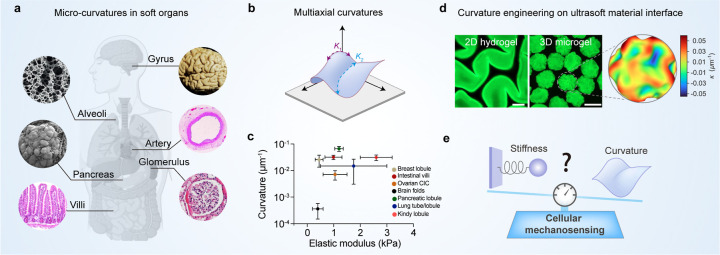 Figure 1
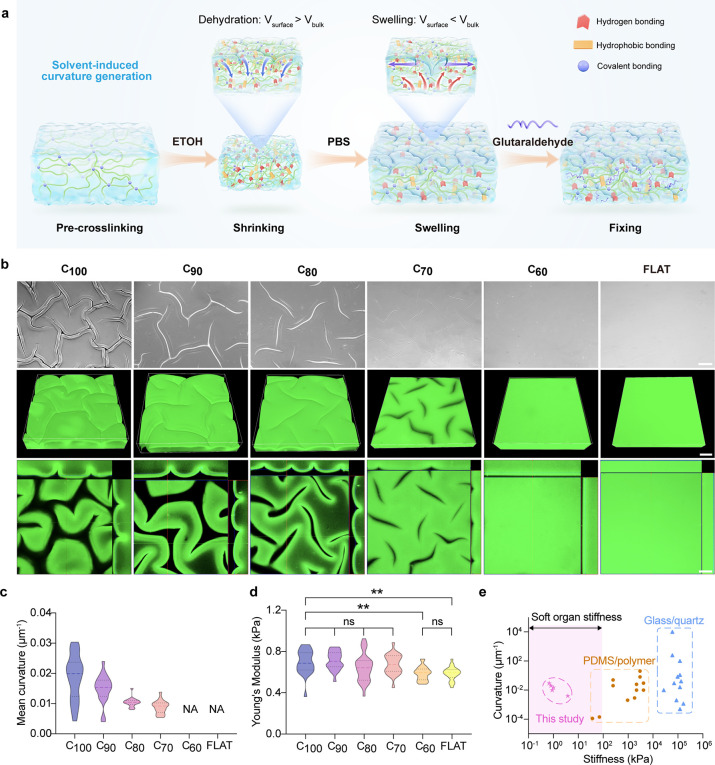 Figure 2
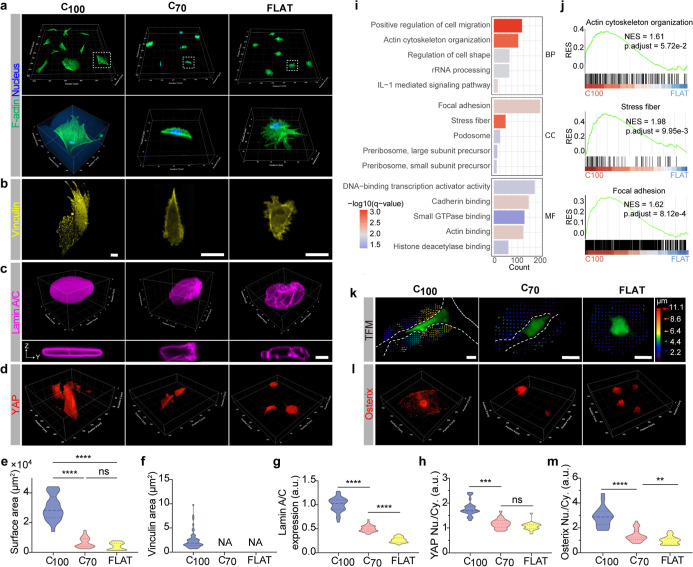 Figure 3
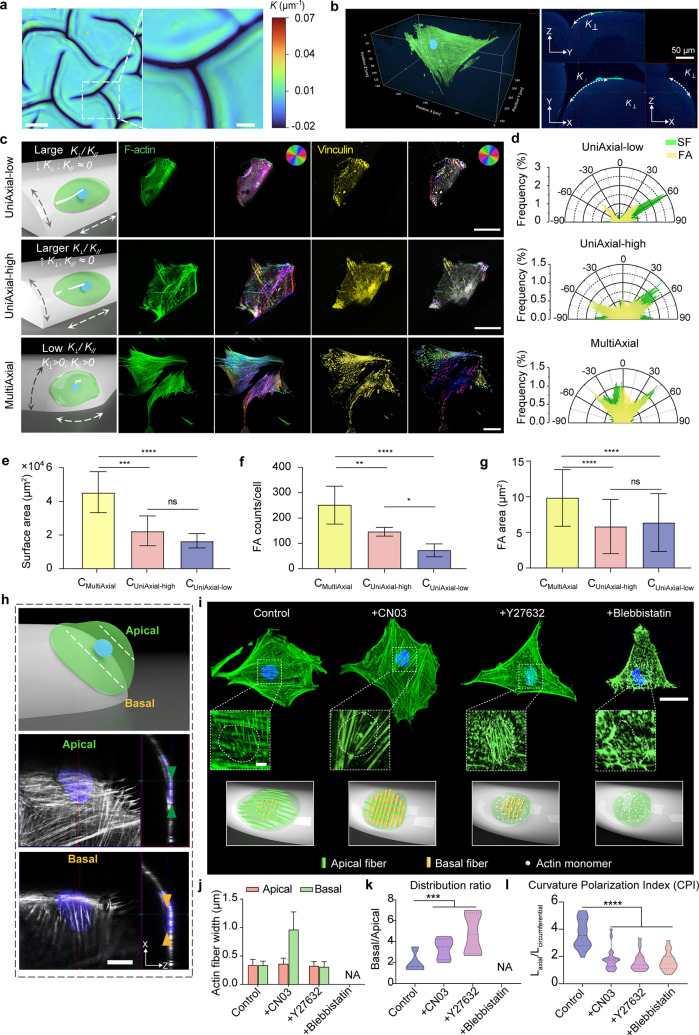 Figure 4
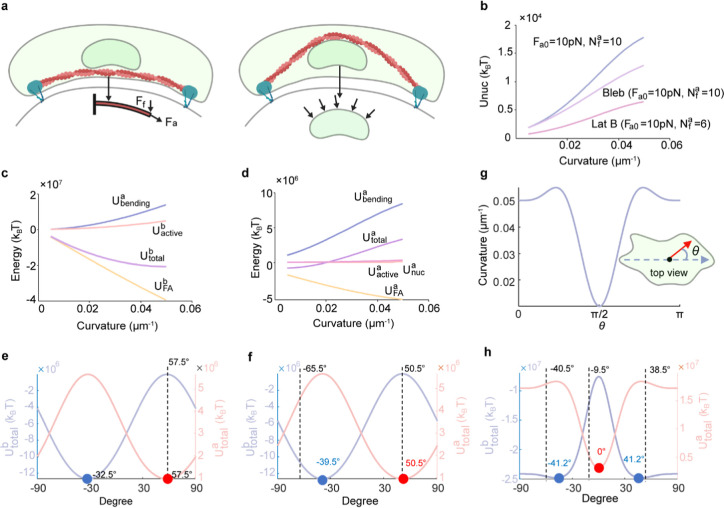 Figure 5
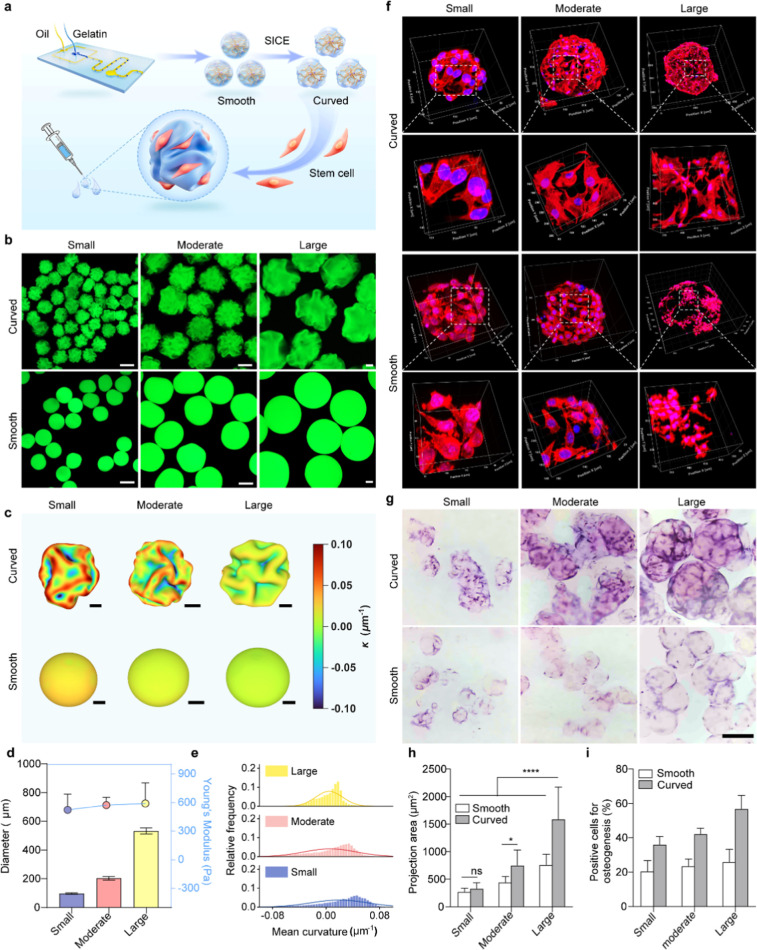 Figure 6
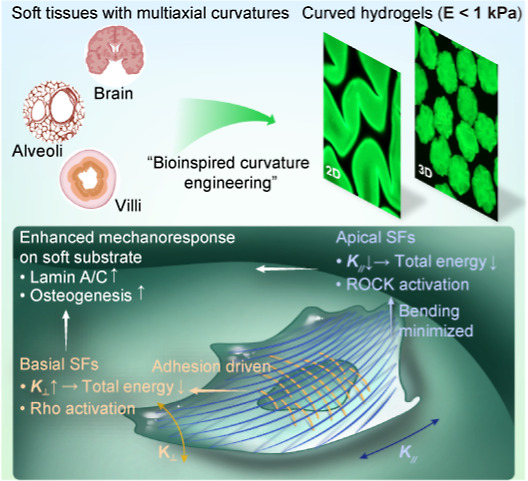 Figure 7
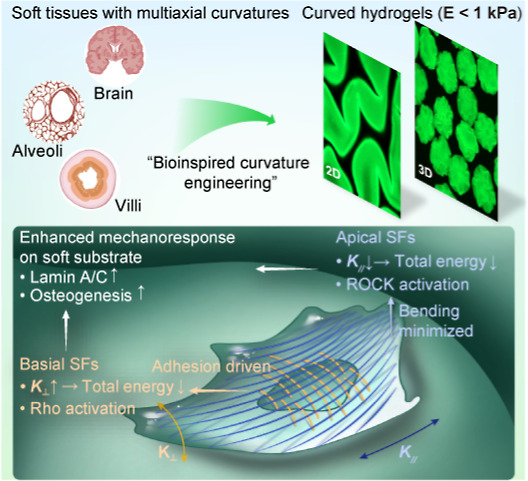 Figure 8
 Figure 9
 Figure 10
Peer Reviews
No public reviews on file for this paper yet. If you reviewed it on a platform where reviews are public (OpenReview, ICLR, NeurIPS, ICML), you can paste yours below so the community can read it here.
Videos
No videos yet. Explain this paper in a talk, walkthrough, or lecture? Add one.
Taxonomy
TopicsCellular Mechanics and Interactions · 3D Printing in Biomedical Research · Advanced Materials and Mechanics