When Heat Meets Pollutants: Integrating Degree-Days and Chemical Activity Concepts for the Assessment of Temperature-Driven Toxicity
Elena Gorokhova, Gastón Alurralde, Sophie Steigerwald, Sebastian Abel, Yves Saladin, Anna Sobek, Ann-Kristin Eriksson-Wiklund, Andrius Garbaras

TL;DR
This study introduces a new framework to assess how rising temperatures and pollutants jointly affect aquatic organisms by combining temperature metrics with chemical exposure.
Contribution
The novel framework integrates degree-days and chemical activity to normalize toxicity assessments under varying temperatures.
Findings
Toxicity differences at higher temperatures were shown to result from faster physiological aging, not increased chemical potency.
Metabolic indicators revealed energy depletion caused by pollutants, independent of temperature.
D° normalization enabled accurate toxicity comparisons across thermal conditions.
Abstract
Aquatic organisms face simultaneous stress from rising temperatures and chemical contaminants, yet ecotoxicological assays rarely account for temperature-driven physiological aging. We introduce a framework combining degree-days (D°) and chemical activity to disentangle physiological and chemical drivers of toxicity. This approach was tested using Daphnia magna exposed to polycyclic aromatic hydrocarbons (PAHs). Two exposure designs were compared: (1) fixed duration (72 h) at 20 and 25 °C, and (2) D°-standardized exposure corresponding to 60 D° (72 h at 20 °C; 58 h at 25 °C). Chemical activity, a thermodynamic measure of bioavailable dose, was used as the exposure metric, with the median lethal activity (La50) as the primary endpoint. To provide a more nuanced view of the metabolism, sublethal responses (δ13C, C/N ratio, protein content) were also evaluated. In fixed-time exposures,…
Genes, proteins, chemicals, diseases, species, mutations and cell lines named across the full text — each resolved to its canonical identifier and authoritative record.
Click any figure to enlarge with its caption.
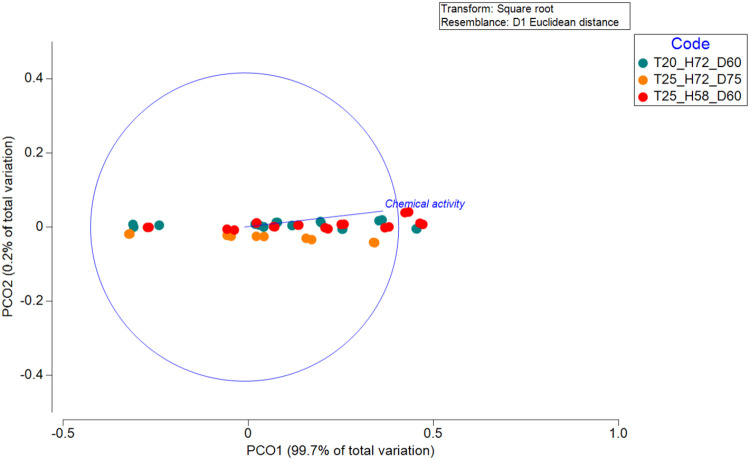 Figure 1
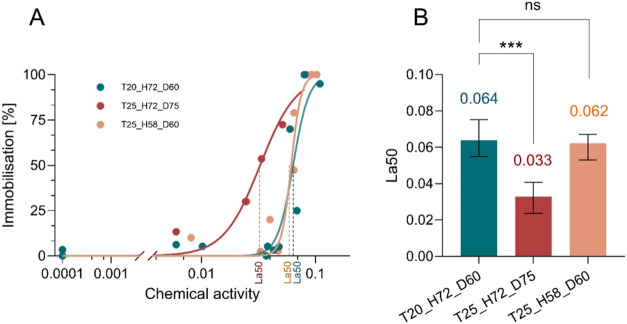 Figure 2
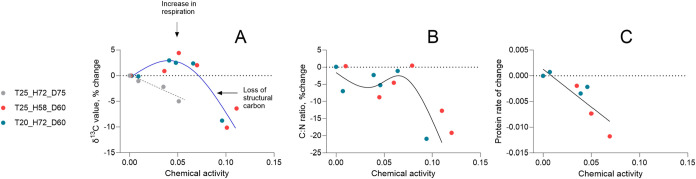 Figure 3
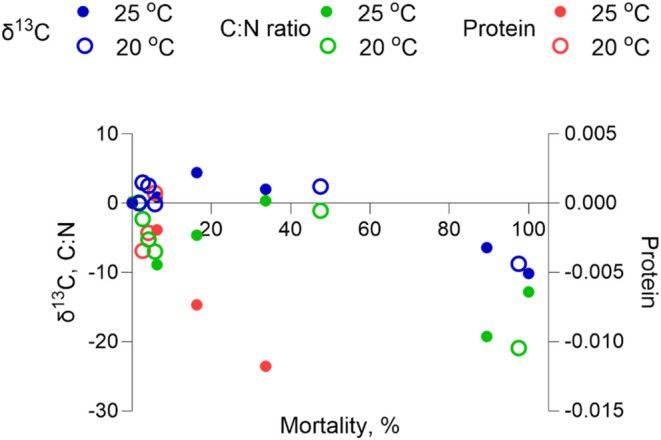 Figure 4
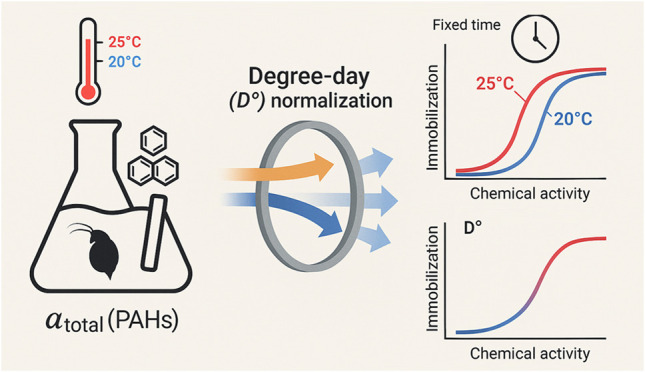 Figure 5
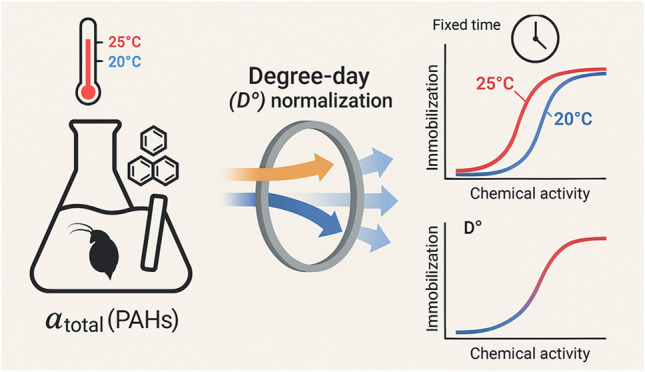 Figure 6
 Figure 7
 Figure 8
Peer Reviews
No public reviews on file for this paper yet. If you reviewed it on a platform where reviews are public (OpenReview, ICLR, NeurIPS, ICML), you can paste yours below so the community can read it here.
Videos
No videos yet. Explain this paper in a talk, walkthrough, or lecture? Add one.
Taxonomy
TopicsEnvironmental Toxicology and Ecotoxicology · Aquatic Ecosystems and Phytoplankton Dynamics · Physiological and biochemical adaptations