Cyanobacterial Bloom and Toxin Identification in Austin, TX, USA Creeks
Hanan Brower, Sahar Mahmood, Joana Ruiz-Escobar, Sara Bagheri, Omar Carrasco-Rubio, Luke Diggins, Anastasia Kuzmina, Wesley Tran, Kevin Zhu, Stuart Reichler

TL;DR
This study found cyanobacterial blooms and toxins in Austin, TX creeks, highlighting potential risks to humans and wildlife.
Contribution
The study provides new data on cyanobacterial blooms and toxin levels in urban waterways in Austin, TX.
Findings
Cyanobacteria, primarily Oscillatoria, was detected in all sampled creeks.
Cylindrospermopsin was the primary cyanotoxin identified, with levels varying by location and season.
Abstract
Cyanobacterial harmful algal blooms (cyanoHABs) can form in freshwater, and their toxins are harmful to flora and fauna, including humans. To assess the extent of cyanoHABs in urban waterways, seven creeks and Lady Bird Lake in Austin, TX USA were sampled from July to December 2024. Water chemistry was measured, cyanoHABs identified by microscopy, and cyanotoxins detected by LC-MS. Cyanobacteria, mostly genus Oscillatoria , was detected in all creeks sampled, and the primary cyanotoxin detected was cylindrospermopsin with levels varying between sampling locations and seasons. This study highlights the presence of cyanoHABs in creeks, and the potential risk they may pose.
Genes, proteins, chemicals, diseases, species, mutations and cell lines named across the full text — each resolved to its canonical identifier and authoritative record.
Click any figure to enlarge with its caption.
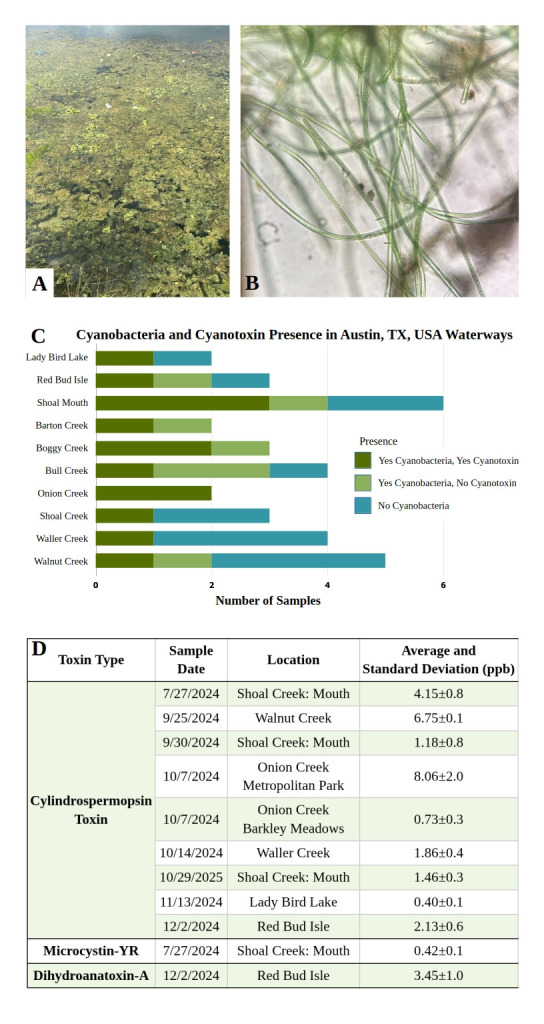 Figure 1
Peer Reviews
No public reviews on file for this paper yet. If you reviewed it on a platform where reviews are public (OpenReview, ICLR, NeurIPS, ICML), you can paste yours below so the community can read it here.
Videos
No videos yet. Explain this paper in a talk, walkthrough, or lecture? Add one.
Taxonomy
TopicsAquatic Ecosystems and Phytoplankton Dynamics · Freshwater macroinvertebrate diversity and ecology · Environmental Toxicology and Ecotoxicology
Description
Cyanobacteria are a group of diverse aquatic photoautotrophic gram-negative bacteria that are becoming increasingly problematic due to their eutrophic growth capabilities and their production of cyanotoxins that can be harmful to flora and fauna (Carmichael, 1992; Ferrão-Filho et al., 2011; Gupta et al., 2013; Zepernick et al., 2023). Cyanotoxin production negatively impacts water use for human recreation, drinking, agriculture (Tanvir et al., 2021; Mutoti et al., 2023; Rocha et al., 2024), and negatively impacts other wildlife (Landsberg, 2002; Ash and Patterson, 2022; Dorantes-Aranda, 2023). The recent increase in cyanoHABs is a global phenomenon amplified by the effects of global warming and urbanization (Paerl and Barnard, 2020; Ranjbar et al., 2022).
The negative impacts of cyanoHABs have already been seen in Austin, Texas. In 2019, multiple dog deaths resulting from cyanotoxin poisonings were reported (Manning et al., 2020; City of Austin. https://www.austintexas.gov/page/algae-austins-waterways retrieved December 15, 2025). Because of this, the City of Austin (COA) has implemented increased surveillance of cyanoHABs and initiated public outreach efforts to raise awareness about the risks of cyanotoxin-related illness. The COA primarily monitors the Lady Bird Lake reservoir, part of the Colorado River (Perri et al., 2024; City of Austin. https://www.austintexas.gov/page/algae-austins-waterways retrieved December 15, 2025). Full coverage of Austin’s water bodies presents a challenge since monitoring is costly and resource-intensive (Gamez et al., 2019). In addition to these constraints, existing research has focused on cyanoHABs in ideal growth conditions such as large and still bodies of water (e.g. lakes and rivers) (Gugger et al., 2005; Huisman and Hulot 2005; Chen et al., 2017; Kozak et al., 2019; Lomeo et al., 2024; Perri et al., 2024). Despite reports of cyanoHABs in mountain streams, creek ecosystems are less frequently monitored (Huisman and Hulot, 2005; Gaysina et al., 2018; Genzoli and Kann, 2020).
Cyanobacteria were identified in all of the creeks sampled ( Figure 1C ). While cyanotoxins were detected in five of the seven creeks, the mouth of Shoal Creek, and sample sites in Lady Bird Lake ( Figure 1C ). Algal blooms were diverse and consisted of multiple cyanobacteria, filamentous green algae, diatoms, and other bacteria genera (Figure 2 B, C , and D). For the cyanobacteria, morphological characteristics were used to differentiate genera. Oscillatoria was found at all sites sampled. *Anabaena * was identified in only two samples.
Cyanotoxins were extracted from samples using solid-phase extraction and analyzed through triple quadrupole LC-MS. Cylindrospermopsin was the only cyanotoxin detected in Austin creeks ( Figure 1D ). Dihydroanatoxin-a (dhATX) was only present at the Red Bud Isle (lake) site ( Figure 1D ). Because these cyanotoxins vary in toxicity, understanding the distribution of the different cyanotoxins across locations is important for preventing future cyanotoxin-caused illnesses. Cylindrospermopsin is known to cause hepatic illness in mammals (Buratti et al., 2017). Cylindrospermopsin poisoning was attributed to cattle deaths observed in Queensland, Australia in 1992 (Thomas et al., 1998). In humans this hepatic illness is shown to be reversible with medical treatment (Buratti et al., 2017). The Environmental Protection Agency (EPA) recommends cylindrospermopsin concentrations do not exceed 15 ppb in recreational water (Ross, 2019). dhATX is a neurotoxin directly linked to fatal poisonings in Austin, TX dogs (Fredrickson et al., 2023). Neither the World Health Organization (WHO) nor the EPA provide recommendations for dhATX in recreational water, however, dhATX, a congener of anatoxin (ATX), was found to be up to four times more lethal in mice than ATX when ingested orally (Puddick et al., 2021; Fredrickson et al., 2023).
With additional ongoing sampling, we are working on elucidating conditions that lead to the production of the different cyanotoxins. The concentrations of detected cyanotoxins were mostly less than the 5 ppb standard ( Figure 1D ). Barton and Boggy Creek did not have detectable levels of cyanotoxin, despite cyanobacteria being seen in both site’s mat samples. CyanoHABs are present in Austin creeks and produce detectable concentrations of cylindrospermopsin cyanotoxin.
Since these creeks are commonly used for recreational activities, the presence of cyanoHABs poses a potential danger to the public. Monitoring creeks during peak bloom seasons can help limit the danger by allowing warnings to be posted when cyanotoxins are detected. Since cyanoHABs monitoring is resource intensive, further elucidation of the connection between environmental factors and cyanoHABs can allow predictive modeling using a more easily quantified variable, like water chemistry (Figure 2F), allowing municipalities to warn people when cyanoHABs are likely to be present.
Methods
Site Characterization
Sites were chosen based on their recreational activity use and access for sampling. The sites Shoal Creek Mouth, Lady Bird Lake, and Red Bud Isle were selected because of previous reports of dog illnesses and deaths at these locations (Manning et al., 2020). Creek sites were chosen as locations where a clear downstream flow could be seen and the site was clearly above the water level at the mouth. Mouth sites were determined to be at the mouth of the creek and contained a mixture of lake and creek water.
Sample Collection and Water Chemistry Measurements
Sites were sampled for algal and possible cyanoHABs between June 28, 2024, and December 2, 2024 (Figure 2E). Sites are Austin, TX, USA creeks and reservoir locations that are accessible to the public for recreational use. Upon arriving at the site, floating and shiny algal mats were sought. Mats were collected by hand or by scraping the creek bed and placed in 500 mL acid-washed plastic amber bottles along with creek water. Water temperature (℃), dissolved oxygen (ppm), pH, and conductivity (μS/cm) were collected on-site using a YSI Multiparameter Probe. Water chemistry analysis was performed within one hour using a Chemetrics V-2000 multi-analyte photometer to determine nitrate (NO 3 ^–^ ) and phosphate (ortho, PO 4 ^3–^ ) concentrations. Samples were stored at room temperature for one hour until imaging and extraction were performed.
Microscopy
Köhler illumination for microscope imaging was achieved using a ZEISS Axiolab 5 Microscope with 50X or 100X magnification.
LC-MS Analysis
The extraction and detection of cyanotoxins followed the protocol from Fredrickson et al., 2023. Samples were processed in reduced light to minimize photolysis. Using a vacuum manifold, Waters C-18 Plus SPE cartridges were conditioned with methanol (100% Optima MeOH) and ultra-pure water. Water samples from the bottles containing collected algae were introduced and passed through the cartridge. Methanol was used to elute the samples, which were evaporated using nitrogen gas and resuspended in 5% Optima MeOH, before analysis on a Shimadzu 8060 triple quadrupole LC-MS (Figure 2 G-J). The cyanotoxins tested for are: microcystin-LR (MC-LR), anatoxin-a (ATXa), cylindrospermopsin (CYR), saxitoxin (STX), dihydroanatoxin-a (dhATX), homoanatoxin-a (HTX), microcystin-YR (MC-YR), microcystin-RR (MC-RR), microcystin-LA (MC-LA), and nodularin (NOD). These 10 cyanotoxin standards were added at 5 ppb, and concentrations were calculated through a standard curve using 0 and 5 ppb by the Shimadzu Lab Solutions™ software.
Reagents
Nitrate Vacu-vials Kit (K-6913)
Reagents: Hydrochloric Acid (S-6901) and Zinc foil packet
Phosphate Vacu-vials Kit (K-8513)
Reagents: Glycerol and Stannous Chloride Dihydrate (S-8500)
The reference list from the paper itself. Each links out to its DOI / PubMed record.
- 1Ash Alexandra K. Patterson Stuart 2022914 Reporting of Freshwater Cyanobacterial Poisoning in Terrestrial Wildlife: A Systematic Map Animals 12182076-26152423242310.3390/ani 1218242336139281 PMC 9494982 · doi ↗ · pubmed ↗
- 2Buratti Franca M. Manganelli Maura Vichi Susanna Stefanelli Mara Scardala Simona Testai Emanuela Funari Enzo 2017121 Cyanotoxins: producing organisms, occurrence, toxicity, mechanism of action and human health toxicological risk evaluation Archives of Toxicology 9130340-57611049113010.1007/s 00204-016-1913-628110405 · doi ↗ · pubmed ↗
- 3Chen Ke Allen Joel Lu Jingrang 2017 Community Structures of Phytoplankton with Emphasis on Toxic Cyanobacteria in an Ohio Inland Lake during Bloom Season Journal of Water Resource and Protection 09111945-30941299131810.4236/jwarp.2017.911083 · doi ↗
- 4Dorantes-Aranda Juan José 2023515 Harmful Algae Impacting Aquatic Organisms: Recent Field and Laboratory Observations Toxins 1552072-665133933910.3390/toxins 1505033937235374 PMC 10223312 · doi ↗ · pubmed ↗
- 5Ferrão-Filho Aloysio da S. Kozlowsky-Suzuki Betina 20111216 Cyanotoxins: Bioaccumulation and Effects on Aquatic Animals Marine Drugs 9121660-33972729277210.3390/md 912272922363248 PMC 3280578 · doi ↗ · pubmed ↗
- 6Fredrickson Anthea Richter Aaron Perri Katherine A. Manning Schonna R. 202381 First Confirmed Case of Canine Mortality Due to Dihydroanatoxin-a in Central Texas, USA Toxins 1582072-665148548510.3390/toxins 1508048537624242 PMC 10467149 · doi ↗ · pubmed ↗
- 7Gámez Tatiana E. Benton Lisa Manning Schonna R. 201991 Observations of two reservoirs during a drought in central Texas, USA: Strategies for detecting harmful algal blooms Ecological Indicators 1041470-160X 58859310.1016/j.ecolind.2019.05.022 · doi ↗
- 8Gaysina Lira A. Saraf Aniket Singh Prashant 2019 Cyanobacteria in Diverse Habitats Cyanobacteria 12810.1016/b 978-0-12-814667-5.00001-5 · doi ↗