Clinical characteristics and associated risk factors for diminished ovarian reserve among Chinese women: a matched case-control study
Fan Zhao, Penghao Li, Ruobing Mei, Chongbi Huang, Dongsen Hu, Tony Cheung, Yajiao Lu, Pulin Luo, Lucas Gonzalo Garay, Ying Yang, Dandan Zhao, Juan Yang, Jing Li, Leesa Lin

TL;DR
This study identifies risk factors for diminished ovarian reserve in Chinese women, including infections and lifestyle factors, with age-related differences in their impact.
Contribution
The study provides novel insights into TORCH infections and demographic factors as risk indicators for DOR in a Chinese population.
Findings
Non-Han ethnicity, obesity, and T. gondii infection were independently associated with DOR.
TORCH infections showed strong associations with DOR in younger women (20–35 years) but not in older women (36–47 years).
Age-related effect modification was observed for pregnancy history and infections.
Abstract
Diminished ovarian reserve (DOR) has emerged as a significant reproductive challenge and a broader societal concern. Most previous studies have focused on ovarian reserve markers, while limited research has examined DOR as a primary outcome, and the potential association between TORCH infections (toxoplasmosis, others, rubella, cytomegalovirus, herpes) and DOR risk remains unclear. A matched case–control study was conducted among women aged 20–47 years who sought assisted reproductive technology at a maternity hospital in Sichuan, China, between January 2022 and August 2024. DOR was diagnosed according to the Consensus on clinical diagnosis and management of diminished ovarian reserve from China. Age-matched controls (1:1) with normal ovarian reserve were selected. Conditional logistic regression was used to identify factors associated with DOR, with multivariable models adjusting for…
Genes, proteins, chemicals, diseases, species, mutations and cell lines named across the full text — each resolved to its canonical identifier and authoritative record.
Click any figure to enlarge with its caption.
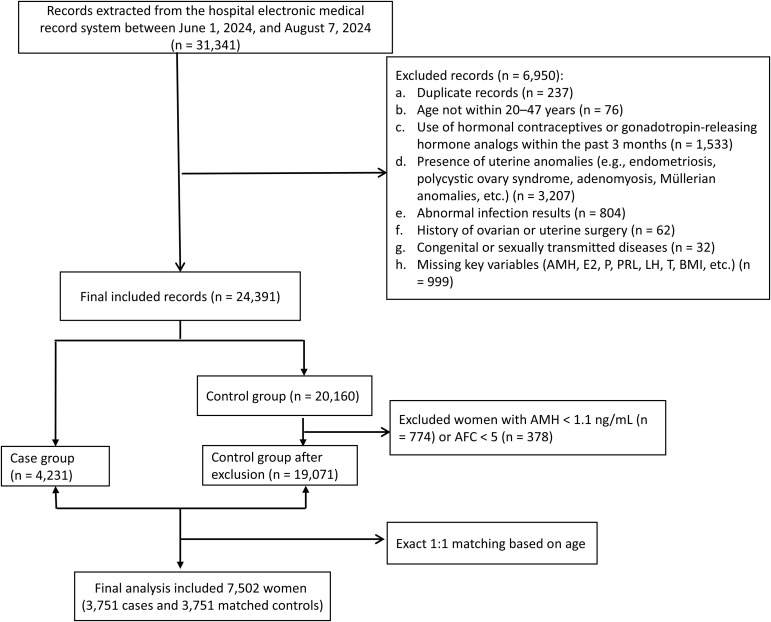 Figure 1
Peer Reviews
No public reviews on file for this paper yet. If you reviewed it on a platform where reviews are public (OpenReview, ICLR, NeurIPS, ICML), you can paste yours below so the community can read it here.
Videos
No videos yet. Explain this paper in a talk, walkthrough, or lecture? Add one.
Taxonomy
TopicsOvarian function and disorders · Cytomegalovirus and herpesvirus research · Reproductive Biology and Fertility