Kidney-Tonifying, Phlegm-Resolving, and Blood Stasis–Removing Therapy for Multiple Myeloma: Protocol for a Randomized Controlled Trial on Epigenetic and Immune Modulation
Xiaoqi Sun, Yongming Zhou, Yujue Wang, Youya Dai, Wenwei Zhu, Hailin Chen

TL;DR
This study tests a traditional Chinese medicine therapy for multiple myeloma by examining its effects on the immune system and epigenetic changes.
Contribution
The study introduces a novel integration of TCM with modern epigenetics to target immune modulation in multiple myeloma.
Findings
The KPR herbal formula is hypothesized to improve the immune microenvironment via the PHF19-EZH2-H3K27me3 axis.
The trial is designed to evaluate the safety and mechanism of KPR in combination with standard therapy for MM.
The study will provide a framework for integrating TCM into evidence-based oncology for treatment-refractory patients.
Abstract
Multiple myeloma (MM) is characterized by kidney deficiency, phlegm, and blood stasis as core findings, specifically in Traditional Chinese Medicine (TCM), and the kidney-tonifying, phlegm-resolving, and blood stasis–removing (KPR) method is a fundamental therapeutic approach for MM in TCM. Western medicine primarily focuses on targeted immunotherapy or chemotherapy for MM treatment, whereas TCM characterizes MM through distinct pathological patterns that directly correspond to immune microenvironment dysregulation. Emerging evidence implicates the PHD finger protein 19 (PHF19)/enhancer of zeste homolog 2 (EZH2)/trimethylated histone H3 at lysine 27 (H3K27me3) epigenetic axis in immune microenvironment dysregulation and MM progression. Notably, TCM “blood stasis” correlates with hypoxia-induced immune gene silencing in MM bone marrow, and KPR (a clinically validated TCM decoction with…
Genes, proteins, chemicals, diseases, species, mutations and cell lines named across the full text — each resolved to its canonical identifier and authoritative record.
Click any figure to enlarge with its caption.
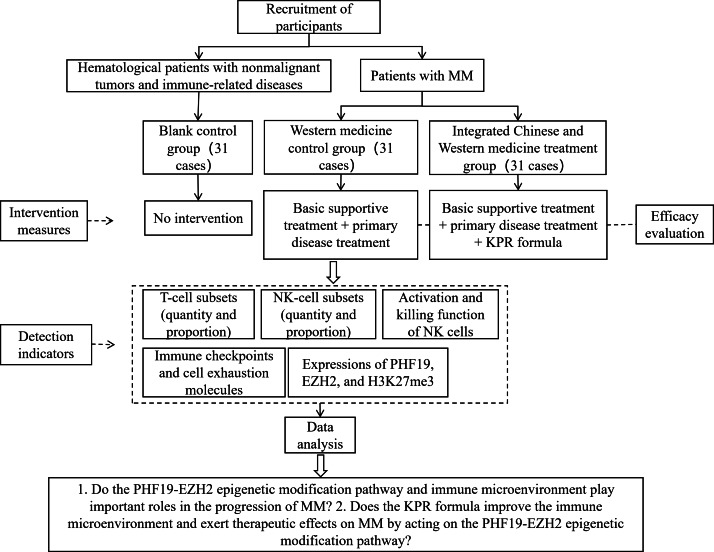 Figure 1
Peer Reviews
No public reviews on file for this paper yet. If you reviewed it on a platform where reviews are public (OpenReview, ICLR, NeurIPS, ICML), you can paste yours below so the community can read it here.
Videos
No videos yet. Explain this paper in a talk, walkthrough, or lecture? Add one.
Taxonomy
TopicsMultiple Myeloma Research and Treatments · Acute Myeloid Leukemia Research · Glioma Diagnosis and Treatment