Assistive Robotic Arm to Support Activities of Daily Living in Individuals With Tetraplegia: Protocol for a Real-World Convergent Parallel Mixed Methods Feasibility Study
Vera Fosbrooke, Aline Christen, Barbara Catherine Wortmann, Iris Theodora Maria de Boer, Raphael Rätz, Julian Frederik Rösch, Gabriel Gruener, Anja M Raab

TL;DR
This study explores how a robotic arm mounted on a wheelchair can help people with tetraplegia perform daily tasks and improve their quality of life.
Contribution
The novel contribution is a real-world feasibility study of a robotic arm for tetraplegia, combining usability and economic analysis.
Findings
The study will assess task performance, user experience, and cost-effectiveness of a robotic arm in real-life settings.
Qualitative and quantitative data will be combined to evaluate feasibility and health economic outcomes.
Results may inform future development and adoption of assistive robotic technologies for tetraplegia.
Abstract
Tetraplegia, often resulting from cervical spinal cord injury, may lead to significant motor and sensory loss, severely impacting independence and quality of life (QoL). Assistive technologies, such as wheelchair-mounted robotic arms (WMRAs), offer potential to enhance autonomy in daily living. However, adoption remains limited due to high costs, complex controls, and insufficient end user involvement. Robust evidence on their real-world effectiveness, particularly post hospitalization, is still lacking. This study aims to explore the feasibility, usability, and user experience of a WMRA for individuals with tetraplegia in real-life posthospitalization settings. It aims to evaluate its support in activities of daily living and conduct a preliminary health economic analysis comparing cost-effectiveness and QoL outcomes with standard care. This mixed methods feasibility study will be…
Genes, proteins, chemicals, diseases, species, mutations and cell lines named across the full text — each resolved to its canonical identifier and authoritative record.
Click any figure to enlarge with its caption.
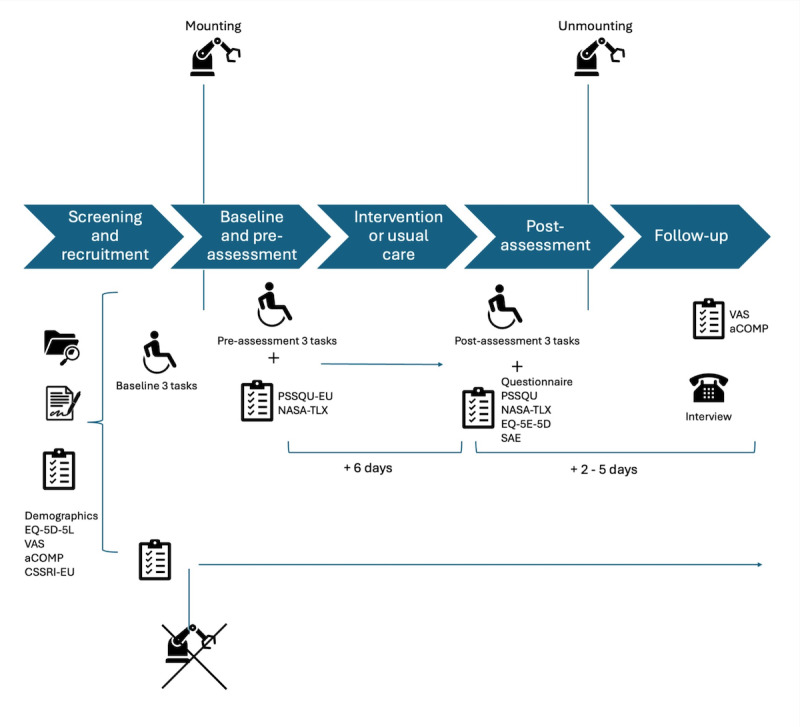 Figure 1
Peer Reviews
No public reviews on file for this paper yet. If you reviewed it on a platform where reviews are public (OpenReview, ICLR, NeurIPS, ICML), you can paste yours below so the community can read it here.
Videos
No videos yet. Explain this paper in a talk, walkthrough, or lecture? Add one.
Taxonomy
TopicsGaze Tracking and Assistive Technology · Prosthetics and Rehabilitation Robotics · Spinal Cord Injury Research