How Physicians in Japan Consider Patients' Social Backgrounds in Bedside Resource Allocation Decisions
Tomoari Mori, Ai Unzaki, Mizuho Suzuki, Kana Nishida, Yuko Ohnuki, Kei Takeshita

TL;DR
This study explores how Japanese physicians consider patients' social backgrounds when making resource allocation decisions at the bedside, revealing three distinct reasoning styles and the need for transparent ethical frameworks.
Contribution
The study introduces the concept of 'answerable flexibility' and identifies three distinct reasoning tendencies in resource allocation decisions influenced by social factors.
Findings
Three recurring reasoning tendencies were identified: Strict Egalitarians, Contextual Pragmatists, and Responsibility-Sensitive Allocators.
Physicians shift between these reasoning styles depending on patient circumstances, team norms, and local capacity.
The study highlights the importance of transparency and ethical clarity in implicit bedside allocation decisions.
Abstract
Clinicians routinely make micro‐level allocation decisions at the bedside—how much time to spend, which tests to order, or how intensively to treat. While fairness and efficiency have been studied, little is known about how patients' social backgrounds shape these decisions under universal coverage. In Japan, where financial access and free provider choice minimize monetary barriers, bedside allocation may often occur implicitly and through local negotiation rather than explicit protocols. We conducted semi‐structured interviews with 12 physicians across internal medicine, emergency, and community care settings. Transcripts were analyzed using reflexive thematic analysis to examine how social factors—such as family support, logistics/transport, and patient capability/engagement—enter allocation reasoning. Three recurring reasoning tendencies emerged: Strict Egalitarians, who minimize…
Genes, proteins, chemicals, diseases, species, mutations and cell lines named across the full text — each resolved to its canonical identifier and authoritative record.
Click any figure to enlarge with its caption.
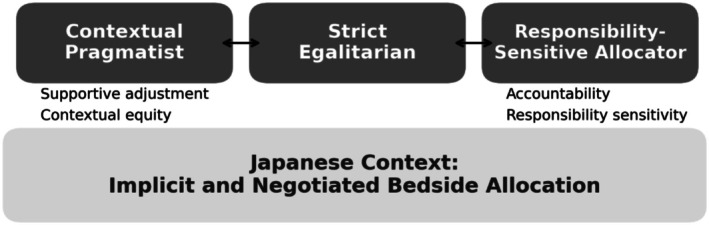 Figure 1
Peer Reviews
No public reviews on file for this paper yet. If you reviewed it on a platform where reviews are public (OpenReview, ICLR, NeurIPS, ICML), you can paste yours below so the community can read it here.
Videos
No videos yet. Explain this paper in a talk, walkthrough, or lecture? Add one.
Taxonomy
TopicsHealthcare Policy and Management · Heart Failure Treatment and Management · Palliative Care and End-of-Life Issues