Evaluation of Smartphone Camera Positioning on Artificial Intelligence Pose Estimation Accuracy for Exercise Detection: Observational Study
Eduarda Oliosi, Soraia Ferreira, Ana Paula Giordano, Guilherme Viveiros, José Parraca, Paulo Pereira, Federico Guede-Fernández, Salomé Azevedo

TL;DR
This study shows that smartphone camera positioning affects AI's ability to track exercises, with diagonal and mid-range views giving the best results for push-ups and squats.
Contribution
The study provides empirical evidence on how camera angle and distance affect AI-based exercise detection accuracy and repetition counting.
Findings
Diagonal and frontal mid-range (180-200 cm) views provided highest detection accuracy for push-ups and squats.
Frontal and diagonal views outperformed side views across distances for squats (P<.001).
Push-up detection was most accurate at 90-180 cm diagonal views (85.7%) and worst at 360 cm front view (20%).
Abstract
Artificial intelligence (AI)–driven pose estimation (PE) offers a scalable and cost-effective solution to track exercises in mobile health apps. However, occlusion, influenced by camera angle and distance, can reduce detection accuracy and repetition counting precision. The influence of smartphone positioning on these performance metrics remains underexplored in controlled studies. The study aimed to examine how smartphone camera angle (front, side, and diagonal) and distance (90 cm, 180 cm, 200 cm, and 360 cm) affect detection performance and repetition counting accuracy during push-ups and squats using AI-based PE. In this cross-sectional, within-subject study, 44 healthy university students (9 [20.5%] female participants; mean age 20.3 y, SD 0.4 y; mean BMI 23.2, SD 0.6 kg/m²) were assigned to perform either squats or push-ups. Each participant completed their assigned exercise…
Genes, proteins, chemicals, diseases, species, mutations and cell lines named across the full text — each resolved to its canonical identifier and authoritative record.
Click any figure to enlarge with its caption.
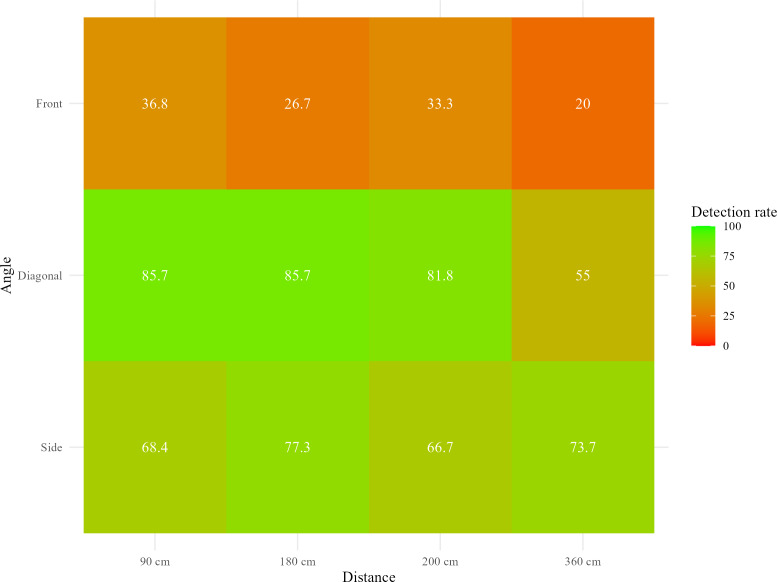 Figure 1
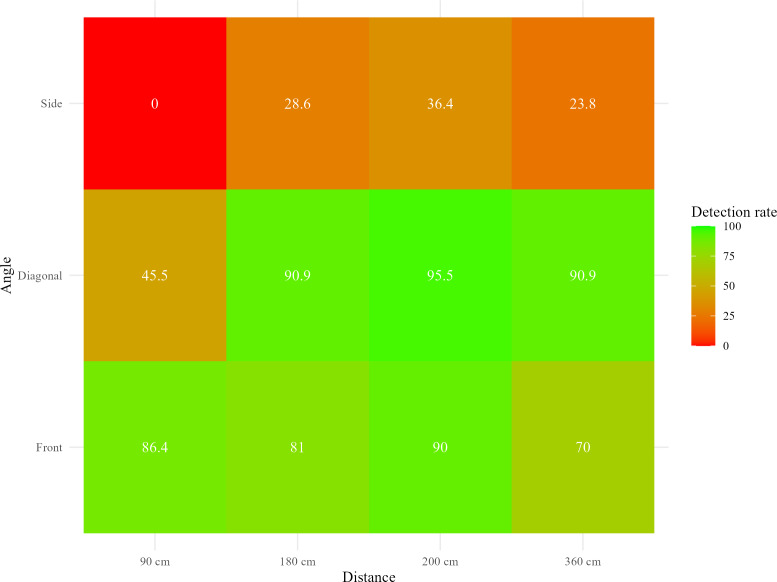 Figure 2
Peer Reviews
No public reviews on file for this paper yet. If you reviewed it on a platform where reviews are public (OpenReview, ICLR, NeurIPS, ICML), you can paste yours below so the community can read it here.
Videos
No videos yet. Explain this paper in a talk, walkthrough, or lecture? Add one.
Taxonomy
TopicsContext-Aware Activity Recognition Systems · Human Pose and Action Recognition · Inertial Sensor and Navigation