Insulin resistance and metabolic health predict cardiorespiratory fitness: cohort study
Liliana Muñoz-Hernandez, Ana Leonor Rivera, Adrian Soto-Mota, Jesus Paez-Mayorga, Jesus Flores-Brito, Erick Resendiz-Carrillo, Guillermo Roa-Alvarez, Leticia Lopez-Carreola, Sebastian Zamora-Gutierrez, Perla Alpizar-Chacon, Eunice Barbosa-Meillon, Antonio Barajas-Martínez

TL;DR
This study shows that insulin resistance and metabolic health are strong predictors of cardiorespiratory fitness, which is linked to overall mortality risk.
Contribution
The study identifies insulin resistance as a key modifiable factor influencing cardiorespiratory fitness in individuals without cardiovascular disease.
Findings
Insulin resistance, measured by QUICKI, explained up to 43% of VO2max variability.
Higher BMI and fat mass were inversely associated with cardiorespiratory fitness.
Insulin resistance reduces muscle glucose uptake and oxygen consumption during maximum effort.
Abstract
Decreased cardiorespiratory fitness (CRF) is an all-cause mortality predictor. Oxygen consumption at peak exercise (VO2max) during a cardiopulmonary exercise test (CPET) is the gold standard for its evaluation. Since cardiometabolic risk factors reduce CRF, we aimed to assess the cardiopulmonary and metabolic responses during CPET and evaluate their determinants. Subjects underwent incremental treadmill CPET and bioelectrical impedance analysis. Insulin sensitivity was estimated using the HOMA, QUICKI, and METS-IR indices. Multivariate regressions were used to evaluate determinants of VO2max. Nonlinearity was confirmed with an F-test between linear and polynomial models. Five hundred and three subjects were evaluated, 474 met maximum effort criteria, (64% females). Median age was 4(26–52); 41% had normal weight, 33% overweight, 26% obesity. Prevalence of insulin resistance ranged from…
Genes, proteins, chemicals, diseases, species, mutations and cell lines named across the full text — each resolved to its canonical identifier and authoritative record.
Click any figure to enlarge with its caption.
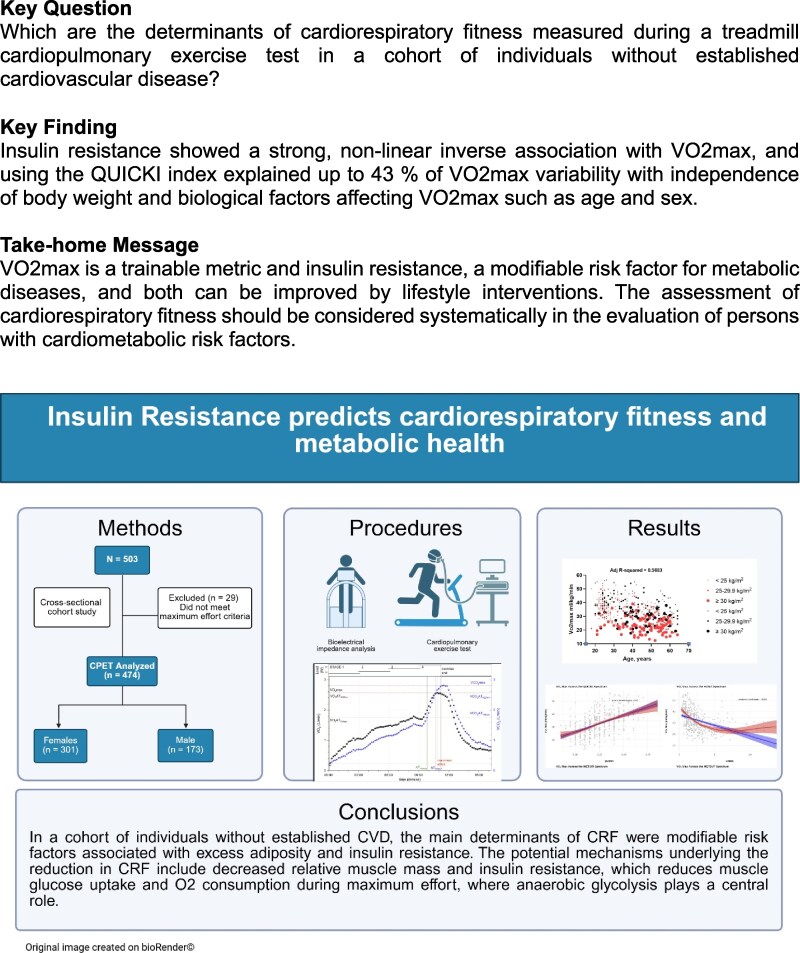 Figure 1
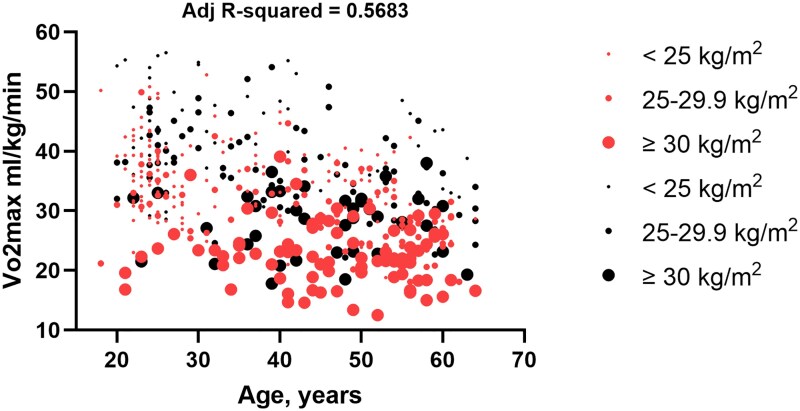 Figure 2
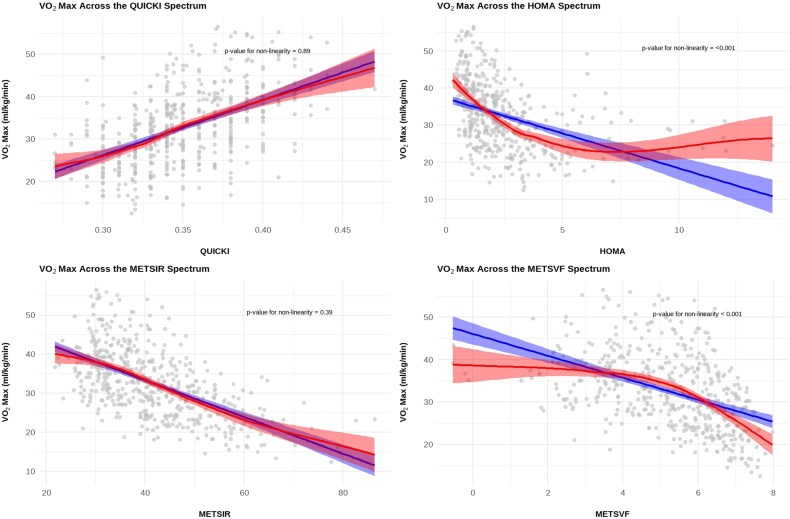 Figure 3
Peer Reviews
No public reviews on file for this paper yet. If you reviewed it on a platform where reviews are public (OpenReview, ICLR, NeurIPS, ICML), you can paste yours below so the community can read it here.
Videos
No videos yet. Explain this paper in a talk, walkthrough, or lecture? Add one.
Taxonomy
TopicsCardiovascular and exercise physiology · Genetics and Physical Performance · Exercise and Physiological Responses