Isolation of toxigenic Corynebacterium diphtheriae from cutaneous lesions in a donkey in Ontario, Canada, 2024: Implications for zoonotic disease transmission and One Health approach
Chidubem Okechukwu, Steven Rebellato, Heidi Pitfield, Kelly Magnusson, Ramien Sereshk, Durda Slavic, Heather McClinchey, Sarah Wilson, Julianne Kus, Colin Lee

TL;DR
A donkey in Canada had skin lesions caused by a toxin-producing bacteria that can spread to humans, highlighting the need for better surveillance and collaboration to prevent zoonotic disease.
Contribution
The study reports the isolation of toxigenic Corynebacterium diphtheriae from a donkey, emphasizing zoonotic risks and the importance of One Health approaches.
Findings
Toxigenic Corynebacterium diphtheriae was isolated from cutaneous lesions in a donkey.
Interagency collaboration was crucial for timely response and public health management.
The case highlights gaps in surveillance and guidance for managing zoonotic agents in animals.
Abstract
This rapid communication describes a case of cutaneous lesions in a donkey in Ontario, Canada, from which toxigenic Corynebacterium diphtheriae (C. diphtheriae) was isolated. Seven human close contacts were identified and assessed. This communication focuses on public health challenges, interagency response and implications for One Health initiatives to prevent zoonotic transmission. Furthermore, it underscores the importance, successes and challenges of interagency collaboration to coordinate timely laboratory investigation, reporting, contact tracing, potential post-exposure prophylaxis and public education in responding to zoonotic disease. This investigation demonstrates the need for enhanced surveillance, clear legislative authority to facilitate reporting, and more specific guidance for close contact management of C. diphtheriae and other zoonotic agents in animals, which can…
Genes, proteins, chemicals, diseases, species, mutations and cell lines named across the full text — each resolved to its canonical identifier and authoritative record.
Click any figure to enlarge with its caption.
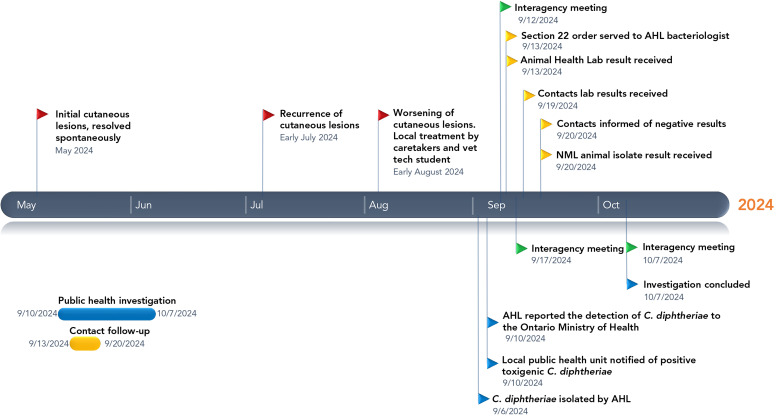 Figure 1
Peer Reviews
No public reviews on file for this paper yet. If you reviewed it on a platform where reviews are public (OpenReview, ICLR, NeurIPS, ICML), you can paste yours below so the community can read it here.
Videos
No videos yet. Explain this paper in a talk, walkthrough, or lecture? Add one.
Taxonomy
TopicsDiphtheria, Corynebacterium, and Tetanus · Botulinum Toxin and Related Neurological Disorders · Intramuscular injections and effects