Abuse recognition by shelter staff and shelter animal adopters
Ineke R. van Herwijnen, Nadieh Reinders, Esmee M. Bus, Claudia M. Vinke, Brittany Florkiewicz, Brittany Florkiewicz, Brittany Florkiewicz, Brittany Florkiewicz, Brittany Florkiewicz

TL;DR
This study explores whether behavioral signs of fear, identified in child abuse research, can help recognize animal abuse in cats and dogs, based on input from shelter staff and adopters.
Contribution
The study adapts behavioral indicators from child abuse research to assess their relevance for identifying animal abuse in cats and dogs.
Findings
Behavioral signs of fear, like fear of the owner, were considered most relevant for identifying animal abuse.
Person-specific fear was seen as a more accurate indicator of abuse than aggression or bonding issues.
Shelter staff and adopters differed in how they assessed behaviors beyond fear when judging possible abuse.
Abstract
Science has provided insight into the physical signs of animal abuse, such as the presence of fractures in different healing stages. Possible behavioural signs of animal abuse are understudied. In studies on child abuse, behavioural signs have been identified. We aimed to study if similar signs would be viewed as relevant signs of animal abuse, focussing on physical abuse of cats and dogs. We targeted shelter staff and shelter animal adopters, as these people may come in contact with abused animals, are known to be willing to participate in research and may do so without ethical constraints applying. We found that the behavioural signs based on child abuse studies, were deemed relevant for the assessment of animal abuse by the respondents in our small-scale study (N = 23 shelter staff and N = 132 shelter animal adopters). Behavioural signs of fear, such as fear of the owner, were deemed…
Genes, proteins, chemicals, diseases, species, mutations and cell lines named across the full text — each resolved to its canonical identifier and authoritative record.
Click any figure to enlarge with its caption.
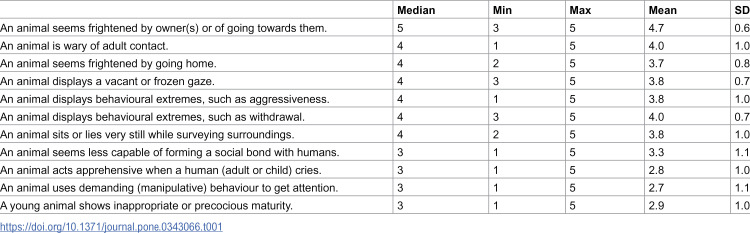 Figure 1
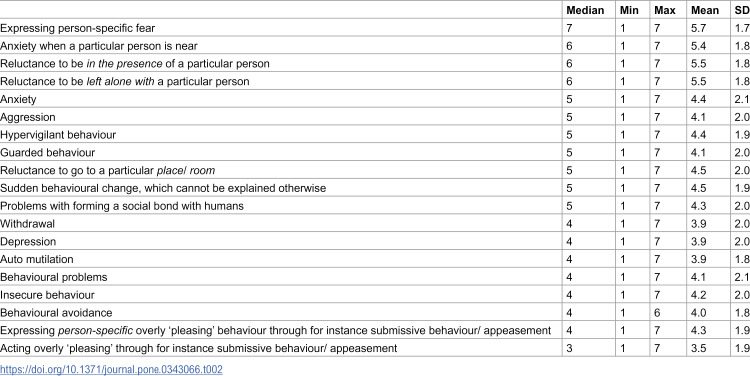 Figure 2
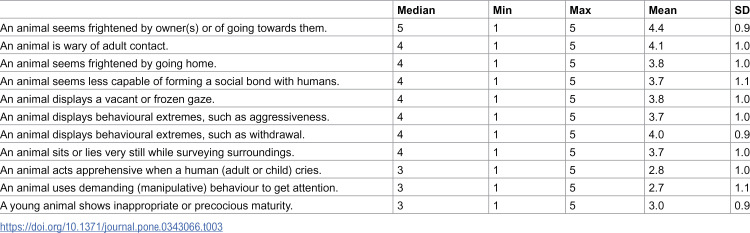 Figure 3
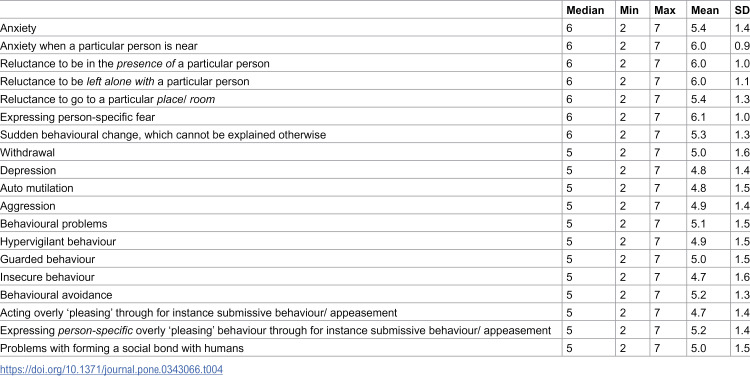 Figure 4
 Figure 5
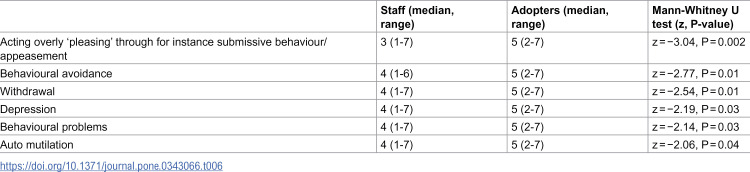 Figure 6
Peer Reviews
No public reviews on file for this paper yet. If you reviewed it on a platform where reviews are public (OpenReview, ICLR, NeurIPS, ICML), you can paste yours below so the community can read it here.
Videos
No videos yet. Explain this paper in a talk, walkthrough, or lecture? Add one.
Taxonomy
TopicsHuman-Animal Interaction Studies · Rabies epidemiology and control · Veterinary Practice and Education Studies