Going full circle: dynamic covalent enzyme immobilisation via visually trackable boronate esters
Glenn Bojanov, Juliette Swit, Francesca Paradisi

TL;DR
This paper introduces a reversible method to attach enzymes to supports, allowing reuse and reducing waste through a color-changing, pH-responsive system.
Contribution
A new reversible enzyme immobilization strategy using boronate esters with a visual reporter for real-time tracking and full support regeneration.
Findings
Alizarin-IDA enables pH-triggered enzyme immobilization and release with real-time colorimetric tracking.
Enzymes retained 77–95% activity and achieved >90% immobilization yield on various supports.
Supports were fully regenerated over five cycles, enabling more than 50 catalytic cycles per carrier.
Abstract
Enzyme immobilisation on solid supports enables biocatalyst recycling but generates significant waste due to single-use resins that are discarded when enzyme activity declines. Here we report a reversible immobilisation strategy based on boronate ester formation between alizarin-functionalised enzymes and boronic acid-modified supports. Alizarin-methyliminodiacetic acid (alizarin-IDA) serves dual roles as both a pH-responsive binding handle and a visual reporter, enabling real-time colourimetric tracking of enzyme loading (red solution → orange resin), immobilisation completeness, and pH-triggered release. A universal labelling protocol was established and successfully applied to four structurally diverse enzymes retaining 77–95% of native activity. All alizarin-labelled enzymes achieved >90% immobilisation yield on different supports, were extensively reusable, and could be removed by…
Genes, proteins, chemicals, diseases, species, mutations and cell lines named across the full text — each resolved to its canonical identifier and authoritative record.
Click any figure to enlarge with its caption.
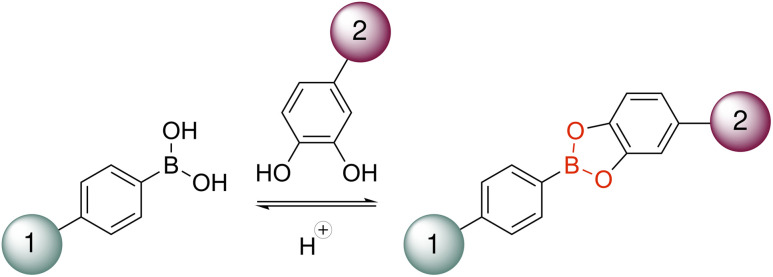 Figure 1
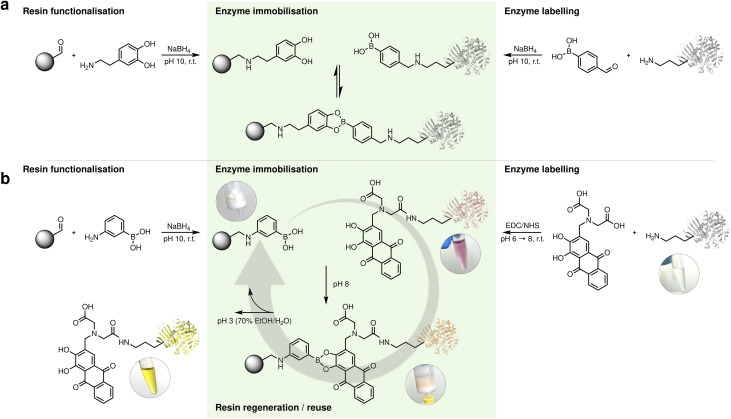 Figure 2
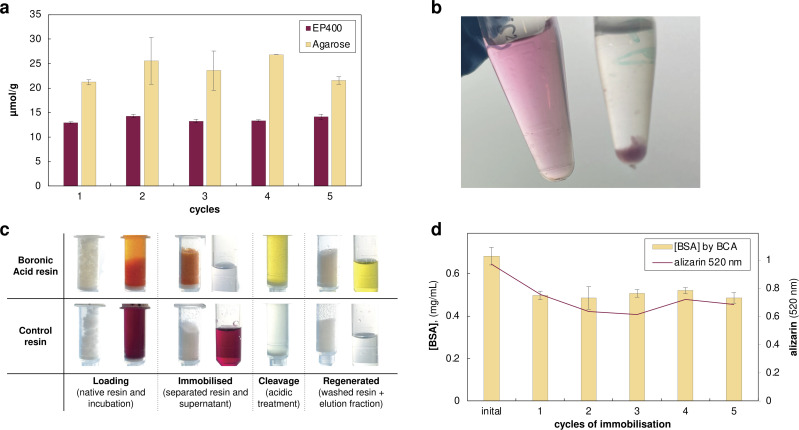 Figure 3
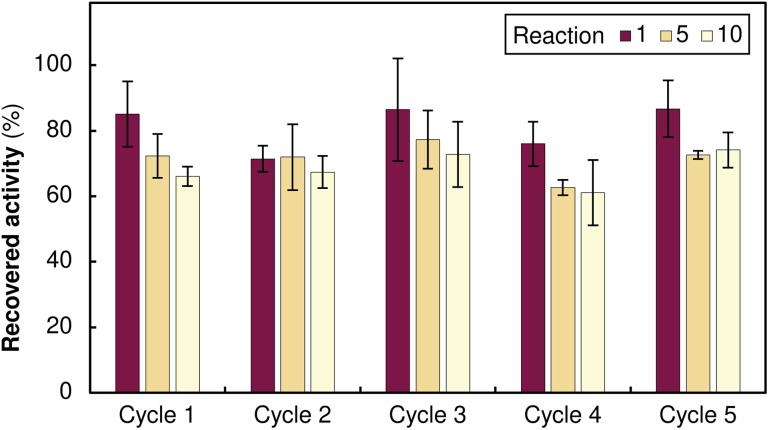 Figure 4
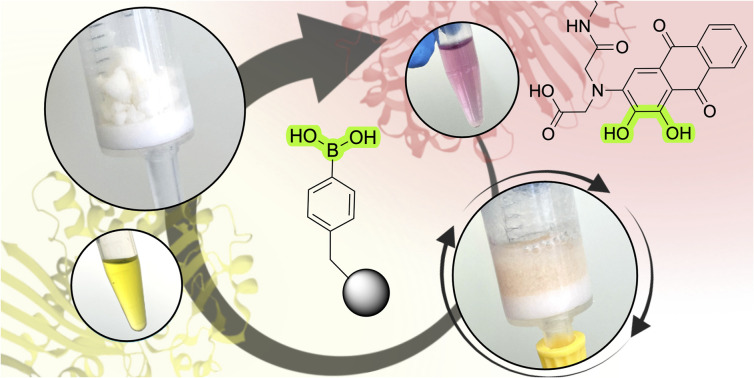 Figure 5
Peer Reviews
No public reviews on file for this paper yet. If you reviewed it on a platform where reviews are public (OpenReview, ICLR, NeurIPS, ICML), you can paste yours below so the community can read it here.
Videos
No videos yet. Explain this paper in a talk, walkthrough, or lecture? Add one.
Taxonomy
TopicsEnzyme Catalysis and Immobilization · biodegradable polymer synthesis and properties · Cyclopropane Reaction Mechanisms