Auditory processing from the perspective of auditory electrophysiological assessment
Pedro de Lemos Menezes, Kelly Cristina Lira de Andrade, Ana Figueiredo Frizzo, Danielle Cavalcante Ferreira, Carlos Henrique Alves Batista, Eliane Schochat, Liliane Desgualdo, Pedro de Lemos Menezes, Kelly Cristina Lira de Andrade, Ana Figueiredo Frizzo

TL;DR
This paper reviews how the auditory system processes sound using electrophysiological measures like auditory evoked potentials.
Contribution
It integrates classical and current research to clarify the roles of different auditory evoked potentials in sound processing.
Findings
Auditory evoked potentials reflect encoding, decoding, and discrimination of sound features.
The N400 component is linked to semantic congruence in auditory processing.
These potentials aid in diagnosing auditory disorders and monitoring performance.
Abstract
To describe sound processing in the auditory system based on auditory evoked potentials. A literature review was conducted on auditory processing from the perspective of electrophysiological auditory assessment, considering both classical and current studies in the field. Studies addressing auditory evoked potentials and their relationship with sound encoding, decoding, discrimination, perception, and semantic congruence processes were included. Data were analyzed in a descriptive and critical manner, integrating information on different auditory evoked potentials and their respective roles in auditory processing. The auditory system organizes and encodes acoustic features, such as frequency, intensity, and temporal modulations, transforming them into neural representations interpreted by the cortex. Auditory evoked potentials provide information on encoding, decoding,…
Genes, proteins, chemicals, diseases, species, mutations and cell lines named across the full text — each resolved to its canonical identifier and authoritative record.
Click any figure to enlarge with its caption.
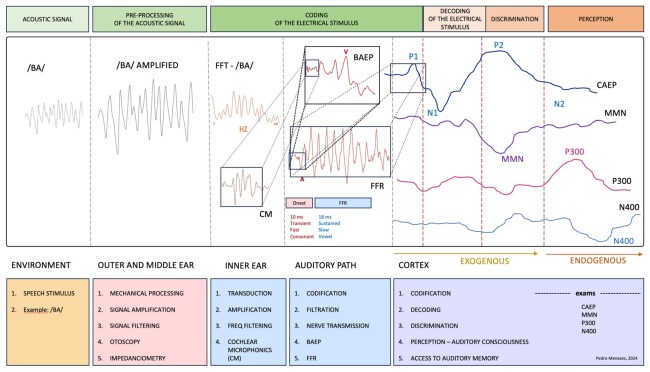 Figure 1
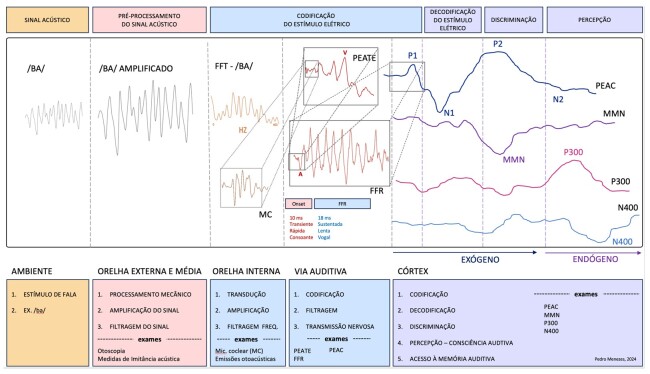 Figure 2
Peer Reviews
No public reviews on file for this paper yet. If you reviewed it on a platform where reviews are public (OpenReview, ICLR, NeurIPS, ICML), you can paste yours below so the community can read it here.
Videos
No videos yet. Explain this paper in a talk, walkthrough, or lecture? Add one.
Taxonomy
TopicsNeuroscience and Music Perception · Hearing Loss and Rehabilitation · Hearing, Cochlea, Tinnitus, Genetics