Perioperative neurocognitive functioning in elderly patients undergoing awake craniotomy for high grade glioma
Eric A Goethe, Kyle R Noll, Subhiksha Srinivasan, Dima Suki, Sujit S Prabhu, Jeffrey S Weinberg, Ian E Mccutcheon, Chibawanye I Ene, Frederick F Lang, Shiao-Pei S Weathers, Catherine Sullaway, Mary F Mcaleer, Jeffrey S Wefel, Sherise D Ferguson

TL;DR
This study examines neurocognitive outcomes in elderly patients undergoing awake craniotomy for brain tumors, finding that age and comorbidities do not worsen outcomes.
Contribution
The study demonstrates that awake craniotomy is safe for elderly patients with high-grade gliomas, with neurocognitive decline not linked to age or comorbidities.
Findings
Elderly patients with high-grade gliomas show similar baseline neurocognitive impairment rates as younger patients.
Postoperative decline in verbal learning and memory is common but not associated with age or tumor volume.
Awake craniotomy is relatively safe for elderly patients with eloquent gliomas.
Abstract
Older patients may be at particular risk of decline in neurocognitive function (NCF) following brain tumor resection, particularly when tumors are near-eloquent regions. We identified 95 patients of advanced age (≥60 years) with newly diagnosed, left hemisphere, high-grade eloquent glioma who underwent a first-time awake craniotomy for tumor resection. All patients had comprehensive neuropsychological evaluations preoperatively and a subset of patients (N = 45) completed postoperative assessment. Median age at surgery was 66 years (range, 60-81) and tumors were most commonly located in the temporal (56%) and frontal (27%) lobes. Preoperatively, most patients exhibited NCF impairment on at least 1 neuropsychological test, most frequently in verbal learning (66%) and memory (71%). Localization in temporal regions conveyed greater impairment to memory, and patients with frontal tumors…
Genes, proteins, chemicals, diseases, species, mutations and cell lines named across the full text — each resolved to its canonical identifier and authoritative record.
Click any figure to enlarge with its caption.
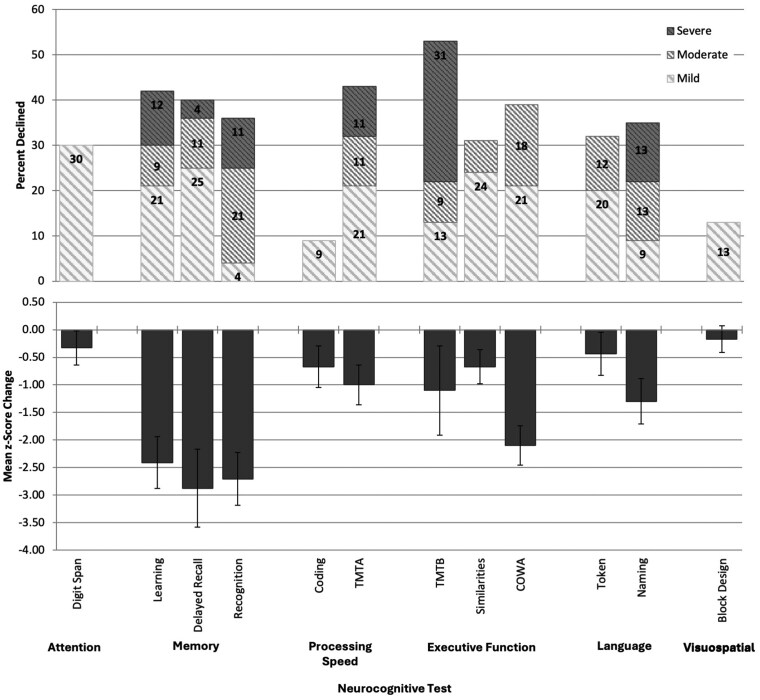 Figure 1
Peer Reviews
No public reviews on file for this paper yet. If you reviewed it on a platform where reviews are public (OpenReview, ICLR, NeurIPS, ICML), you can paste yours below so the community can read it here.
Videos
No videos yet. Explain this paper in a talk, walkthrough, or lecture? Add one.
Taxonomy
TopicsGlioma Diagnosis and Treatment · Intensive Care Unit Cognitive Disorders · Anesthesia and Neurotoxicity Research