Phenotyping of acute heart failure with preserved ejection fraction: real‐world outcomes in a cohort of older patients
Maria Livia Burzo, Giuseppe De Matteis, Amato Serra, Davide Antonio Della Polla, Mariella Fuorlo, Maria Anna Nicolazzi, Benedetta Simeoni, Antonio Gasbarrini, Francesco Franceschi, Giovanni Gambassi, Marcello Covino

TL;DR
This study identifies three distinct subgroups of older patients with heart failure and preserved ejection fraction, showing different clinical features and risks of in-hospital death.
Contribution
The study introduces a novel phenotyping approach using latent class analysis to identify subgroups of HFpEF patients with distinct clinical profiles and outcomes.
Findings
Three phenogroups were identified with differing comorbidities, age, and biomarker levels.
Phenogroups 2 and 3 had significantly higher in-hospital mortality risks compared to phenogroup 1.
Phenogroup 2 showed the worst prognosis with more than double the risk of in-hospital death.
Abstract
Previous studies have identified distinct subgroups (phenogroups) of patients with heart failure with preserved ejection fraction (HFpEF). This study aims to identify distinct phenotypes in older patients with HFpEF hospitalised for acute heart failure (AHF) and investigate the relationship between subgroups and outcomes. Retrospective, single‐center study, including patients ≥65 years hospitalised for AHF over a 4‐year period. We used electronic medical records to collect clinical data, including hospital outcomes. Latent class analysis (LCA) was performed to identify clusters of clinical phenogroups. The primary outcome was all‐cause in‐hospital mortality. Overall, 770 patients were included. Based on LCA, three phenogroups were identified. Phenogroup 1 (n = 323) had both the lowest burden of comorbidities and N‐terminal pro‐brain natriuretic peptides (NT proBNP) values. Phenogroup…
Genes, proteins, chemicals, diseases, species, mutations and cell lines named across the full text — each resolved to its canonical identifier and authoritative record.
Click any figure to enlarge with its caption.
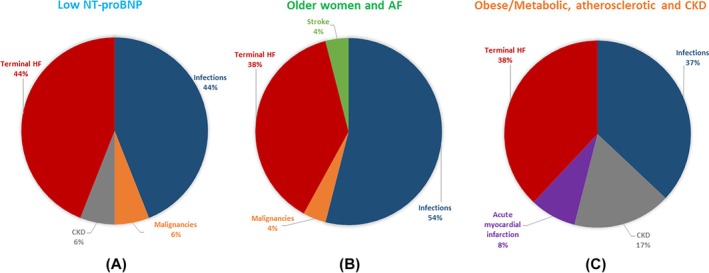 Figure 1
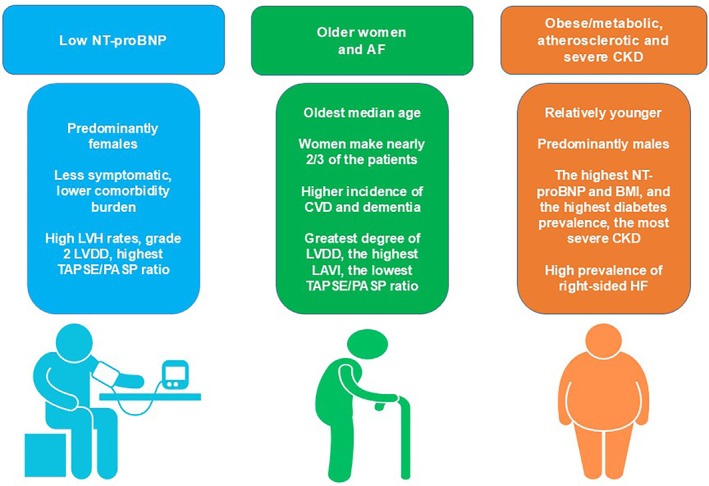 Figure 2
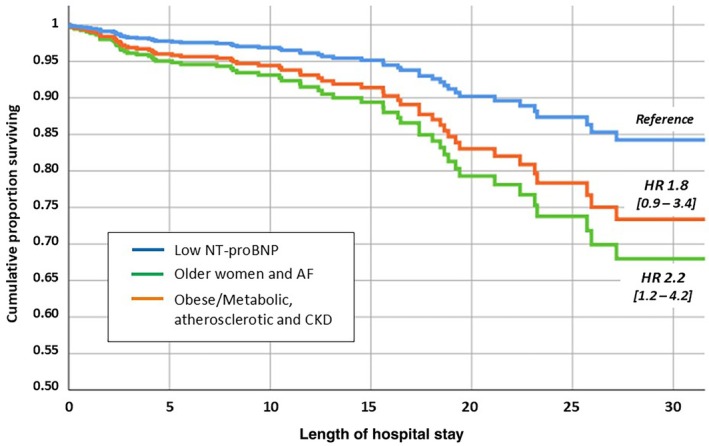 Figure 3
Peer Reviews
No public reviews on file for this paper yet. If you reviewed it on a platform where reviews are public (OpenReview, ICLR, NeurIPS, ICML), you can paste yours below so the community can read it here.
Videos
No videos yet. Explain this paper in a talk, walkthrough, or lecture? Add one.
Taxonomy
TopicsHeart Failure Treatment and Management · Cardiovascular Function and Risk Factors · Cardiac Fibrosis and Remodeling