Successful Treatment of Aplastic Anemia With Eltrombopag During Pregnancy: A Short Report
Sandra M. Frey, Ferras Alashkar, H. Christian Reinhardt, Alexander Röth

TL;DR
A pregnant woman with aplastic anemia was successfully treated with eltrombopag, resulting in a healthy delivery and transfusion independence.
Contribution
This is the first reported case of full-dose eltrombopag use in a pregnant patient with aplastic anemia.
Findings
The patient's blood counts remained stable during treatment with eltrombopag.
The child was born healthy, and the mother achieved transfusion independence postpartum.
Abstract
Aplastic anemia (AA) is a rare bone marrow failure syndrome with pancytopenia, mainly due to immune‐mediated stem cell destruction. First‐line therapy for acquired severe AA ≥ 50 years/non‐severe AA (NSAA) requiring treatment is immunosuppressive therapy with horse anti‐thymocyte globulin, cyclosporine A (CSA), and eltrombopag (EPAG). In pregnancy, cytopenia may worsen, while therapeutic options are limited. We report the first case of a pregnant patient with NSAA/PNH receiving full‐dose EPAG (150 mg/d). Counts remained stable, delivery was uneventful, and the child was healthy. Postpartum, EPAG was discontinued, CSA tapered, and transfusion independence achieved. EPAG may represent a feasible option in selected pregnancies.
Genes, proteins, chemicals, diseases, species, mutations and cell lines named across the full text — each resolved to its canonical identifier and authoritative record.
Click any figure to enlarge with its caption.
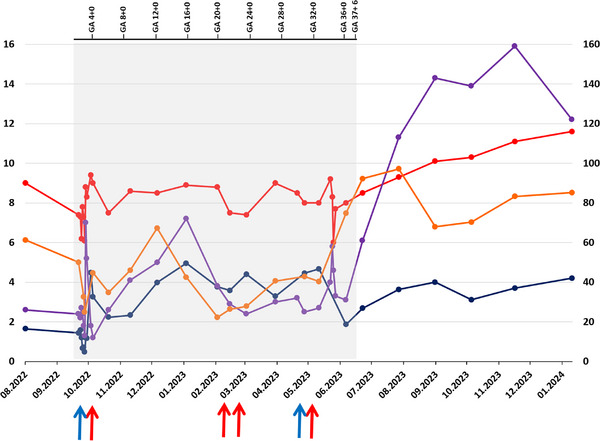 Figure 1
Peer Reviews
No public reviews on file for this paper yet. If you reviewed it on a platform where reviews are public (OpenReview, ICLR, NeurIPS, ICML), you can paste yours below so the community can read it here.
Videos
No videos yet. Explain this paper in a talk, walkthrough, or lecture? Add one.
Taxonomy
TopicsHematopoietic Stem Cell Transplantation · Erythrocyte Function and Pathophysiology · Blood groups and transfusion