Divergent Mechanisms of Antidepressant Efficacy: A Unified Computational Comparison of Synaptogenesis, Stabilization, and Tonic Inhibition in a Model of Depression
Ngo Cheung

TL;DR
This study compares how different antidepressants work by simulating their effects on brain plasticity, showing each has unique benefits and drawbacks in treating depression.
Contribution
The paper introduces a unified computational model to compare three distinct antidepressant mechanisms in a shared framework.
Findings
Ketamine-like synaptogenesis improved stress resilience and durability with minimal relapse.
SSRI-like refinement showed moderate stress resilience but significant relapse vulnerability.
Neurosteroid-like inhibition provided rapid recovery but was state-dependent and less effective under extreme stress.
Abstract
Background: Major depressive disorder (MDD) is increasingly viewed as a disorder of impaired neural plasticity, yet the mechanisms underlying diverse antidepressant classes - glutamatergic (e.g., ketamine), monoaminergic (e.g., selective serotonin reuptake inhibitors (SSRIs)), and GABAergic (e.g., neurosteroids) - remain incompletely integrated. The objective of this study was to extend a pruning-plasticity model of depression and directly compare, from an identical severely pruned baseline state, the efficacy, stress resilience, durability, and relapse vulnerability of three mechanistically distinct interventions: ketamine-like targeted synaptogenesis, SSRI-like gradual refinement of existing connectivity, and neurosteroid-like tonic inhibition. Computational models offer a controlled means to compare these pathways, but prior work has typically examined single mechanisms. Methods: We…
Genes, proteins, chemicals, diseases, species, mutations and cell lines named across the full text — each resolved to its canonical identifier and authoritative record.
Click any figure to enlarge with its caption.
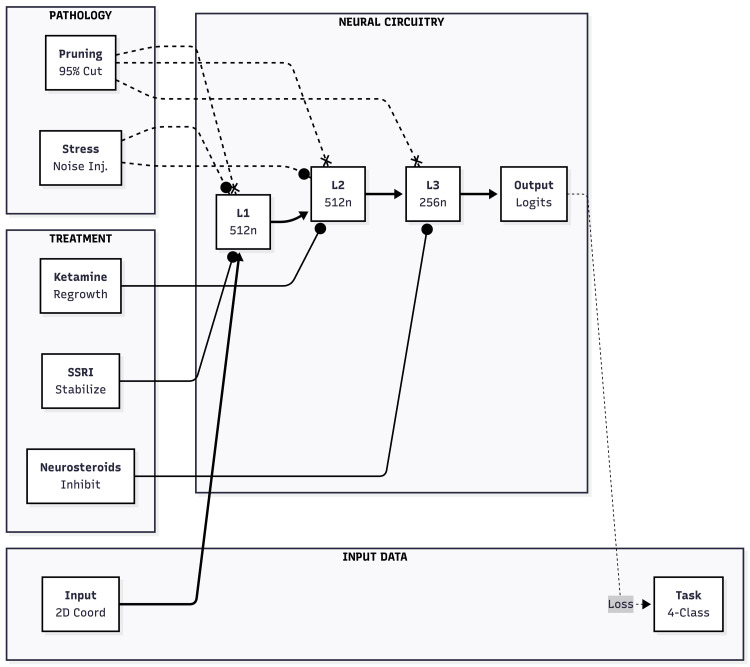 Figure 1
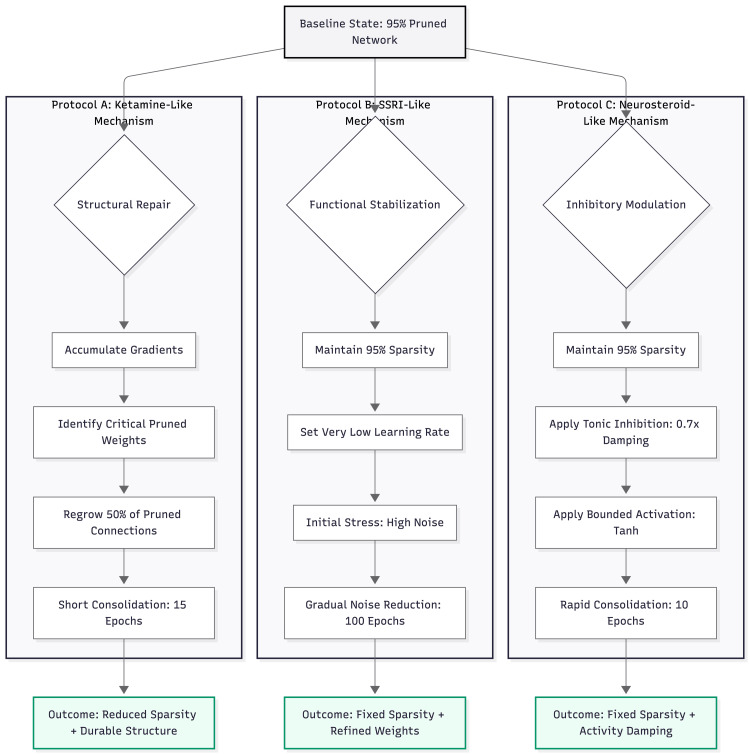 Figure 2
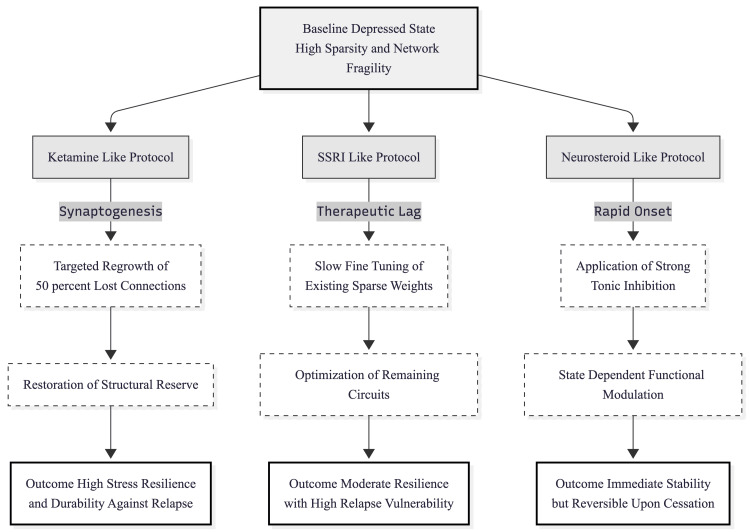 Figure 3
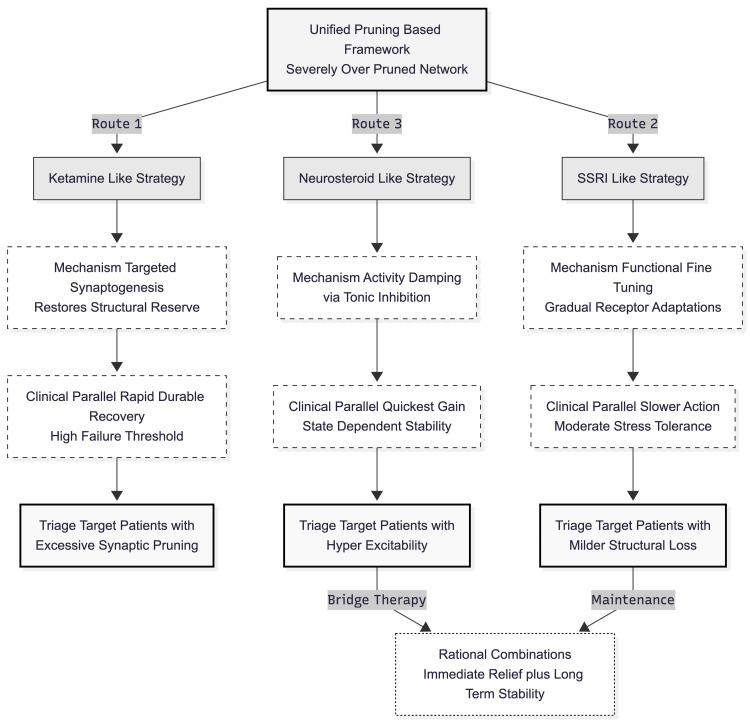 Figure 4
Peer Reviews
No public reviews on file for this paper yet. If you reviewed it on a platform where reviews are public (OpenReview, ICLR, NeurIPS, ICML), you can paste yours below so the community can read it here.
Videos
No videos yet. Explain this paper in a talk, walkthrough, or lecture? Add one.
Taxonomy
TopicsTreatment of Major Depression · Neural dynamics and brain function · Functional Brain Connectivity Studies