Assessing the real-world performance of xylazine test strips for community-based drug checking in Los Angeles
Caitlin A. Molina, Joseph R Friedman, Adam J. Koncsol, Ruby Romero, Morgan E. Godvin, Leslie Nuñez, Karmen G. Pang, Talya Tasini, Ezinne Okonkwo, Matthew Vu, Joshua Smith, Chelsea L. Shover

TL;DR
This study evaluates the effectiveness of xylazine test strips in real-world drug checking in Los Angeles, finding they have low sensitivity but high specificity.
Contribution
The paper provides real-world validation of first-generation xylazine test strips using community-based drug checking data and mass spectrometry.
Findings
Xylazine test strips had a sensitivity of 54.0% and specificity of 87.0% in detecting xylazine.
Most xylazine-positive samples contained low concentrations (<1% by weight).
False positives were often associated with lidocaine presence.
Abstract
The veterinary sedative xylazine is increasingly found in illicit fentanyl and has been associated with numerous health harms. Xylazine test strips (XTS) are an emerging technology that can theoretically assist consumers in avoiding xylazine, but they require real-world validation. We leverage community-based drug checking program data to compare real-world XTS performance to ‘gold standard’ methods. Samples were initially assessed by dissolving 1 mg of drug product in 1 mL water and dipping an XTS (“first generation” Wisebatch™) in the sample. Subsequently, confirmatory testing was performed by sending samples to the National Institute of Standards and Technology for qualitative analysis using direct analysis in real-time mass spectrometry (DART-MS). A subset was analyzed quantitatively with liquid chromatography gas spectrometry (LC–MS) to quantify xylazine, fentanyl, and other…
Genes, proteins, chemicals, diseases, species, mutations and cell lines named across the full text — each resolved to its canonical identifier and authoritative record.
Click any figure to enlarge with its caption.
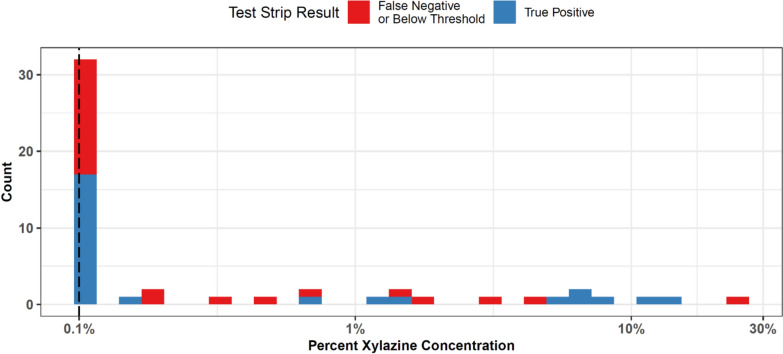 Figure 1
Peer Reviews
No public reviews on file for this paper yet. If you reviewed it on a platform where reviews are public (OpenReview, ICLR, NeurIPS, ICML), you can paste yours below so the community can read it here.
Videos
No videos yet. Explain this paper in a talk, walkthrough, or lecture? Add one.
Taxonomy
TopicsVeterinary Pharmacology and Anesthesia · Forensic Toxicology and Drug Analysis · Opioid Use Disorder Treatment