Vector competence re-evaluation of reared Glossina palpalis gambiensis for transmission of Trypanosoma congolense and Trypanosoma brucei brucei isolates for an experimental event
Tindwendé Justin Yaméogo, Alain Boulangé, Wendemanegde Ernest Salou, Adrien Marie Gaston Belem, Marc Desquesnes, Sophie Ravel, Geoffrey Gimonneau

TL;DR
This study updates the ability of a long-reared tsetse fly colony to transmit two types of trypanosomes, finding changes in transmission efficiency over time.
Contribution
The study provides updated vector competence data for a long-standing tsetse fly colony against specific trypanosome isolates.
Findings
10.58% of tsetse flies developed mature infections with Trypanosoma congolense, yielding a VC index of 0.106.
4.21% of tsetse flies developed mature infections with Trypanosoma brucei brucei, yielding a VC index of 0.042.
Vector competence for T. congolense was 4.8 times higher than previously reported, suggesting changes due to long-term insectary rearing.
Abstract
Tsetse flies (Diptera: Glossinidae) are vectors of human and animal trypanosomes. The Glossina palpalis gambiensis Burkina Faso (BKF) colony, established in 1972 and rejuvenated once in 1981, is a long-standing closed colony used extensively for research and vector control. While its performance and competitiveness for sterile insect technique (SIT) programs are regularly monitored, its vector competence (VC) data are outdated. This study aimed to update the VC data of this 47-year-old colony (from the onset of experiment in 2019) against Trypanosoma congolense and T. brucei brucei in laboratory conditions using trypanosome clone and tsetse fly individuals from the BKF colony. Vector competence was studied by infecting rats with T. congolense IL1180 and T. b. brucei BE8P2P2, on which tsetse flies received their first blood meal. Dissections were subsequently performed at different time…
Genes, proteins, chemicals, diseases, species, mutations and cell lines named across the full text — each resolved to its canonical identifier and authoritative record.
Click any figure to enlarge with its caption.
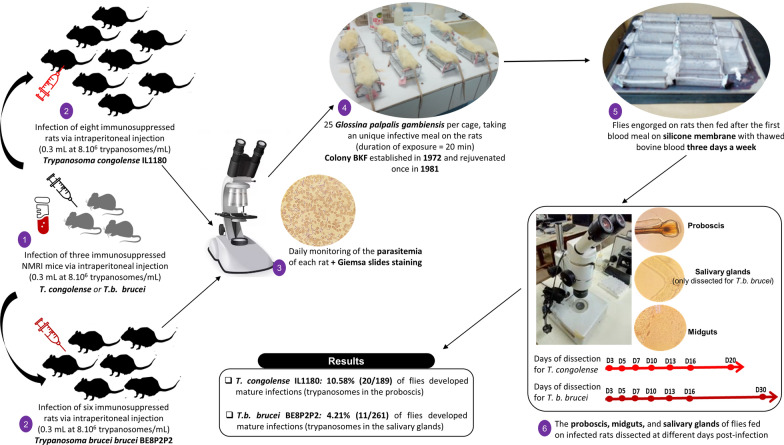 Figure 1
Peer Reviews
No public reviews on file for this paper yet. If you reviewed it on a platform where reviews are public (OpenReview, ICLR, NeurIPS, ICML), you can paste yours below so the community can read it here.
Videos
No videos yet. Explain this paper in a talk, walkthrough, or lecture? Add one.
Taxonomy
TopicsTrypanosoma species research and implications · Research on Leishmaniasis Studies · Parasites and Host Interactions