A randomised Study Within a Trial (SWAT) to determine if participant information leaflet design affects recruitment rate into an interventional trial taking place in a UK emergency department
Rachelle Sherman, Andrew Tabner, Apostolos Fakis, Adwoa Parker, Graham Johnson

TL;DR
This study tested if changing the design of participant information leaflets affects recruitment rates in a UK emergency department trial, but found no significant difference.
Contribution
The study provides empirical evidence that PIL design changes do not significantly influence recruitment rates or decision-making in emergency trial settings.
Findings
Optimized PILs had a 47.1% recruitment rate compared to 48.9% for conventional PILs, with no statistical significance.
No significant differences were found in participants' decision-making based on PIL type.
Readability and visual improvements in PILs did not impact recruitment or decision-making.
Abstract
Exploring barriers and enablers to participant recruitment into trials is a common discussion point in trial methodology. Participant information leaflets (PIL) can be long, have complexity above the average UK reading age, and may discourage engagement with research. This Study Within a Trial (SWAT) explored whether changing the design of a PIL influences recruitment rate and its value in patient decision-making. It was conducted within a host trial taking place in an emergency setting, where time is at a premium, and decisions on trial participation are needed more quickly than in most non-emergency settings. We have conducted a randomised SWAT, comparing the standard format PIL with one that has been adapted to be visually appealing, with improved readability and reduced word count. Patients considered eligible for the host trial were provided with a randomly allocated PIL type;…
Genes, proteins, chemicals, diseases, species, mutations and cell lines named across the full text — each resolved to its canonical identifier and authoritative record.
Click any figure to enlarge with its caption.
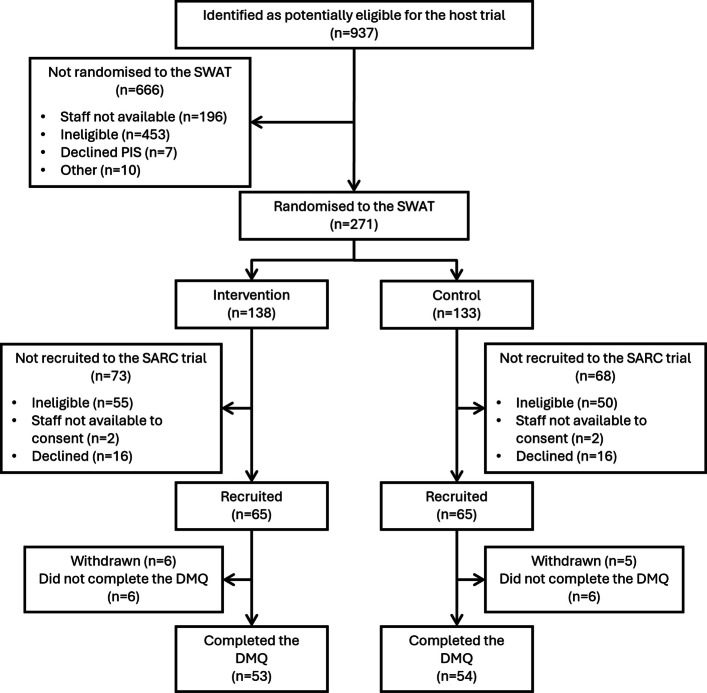 Figure 1
Peer Reviews
No public reviews on file for this paper yet. If you reviewed it on a platform where reviews are public (OpenReview, ICLR, NeurIPS, ICML), you can paste yours below so the community can read it here.
Videos
No videos yet. Explain this paper in a talk, walkthrough, or lecture? Add one.
Taxonomy
TopicsMental Health and Patient Involvement · Health Literacy and Information Accessibility · Ethics in Clinical Research