Differential targeting of human pyroptotic caspase-5 and caspase-4 by Shigella OspC2 and OspC3
Kyungsub Kim, Marcos Antonio Valdespino Diaz, Rowan M. Karr, Michele E. Muscolo, Lisa Goers, Truelian Yu, Tera C. Levin, Jonathan N. Pruneda, Cammie F. Lesser

TL;DR
Shigella bacteria use two similar proteins, OspC2 and OspC3, to block human cell death pathways by targeting different caspases, CASP5 and CASP4, revealing an evolutionary arms race between bacteria and host defenses.
Contribution
The discovery of a PCS domain that determines effector protein specificity for CASP4 or CASP5, and evidence of evolutionary adaptation in CASP5.
Findings
OspC2 and OspC3 target CASP5 and CASP4, respectively, via a newly identified PCS domain.
CASP5 shows signs of positive selection at residues interacting with OspC2, indicating evolutionary adaptation.
Changing orangutan-specific residues in CASP5 disrupts its interaction with OspC2, showing functional variation in host defense.
Abstract
Pyroptosis is an inflammatory cell death pathway that is a key defense mechanism of intestinal epithelial cells. To successfully establish an infection, intracytosolic gram-negative pathogens must block this host response. Indeed, a Shigella effector OspC3, injected into cells by its type III secretion system, suppresses epithelial pyroptosis by targeting and inactivating caspase-4 (CASP4). Here, we demonstrate that OspC2, which shares 96% identity with OspC3, targets caspase-5 (CASP5), a close paralog of CASP4. Through a combination of yeast two-hybrid, transfection, and bacterial infection assays, we show that the distinct pyroptotic caspase specificities of OspC2 and OspC3 are determined by a short α-helical region, designated the pyroptotic caspase specificity (PCS) domain. This domain is located upstream from the ankyrin-rich repeat (ARR) region previously established to promote…
Genes, proteins, chemicals, diseases, species, mutations and cell lines named across the full text — each resolved to its canonical identifier and authoritative record.
Click any figure to enlarge with its caption.
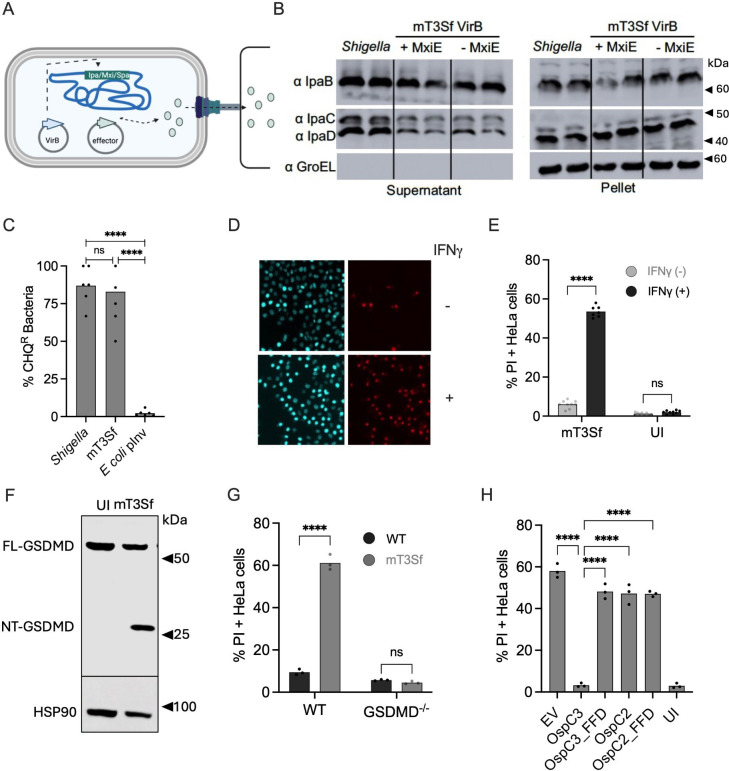 Figure 1
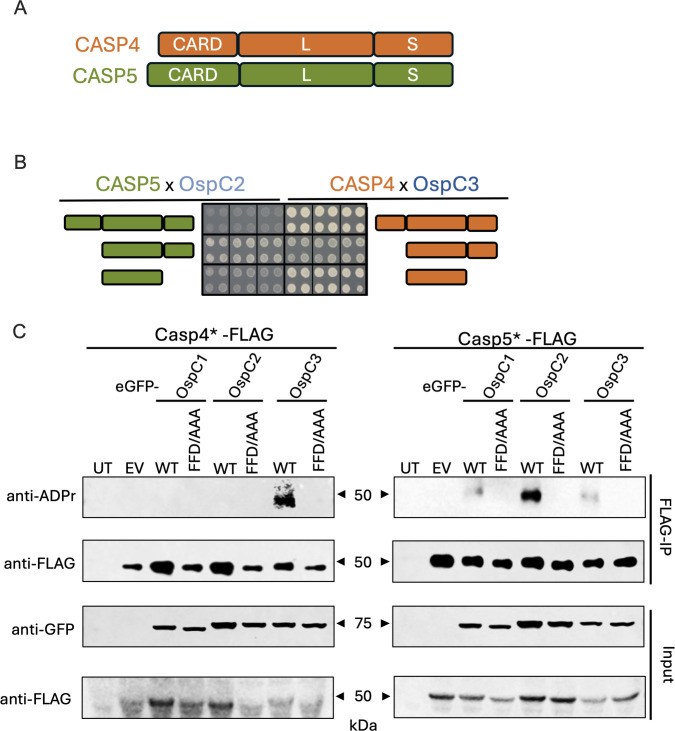 Figure 2
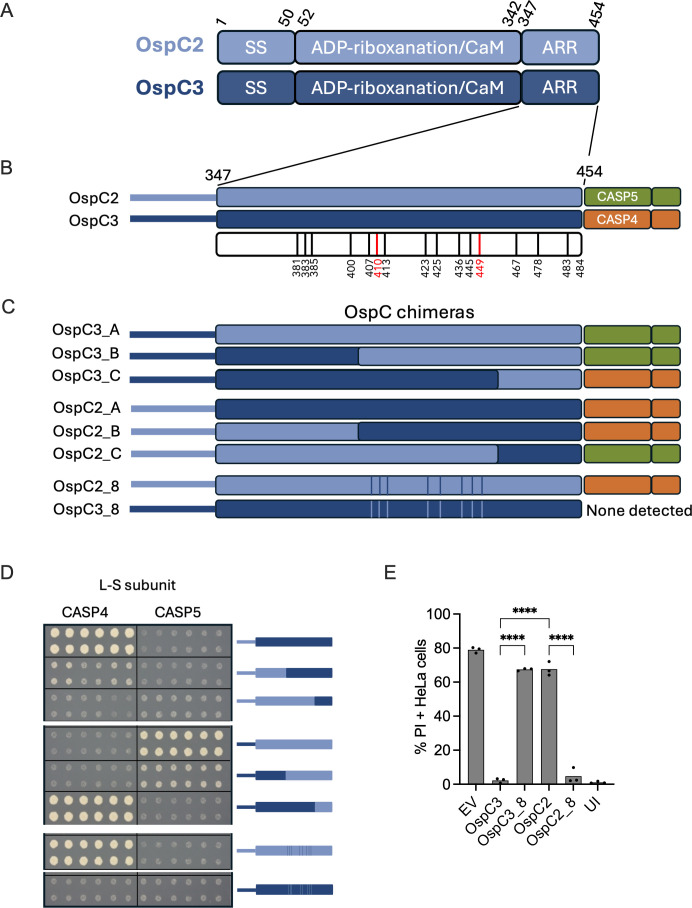 Figure 3
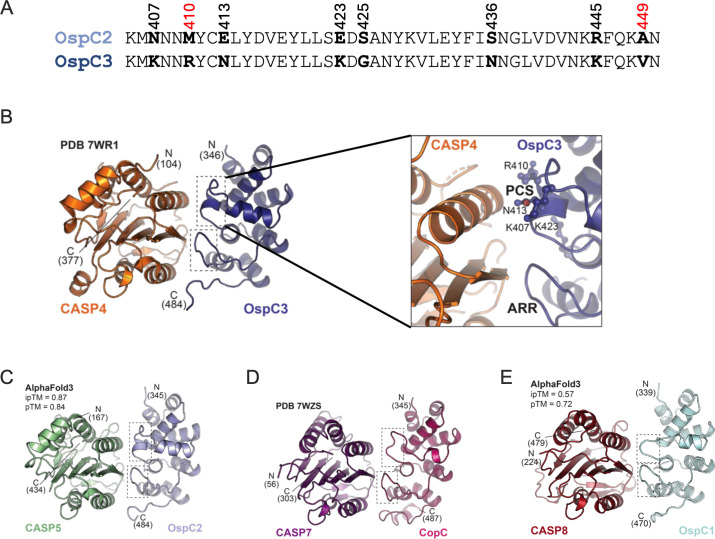 Figure 4
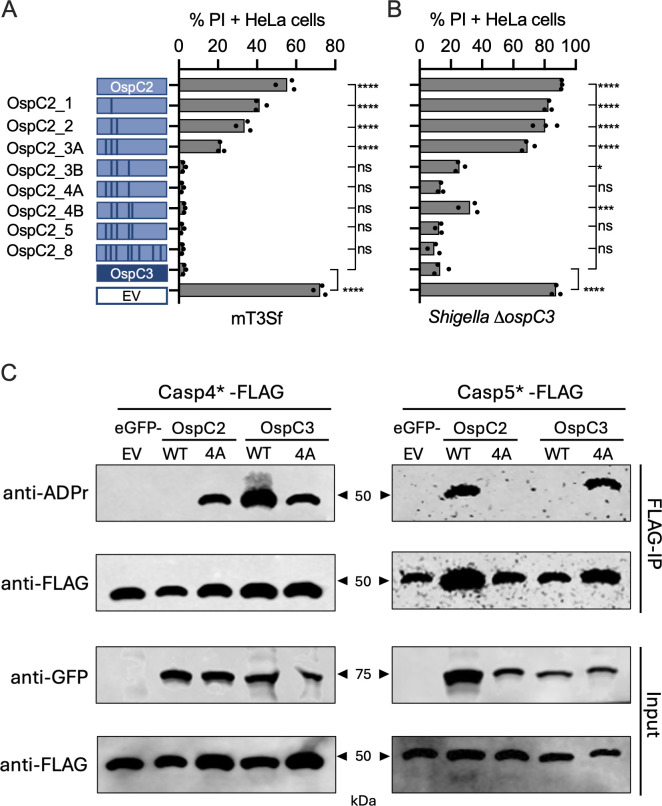 Figure 5
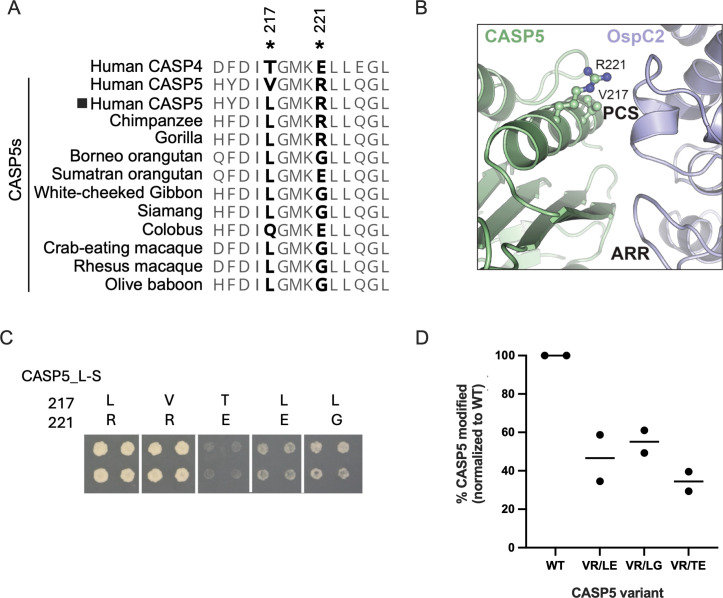 Figure 6
Peer Reviews
No public reviews on file for this paper yet. If you reviewed it on a platform where reviews are public (OpenReview, ICLR, NeurIPS, ICML), you can paste yours below so the community can read it here.
Videos
No videos yet. Explain this paper in a talk, walkthrough, or lecture? Add one.
Taxonomy
TopicsInflammasome and immune disorders · Cell death mechanisms and regulation · Streptococcal Infections and Treatments