The lipid language of tuberculosis: Mycobacterium tuberculosis surface molecules in host interaction and drug resistance
Sandhya Krishnan Radhakrishnan, Varadharajan Sundaramurthy

TL;DR
This paper explores how Mycobacterium tuberculosis uses lipids to interact with the host, evade the immune system, and resist drugs, offering insights into new treatment strategies.
Contribution
The paper provides a comprehensive review of the diverse roles of Mtb lipids in host interaction and drug resistance, highlighting recent advances and challenges.
Findings
Mtb lipids modulate host immune pathways and facilitate intracellular survival by altering phagosome maturation and autophagy.
Lipids like PDIM and TDM promote granuloma formation and pathological features critical for TB transmission.
The lipid envelope acts as a barrier to antibiotics, with resistance linked to altered lipid composition in drug-resistant strains.
Abstract
Mycobacterium tuberculosis (Mtb), the causative agent of tuberculosis (TB), is a uniquely successful pathogen due in large part to its complex lipid-rich cell envelope. Comprising nearly 40% of its dry weight, Mtb lipids—such as mycolic acids, phthiocerol dimycocerosates (PDIM), trehalose dimycolate (TDM), and sulfolipids (SLs)—play crucial roles in infection, immune evasion, intracellular persistence, granuloma formation, transmission, and drug resistance. These lipids modulate host-pathogen interactions by altering host membrane biophysics, hijacking phagosome maturation, and interfering with host immune pathways, including autophagy and inflammatory signaling. Upon inhalation, Mtb surface lipids inhibit pulmonary surfactant function and mask pathogen-associated molecular patterns, facilitating uptake by permissive macrophage subsets. Intracellularly, lipoglycans like mannose-capped…
Genes, proteins, chemicals, diseases, species, mutations and cell lines named across the full text — each resolved to its canonical identifier and authoritative record.
Click any figure to enlarge with its caption.
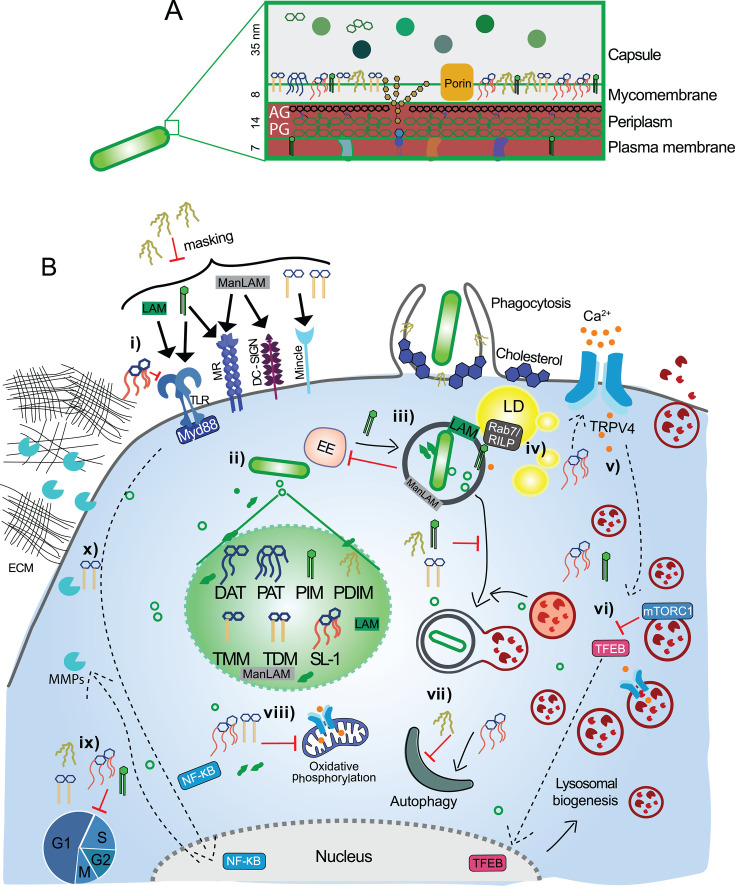 Figure 1
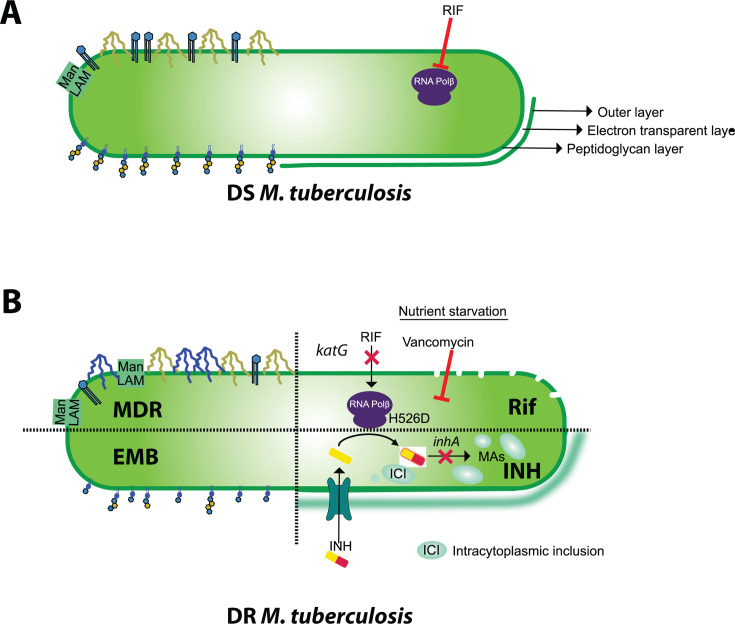 Figure 2
Peer Reviews
No public reviews on file for this paper yet. If you reviewed it on a platform where reviews are public (OpenReview, ICLR, NeurIPS, ICML), you can paste yours below so the community can read it here.
Videos
No videos yet. Explain this paper in a talk, walkthrough, or lecture? Add one.
Taxonomy
TopicsTuberculosis Research and Epidemiology · Pneumonia and Respiratory Infections · Inhalation and Respiratory Drug Delivery