Efficient detection and typing of phage-plasmids
Karina Ilchenko, Remy A. Bonnin, Eduardo P. C. Rocha, Eugen Pfeifer

TL;DR
This paper introduces tyPPing, a new method to accurately detect and classify phage-plasmids, which are hybrid genetic elements that are often misclassified by existing tools.
Contribution
The paper introduces tyPPing, a novel computational method for precise and systematic detection and typing of phage-plasmids.
Findings
tyPPing accurately separates phage-plasmids from phages and plasmids using conserved protein frequencies.
tyPPing outperforms existing tools in sensitivity and scalability for phage-plasmid classification.
tyPPing was validated on diverse datasets and experimentally confirmed to identify functional phage-plasmids.
Abstract
Phage-plasmids (P-Ps) are temperate phages that replicate as plasmids during lysogeny. Despite their high diversity, they carry genes similar to phages and plasmids. This leads to gene exchanges and to the formation of hybrid or defective elements, which limits accurate detection of P-Ps. To address this challenge, we developed tyPPing, an easy-to-use method that efficiently detects and types P-Ps with high accuracy. It searches for distinct frequencies and sets of conserved proteins to separate P-Ps from plasmids and phages. tyPPing’s strength comes from both its precise predictions and its ability to systematically type P-Ps, including the assignment of confidence levels. We tested tyPPing on several databases and a collection of incomplete (draft) genomes. While predictions rely on the quality of assemblies, we detected high-quality P-Ps and experimentally proved them to be…
Genes, proteins, chemicals, diseases, species, mutations and cell lines named across the full text — each resolved to its canonical identifier and authoritative record.
Click any figure to enlarge with its caption.
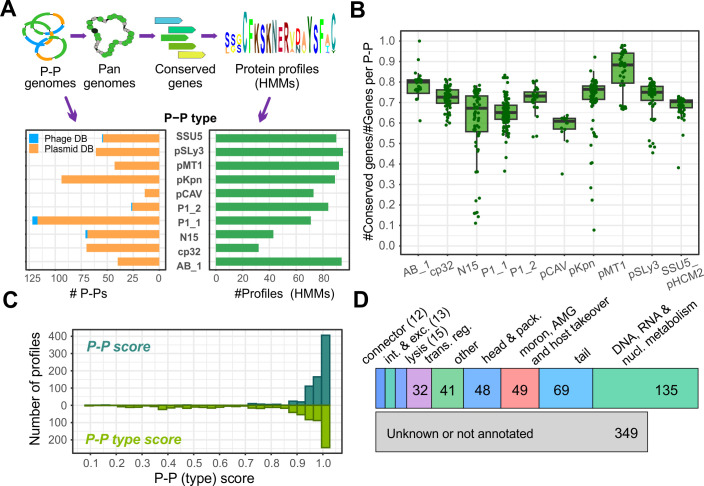 Figure 1
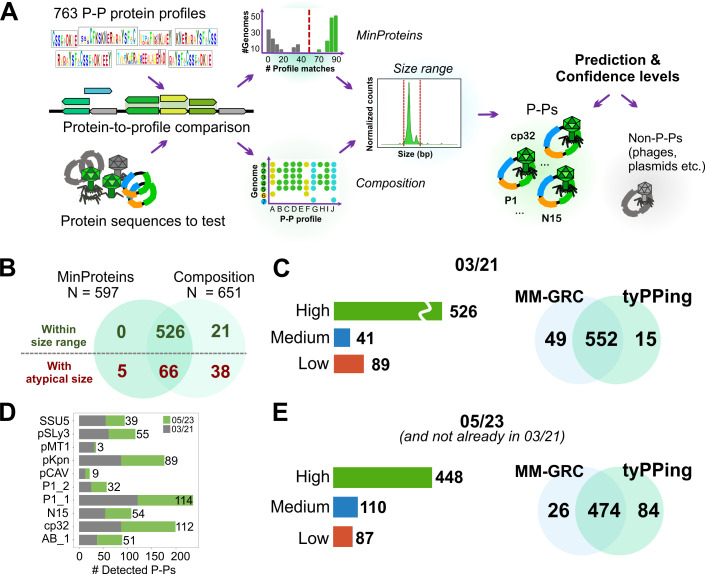 Figure 2
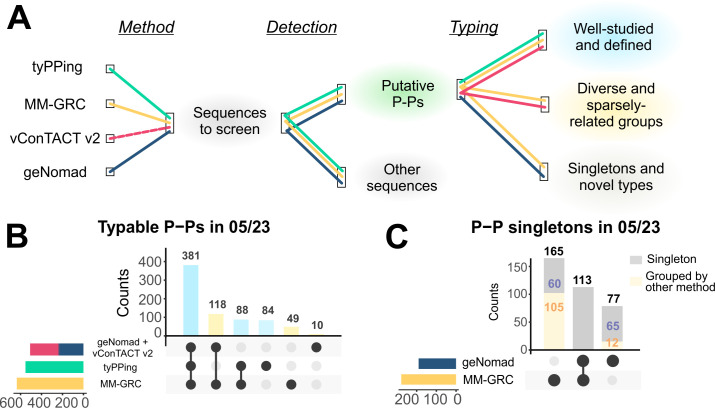 Figure 3
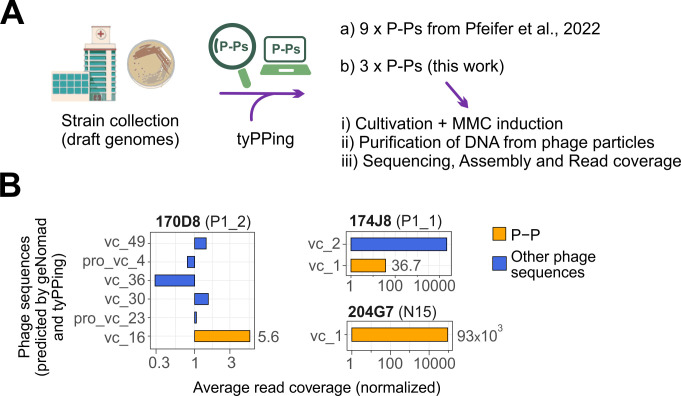 Figure 4
 Figure 5
 Figure 6
 Figure 7
Peer Reviews
No public reviews on file for this paper yet. If you reviewed it on a platform where reviews are public (OpenReview, ICLR, NeurIPS, ICML), you can paste yours below so the community can read it here.
Videos
No videos yet. Explain this paper in a talk, walkthrough, or lecture? Add one.
Taxonomy
TopicsBacteriophages and microbial interactions · Vibrio bacteria research studies · Salmonella and Campylobacter epidemiology