A scoping review of the Stanford Integrated Psychosocial Assessment for Transplantation (SIPAT) for use with liver transplant candidates
Alberto Olivero, Marco Miniotti, Alessandro Godono, Paolo Leombruni

TL;DR
This review examines how the SIPAT tool is used to assess psychosocial factors in liver transplant candidates, highlighting its potential and limitations.
Contribution
The study provides a comprehensive scoping review of SIPAT's use in liver transplantation, identifying gaps in evidence and methodological consistency.
Findings
A substantial proportion of liver transplant candidates are classified as having moderate-to-high psychosocial risk using SIPAT.
Higher SIPAT scores are associated with lower transplant listing likelihood and worse post-transplant outcomes like nonadherence and acute rejection.
SIPAT scores in alcohol-related liver disease candidates correlate with increased risk of harmful alcohol relapse.
Abstract
Liver transplantation (LT) is a life-saving treatment for end-stage liver disease, and psychosocial factors significantly influence eligibility, adherence, and outcomes. The Stanford Integrated Psychosocial Assessment for Transplantation (SIPAT) was developed to standardize psychosocial evaluation across four domains: treatment readiness, social support, psychopathology, and substance use. Despite its growing global adoption, evidence regarding its validity, predictive value, and applicability, specifically in LT, remains fragmented and heterogeneous. This scoping review maps and summarizes the available empirical evidence on SIPAT use in adult LT candidates. It focuses on (1) score distributions (2), psychosocial differences by disease etiology, and (3) associations with listing decisions, post-transplant outcomes, relapse risk, and quality of life. A systematic search of PubMed,…
Genes, proteins, chemicals, diseases, species, mutations and cell lines named across the full text — each resolved to its canonical identifier and authoritative record.
Click any figure to enlarge with its caption.
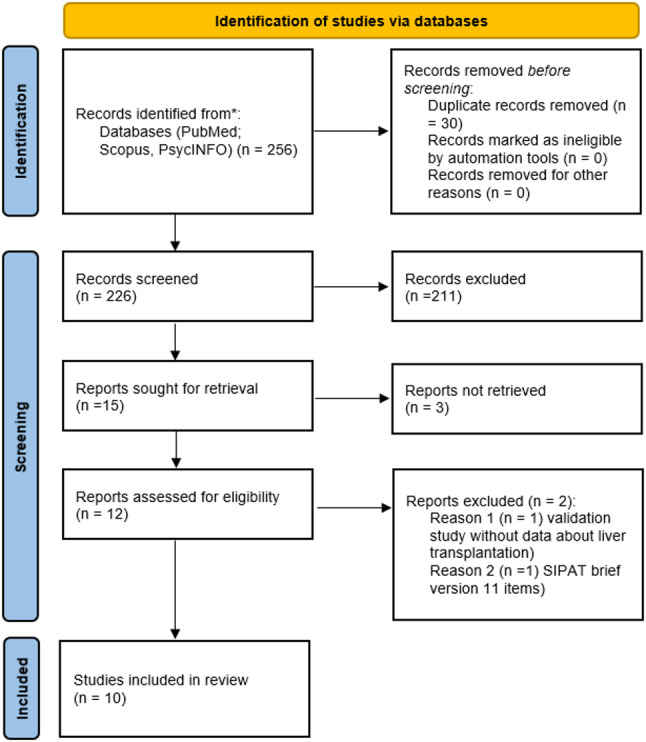 Figure 1
Peer Reviews
No public reviews on file for this paper yet. If you reviewed it on a platform where reviews are public (OpenReview, ICLR, NeurIPS, ICML), you can paste yours below so the community can read it here.
Videos
No videos yet. Explain this paper in a talk, walkthrough, or lecture? Add one.
Taxonomy
TopicsAlcohol Consumption and Health Effects · Liver Disease and Transplantation · Organ Transplantation Techniques and Outcomes