Exploring the Readiness for Digital Health Literacy Transformation and Intervention Preferences From the Perspectives of Patients With Cancer, Caregivers, and Health Care Professionals: Qualitative Interview Study
Hind Mohamed, Turki Alanzi, Jon Salsberg, Mudathir Mohamed, Dervla Kelly

TL;DR
This study explores how cancer patients, caregivers, and healthcare professionals view digital health literacy training and identifies preferences for effective interventions.
Contribution
The study introduces microlearning as a novel approach for digital health literacy training and highlights stakeholder collaboration.
Findings
Patients and caregivers are motivated to use technology for improving digital health literacy despite concerns about online information reliability.
Participants prefer concise, user-friendly, and web-based training materials accessible in multiple languages.
Microlearning pedagogy aligns with preferences for tailored digital health literacy training.
Abstract
Technology is changing the way the world communicates and how we learn, remember, and transform information. The ascendancy of the internet has dramatically altered the landscape of health information access and seeking behaviors. This transformation is embodied by the concept of digital health literacy (DHL) and the need for interventions that improve DHL. This study aims to explore readiness for DHL transformation and intervention preferences from the perspectives of patients with cancer, caregivers, and health care professionals. We conducted semistructured telephone and on-site interviews with 19 patients with cancer, 6 caregivers, and 10 oncology health care professionals. Purposive sampling was used to recruit the participants. We followed the 7 stages of the Framework Method analysis: transcription, familiarization with the interview, coding, developing a working analytical…
Genes, proteins, chemicals, diseases, species, mutations and cell lines named across the full text — each resolved to its canonical identifier and authoritative record.
Click any figure to enlarge with its caption.
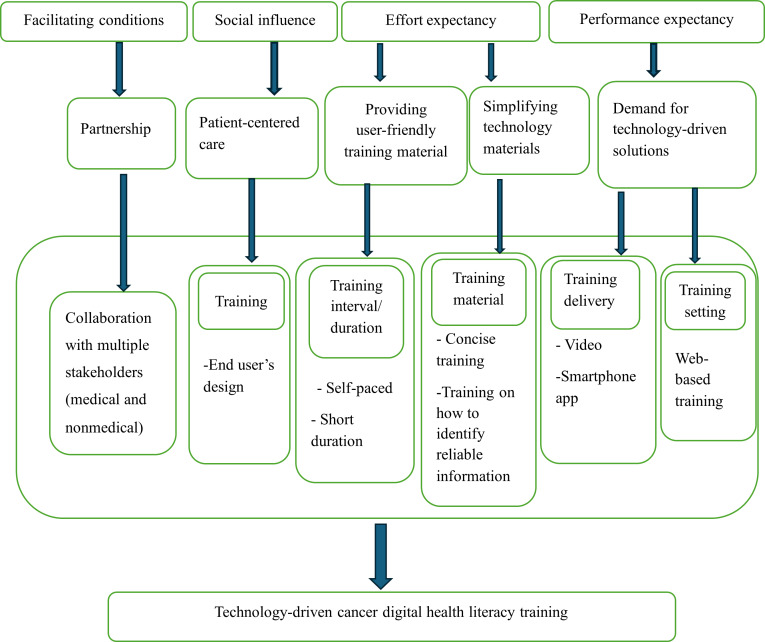 Figure 1
Peer Reviews
No public reviews on file for this paper yet. If you reviewed it on a platform where reviews are public (OpenReview, ICLR, NeurIPS, ICML), you can paste yours below so the community can read it here.
Videos
No videos yet. Explain this paper in a talk, walkthrough, or lecture? Add one.
Taxonomy
TopicsE-Learning and COVID-19 · Social Media in Health Education · Health Literacy and Information Accessibility