Improving Protein Structure Determination by Integrating Ensemble-Driven Molecular Dynamics with Chemical Shift-Based Restraints
Márton Gadanecz, Zsolt Fazekas, Dóra K. Menyhárd, András Perczel

TL;DR
This paper introduces a new method that combines molecular dynamics with chemical shift data to improve the accuracy of protein structure determination.
Contribution
The novel protocol integrates EDMD with chemical shift-based restraints to refine protein structures more accurately.
Findings
EDMD improved backbone RMSD compared to CS-Rosetta ensembles for 5 benchmark proteins.
EDMD enhanced fulfillment of NOE-derived distance restraints over CS-Rosetta and unrestrained MD.
EDMD maintained correct protein–ligand conformations and can refine nonconverged CS-Rosetta results.
Abstract
We present a protocol for nuclear magnetic resonance (NMR) chemical shift-based structure determination that employs ensemble-driven molecular dynamics (EDMD) for structure refinement. Here, specifically, Chemical-Shift-Rosetta (CS-Rosetta) was applied, followed by EDMD. EDMD eliminates the need to predict chemical shifts at every molecular dynamics (MD) step by defining continuous, differentiable potential energy functions (PEFs) based on dihedral angle distributions from CS-Rosetta models while incorporating the measurement temperature. This yielded a thermodynamically realistic, experiment-based custom force field for each studied system. We benchmarked EDMD against 5 proteins (13.1–19.2 kDa), focusing on systems with nonprotein components and demonstrated its consistent improvement of backbone root-mean-square deviation (RMSD) relative to known reference structures over the original…
Genes, proteins, chemicals, diseases, species, mutations and cell lines named across the full text — each resolved to its canonical identifier and authoritative record.
Click any figure to enlarge with its caption.
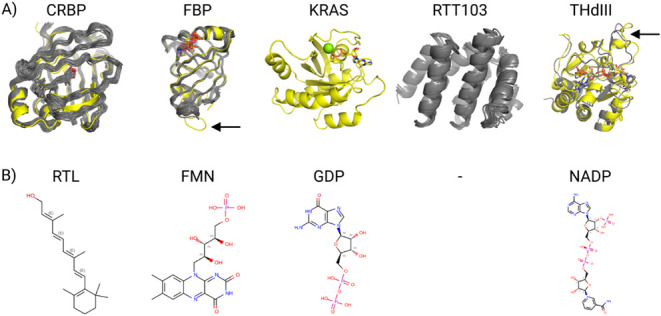 Figure 1
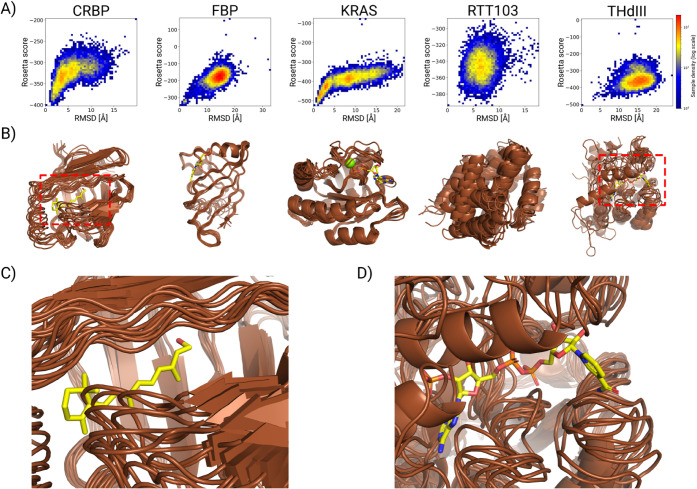 Figure 2
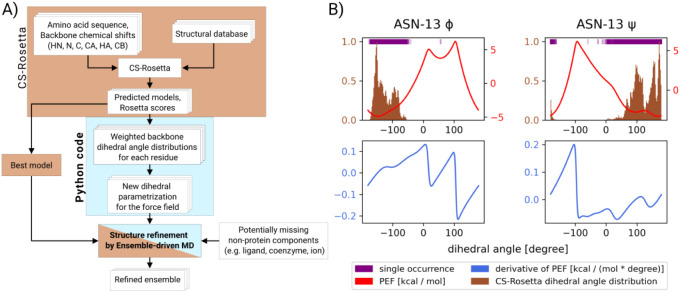 Figure 3
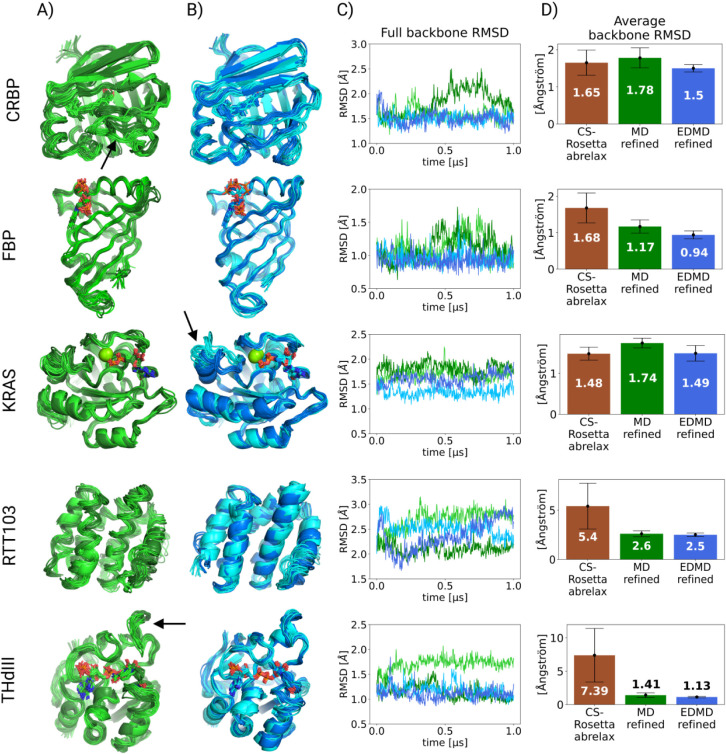 Figure 4
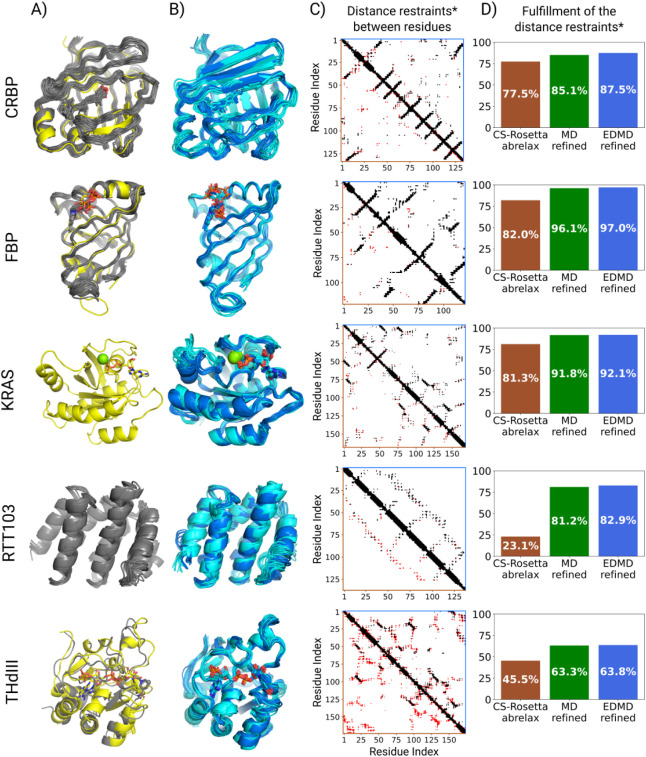 Figure 5
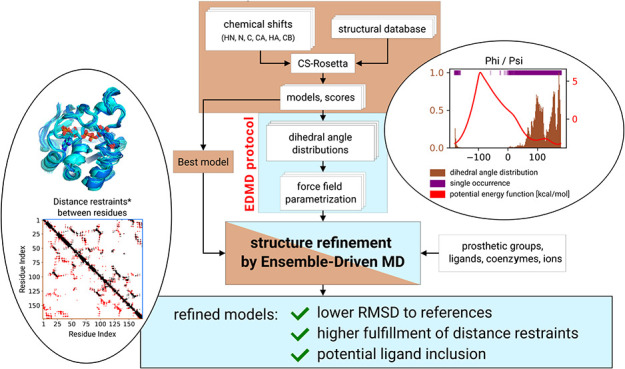 Figure 6
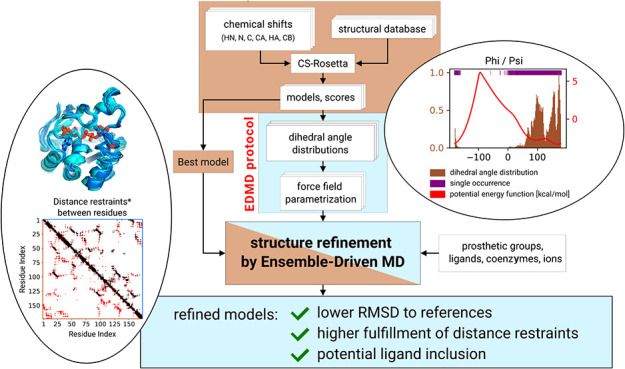 Figure 7
 Figure 8
Peer Reviews
No public reviews on file for this paper yet. If you reviewed it on a platform where reviews are public (OpenReview, ICLR, NeurIPS, ICML), you can paste yours below so the community can read it here.
Videos
No videos yet. Explain this paper in a talk, walkthrough, or lecture? Add one.
Taxonomy
TopicsProtein Structure and Dynamics · Advanced NMR Techniques and Applications · Molecular spectroscopy and chirality