Cerebrospinal fluid sclerostin levels in the early Alzheimer's disease stages
Manuela Dicarlo, Patrizia Pignataro, Daniele Urso, Chiara Zecca, Maria Teresa Dell'Abate, Francesco Borlizzi, Valentina Gnoni, Alessia Giugno, Angela Oranger, Graziana Colaianni, Roberta Zerlotin, Clelia Suriano, Silvia Colucci, Giancarlo Logroscino, Maria Grano

TL;DR
This study found that higher levels of sclerostin in cerebrospinal fluid are linked to early Alzheimer's disease and could serve as a potential biomarker.
Contribution
The study identifies sclerostin as a potential biomarker for early Alzheimer's disease stages by analyzing its correlation with AD biomarkers.
Findings
CSF sclerostin levels increased in patients with Alzheimer's disease.
Sclerostin correlated negatively with amyloid beta 42 and positively with phosphorylated tau and dementia severity.
Sclerostin shows potential as a biomarker in early Alzheimer's disease.
Abstract
Sclerostin, a negative regulator of bone formation, has been involved in memory impairment in Alzheimer's disease (AD) mouse models and is increased in elderly people at risk of AD. Here, we investigated sclerostin's role across the clinical stages of AD. We evaluated cerebrospinal fluid (CSF) sclerostin levels in patients with dementia due to AD, mild cognitive impairment, and subjective memory complaints, biologically characterized via the amyloid/tau/neurodegeneration classification. Results were correlated with AD biomarkers, amyloid beta (Aβ) 42, phosphorylated tau (p‐tau), and total tau (t‐tau), and clinical parameters of dementia severity. CSF sclerostin increased in patients with dementia due to AD and correlated negatively with Aβ42 and positively with p‐tau, t‐tau, and dementia severity. The association of CSF sclerostin with Aβ42, tau pathology, and dementia severity in…
Genes, proteins, chemicals, diseases, species, mutations and cell lines named across the full text — each resolved to its canonical identifier and authoritative record.
Click any figure to enlarge with its caption.
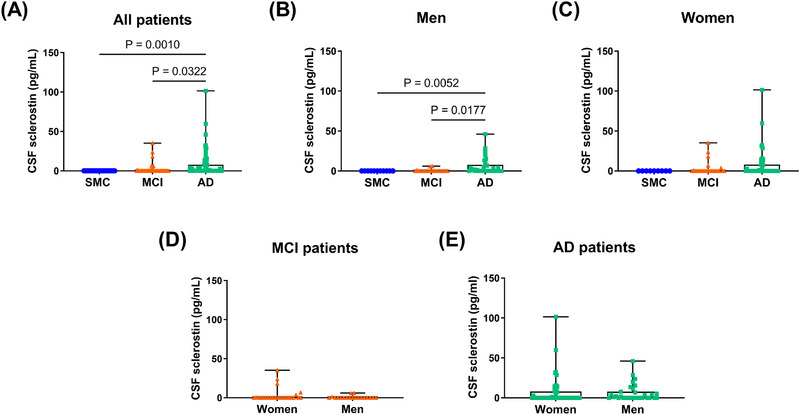 Figure 1
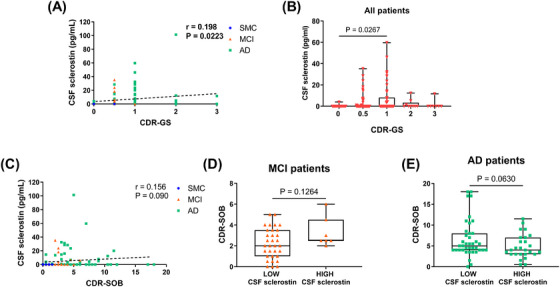 Figure 2
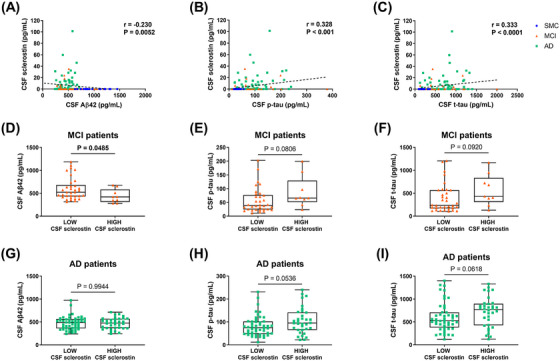 Figure 3
Peer Reviews
No public reviews on file for this paper yet. If you reviewed it on a platform where reviews are public (OpenReview, ICLR, NeurIPS, ICML), you can paste yours below so the community can read it here.
Videos
No videos yet. Explain this paper in a talk, walkthrough, or lecture? Add one.
Taxonomy
TopicsDementia and Cognitive Impairment Research · Alzheimer's disease research and treatments · Bone health and osteoporosis research