Pitfalls in estimating secular changes in incidence and prevalence of dementia from administrative datasets
Leon Flicker, Patrick Fitzgerald, Osvaldo P. Almeida, Kaarin J. Anstey, Michael Waller, Michelle Trevenen, Annette J. Dobson

TL;DR
The study shows that changes in dementia rates estimated from administrative data may be due to changes in data sources and diagnosis practices, not actual changes in dementia occurrence.
Contribution
The study identifies how secular trends and data source availability bias dementia incidence and prevalence estimates from administrative datasets.
Findings
Prevalence and incidence estimates increased over time, with a rapid rise after 2000–2004 due to aged care data inclusion.
A decrease in estimates from 2015–2019 coincided with the unavailability of aged care assessment data.
Secular changes in dementia rates may reflect diagnosis trends and data availability rather than true epidemiological shifts.
Abstract
Administrative datasets can be used to calculate population incidence and prevalence of dementia. It is unclear how changes in data sources may affect these estimates. We obtained linked administrative health data for individuals 60 years of age or older in Western Australia for 1989–2019 (n = 893,243) including hospital admissions, emergency department, cause‐of‐death, aged care assessment (from April 2003), and mental health services. There was a marked increase in prevalence and incidence estimates over time. There appeared to be two phases: an initial increase attenuated by 1995–1999 and a rapid increase since 2000–2004 corresponding to inclusion of aged care assessments. There was a decrease in 2015–2019 coinciding with the unavailability of aged care assessment data. An apparent secular change in rates of dementia over 31 years may be a product of increased propensity to record…
Genes, proteins, chemicals, diseases, species, mutations and cell lines named across the full text — each resolved to its canonical identifier and authoritative record.
Click any figure to enlarge with its caption.
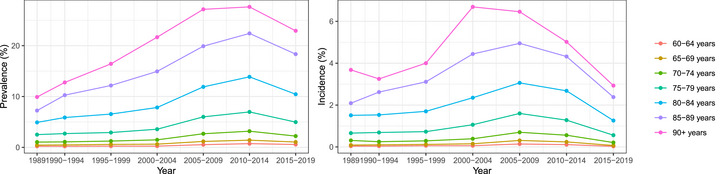 Figure 1
Peer Reviews
No public reviews on file for this paper yet. If you reviewed it on a platform where reviews are public (OpenReview, ICLR, NeurIPS, ICML), you can paste yours below so the community can read it here.
Videos
No videos yet. Explain this paper in a talk, walkthrough, or lecture? Add one.
Taxonomy
TopicsDementia and Cognitive Impairment Research · Geriatric Care and Nursing Homes · Insurance, Mortality, Demography, Risk Management