Stress-associated High Production of Large Extracellular Vesicles in the Parent Generation is Not Inherited by C. elegans F1 Progeny
Guoqiang Wang, Anna Joelle Smart, Jason F. Cooper, Monica Driscoll

TL;DR
The study finds that high production of large extracellular vesicles in parent C. elegans is not passed on to their offspring.
Contribution
The novelty is demonstrating that exopher production in C. elegans is not a heritable trait.
Findings
Offspring of parents producing exophers showed similar exopher levels as those from non-producing parents.
Exopher production levels in offspring did not inherit the high production trait from stressed parents.
Exopher response to fasting remained unchanged in the F1 generation.
Abstract
Parental stress can influence stress responses in offspring. In C. elegans neurons, proteostress can induce the extrusion of aggregates and organelles in large extracellular vesicles called exophers. Under mild proteostress, ~20% of ALMR neurons produce exophers. We tested if the high exopher production trait is heritable. Offspring of parents that produced exophers (both under standard growth conditions and after 6-hour food withdrawal) displayed similar exopher production levels compared to offspring of parents that didn't produce ALMR exophers and the exopher level changes in response to fasting remained the same. Our data suggest that the high exopher production trait is not heritable.
Genes, proteins, chemicals, diseases, species, mutations and cell lines named across the full text — each resolved to its canonical identifier and authoritative record.
Click any figure to enlarge with its caption.
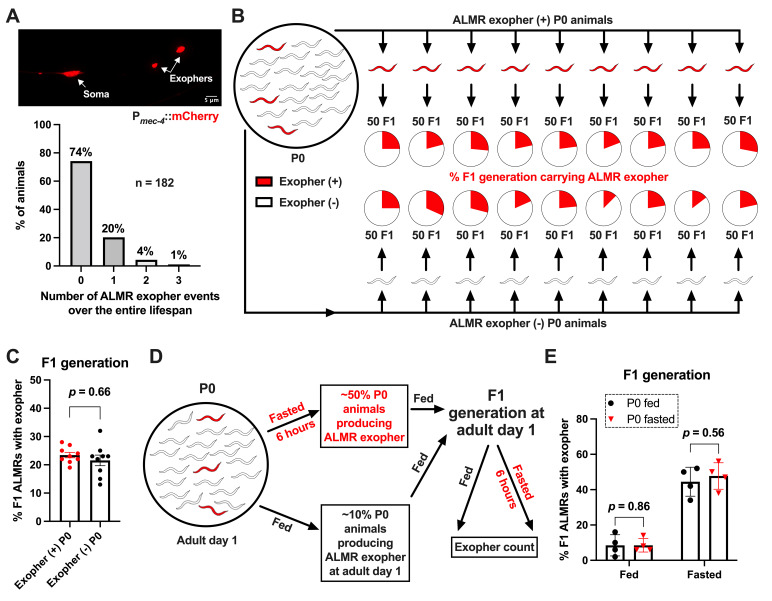 Figure 1
Peer Reviews
No public reviews on file for this paper yet. If you reviewed it on a platform where reviews are public (OpenReview, ICLR, NeurIPS, ICML), you can paste yours below so the community can read it here.
Videos
No videos yet. Explain this paper in a talk, walkthrough, or lecture? Add one.
Taxonomy
TopicsGenetics, Aging, and Longevity in Model Organisms · Extracellular vesicles in disease · Cellular transport and secretion