Understanding memory dynamics in stroke patients: Learning and forgetting patterns based on verbal recall
Selma Lugtmeijer, Edward H. F. de Haan, Roy P. C. Kessels

TL;DR
Stroke patients have trouble remembering words over time compared to healthy people, due to faster forgetting and less effective learning.
Contribution
This study reveals that stroke patients have shallower learning curves and higher forgetting rates on delayed recall tests.
Findings
Stroke patients recalled fewer words after five learning trials compared to controls.
Stroke patients showed higher forgetting rates in 30-minute and 1-week delayed recall tests.
The findings suggest accelerated long-term forgetting in stroke patients.
Abstract
Memory deficits are common post stroke. Most episodic memory tests consist of a learning phase, immediate recall and a 30‐min delayed recall test. Recent research suggests a proportion of stroke patients exhibit accelerated long‐term forgetting after a longer delay. Based on a word‐list learning test in stroke patients and controls, we demonstrate that stroke patients recalled fewer words after five learning trials, and on 30‐min and 1‐week delayed recall tests, caused by shallower learning curves and higher percentages of forgetting.
Genes, proteins, chemicals, diseases, species, mutations and cell lines named across the full text — each resolved to its canonical identifier and authoritative record.
Click any figure to enlarge with its caption.
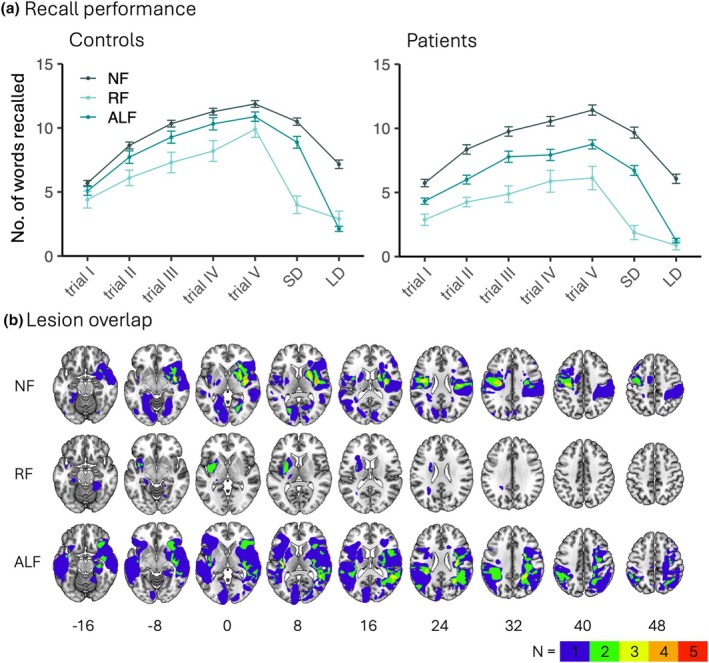 Figure 1
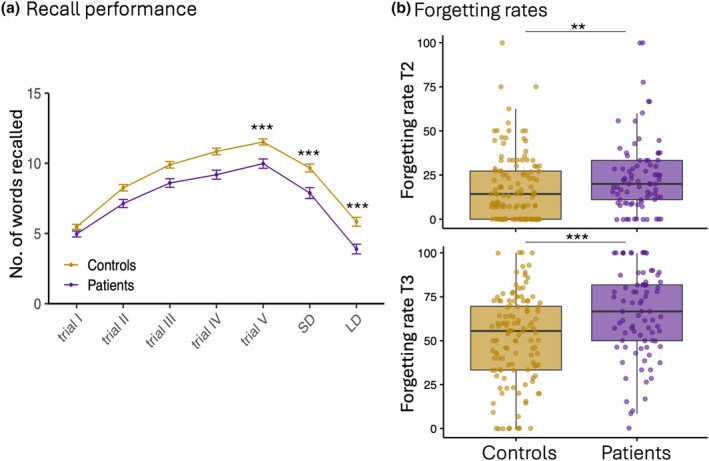 Figure 2
Peer Reviews
No public reviews on file for this paper yet. If you reviewed it on a platform where reviews are public (OpenReview, ICLR, NeurIPS, ICML), you can paste yours below so the community can read it here.
Videos
No videos yet. Explain this paper in a talk, walkthrough, or lecture? Add one.
Taxonomy
TopicsMemory and Neural Mechanisms · Sleep and Wakefulness Research · Memory Processes and Influences