Category fluency and creative potential in semantic aphasia
Hannah E. Thompson, Paul T. Sowden, Lucy Cogdell‐Brooke, Ines R. Violante, Beth Jefferies

TL;DR
This study explores how people with semantic aphasia can be creative by linking unrelated concepts, despite difficulties in controlling their semantic associations.
Contribution
The study is the first to investigate creative potential in semantic aphasia, showing that spreading activation can support creativity despite impaired semantic control.
Findings
SA patients showed creative potential in constrained fluency tasks despite impaired semantic control.
In unconstrained fluency tasks, SA patients struggled with strategic use but matched controls in creative potential when fluency was controlled.
The findings suggest that spreading activation supports creativity in SA, depending on task demands.
Abstract
Creative cognition involves linking weakly or unrelated concepts, enabled by semantic control (inhibiting dominant associations to retrieve weaker ones) or through spreading activation within the semantic system. Semantic aphasia (SA) patients have impaired semantic control despite relatively preserved semantic representations. To date, no studies have examined creativity in SA. It remains unclear how impaired control affects patients' creative potential, and whether spreading activation alone supports this. Creative potential was assessed across three experiments. Experiments 1 and 2 involved 11 SA patients and 25 controls; Experiment 3 included 13 SA patients and 14 controls. In Experiment 1 (category judgement), participants selected five targets from distractors across 24 categories with differing coherence levels (shared features among members). Experiment 2 (constrained category…
Genes, proteins, chemicals, diseases, species, mutations and cell lines named across the full text — each resolved to its canonical identifier and authoritative record.
Click any figure to enlarge with its caption.
 Figure 1
 Figure 2
 Figure 3
 Figure 4
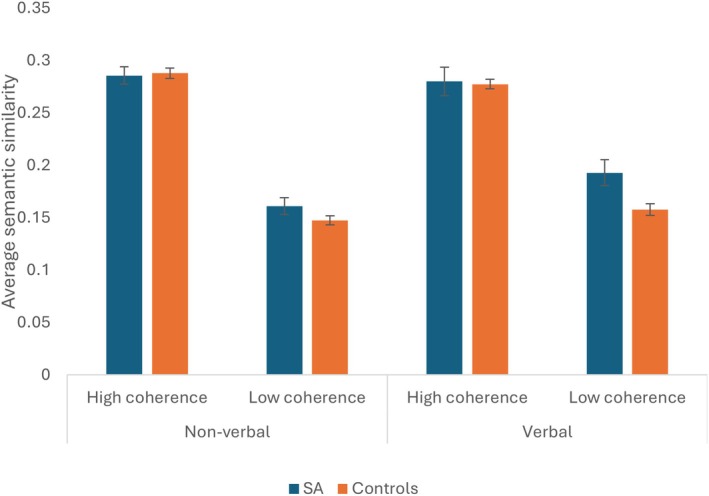 Figure 5
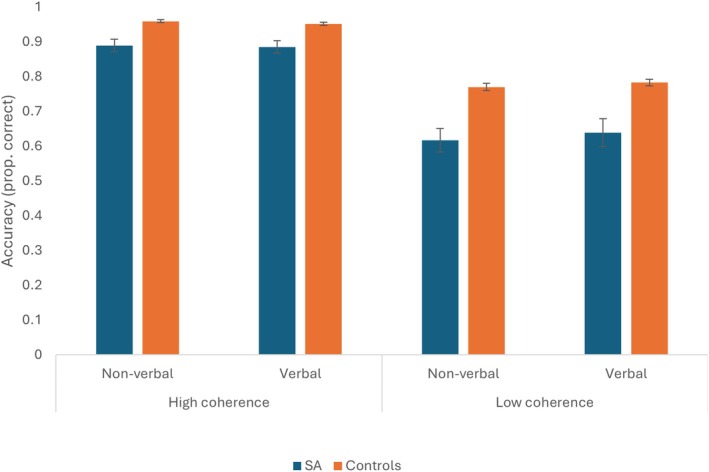 Figure 6
Peer Reviews
No public reviews on file for this paper yet. If you reviewed it on a platform where reviews are public (OpenReview, ICLR, NeurIPS, ICML), you can paste yours below so the community can read it here.
Videos
No videos yet. Explain this paper in a talk, walkthrough, or lecture? Add one.
Taxonomy
TopicsCreativity in Education and Neuroscience · Action Observation and Synchronization · Neurobiology of Language and Bilingualism