Plasma Phosphorylated Tau 217 and Incident Mild Cognitive Impairment and Dementia in Older Women
Aladdin H. Shadyab, Bowei Zhang, Andrea Z. LaCroix, Michelle M. Mielke, Susan M. Resnick, Steve Nguyen, Luigi Ferrucci, Towia A. Libermann, Long Ngo, Ramon Casanova, Alexander P. Reiner, Danni Li, Caroline M. Nievergelt, Adam X. Maihofer, JoAnn E. Manson, Linda K. McEvoy

TL;DR
Higher levels of plasma phosphorylated tau 217 in older women are linked to a greater risk of developing mild cognitive impairment or dementia, with differences based on age, race, and hormone therapy.
Contribution
This study is the first to show how plasma p-tau217's association with cognitive decline varies by race, hormone therapy, and age in older women.
Findings
Higher p-tau217 levels strongly predict dementia, especially in women over 70, APOE ε4 carriers, and White women.
Hormone therapy with estrogen plus progestin increases dementia risk more in women with higher p-tau217.
P-tau217 was not associated with MCI in Black women, highlighting racial differences in biomarker relevance.
Abstract
This cohort study examines associations of baseline plasma phosphorylated tau 217 with incident mild cognitive impairment (MCI) or dementia and whether associations vary by age, race, APOE ε4 carrier status, or hormone therapy use among older men and women. Do associations of plasma phosphorylated tau 217 (p-tau217) with incident mild cognitive impairment (MCI) and dementia vary by race, hormone therapy, age, or APOE ε4 carrier status? In this cohort study among 2766 older women, associations of p-tau217 with incident dementia were larger in magnitude among women assigned to estrogen plus progestin vs placebo but did not vary for estrogen alone vs placebo. P-tau217 associations with MCI or dementia were larger in magnitude for women older than 70 years, APOE ε4 carriers, and White compared with Black women. These findings underscore the value of p-tau217 and show that many factors…
Genes, proteins, chemicals, diseases, species, mutations and cell lines named across the full text — each resolved to its canonical identifier and authoritative record.
Click any figure to enlarge with its caption.
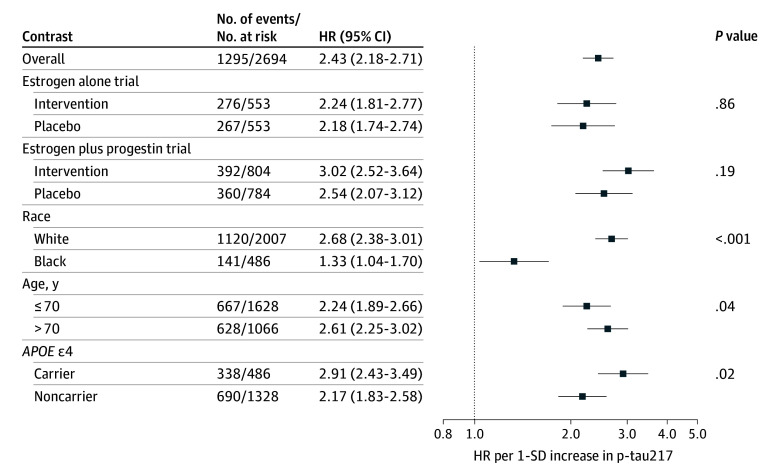 Figure 1
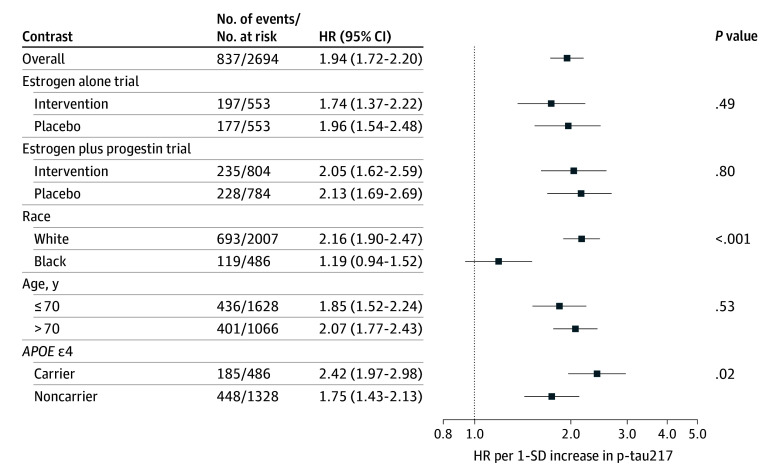 Figure 2
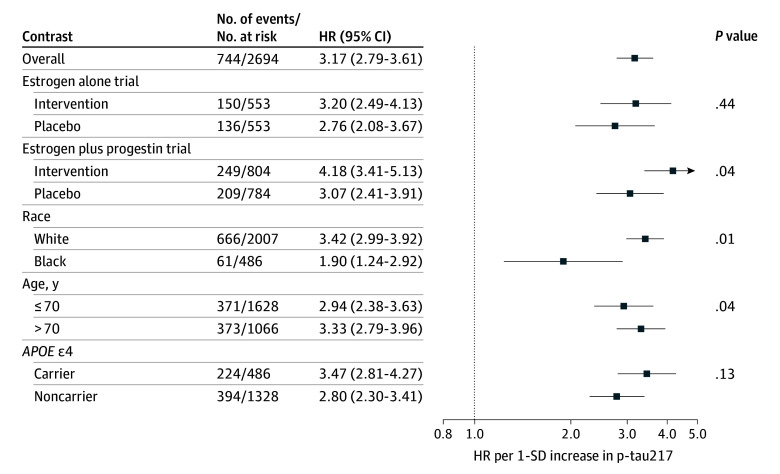 Figure 3
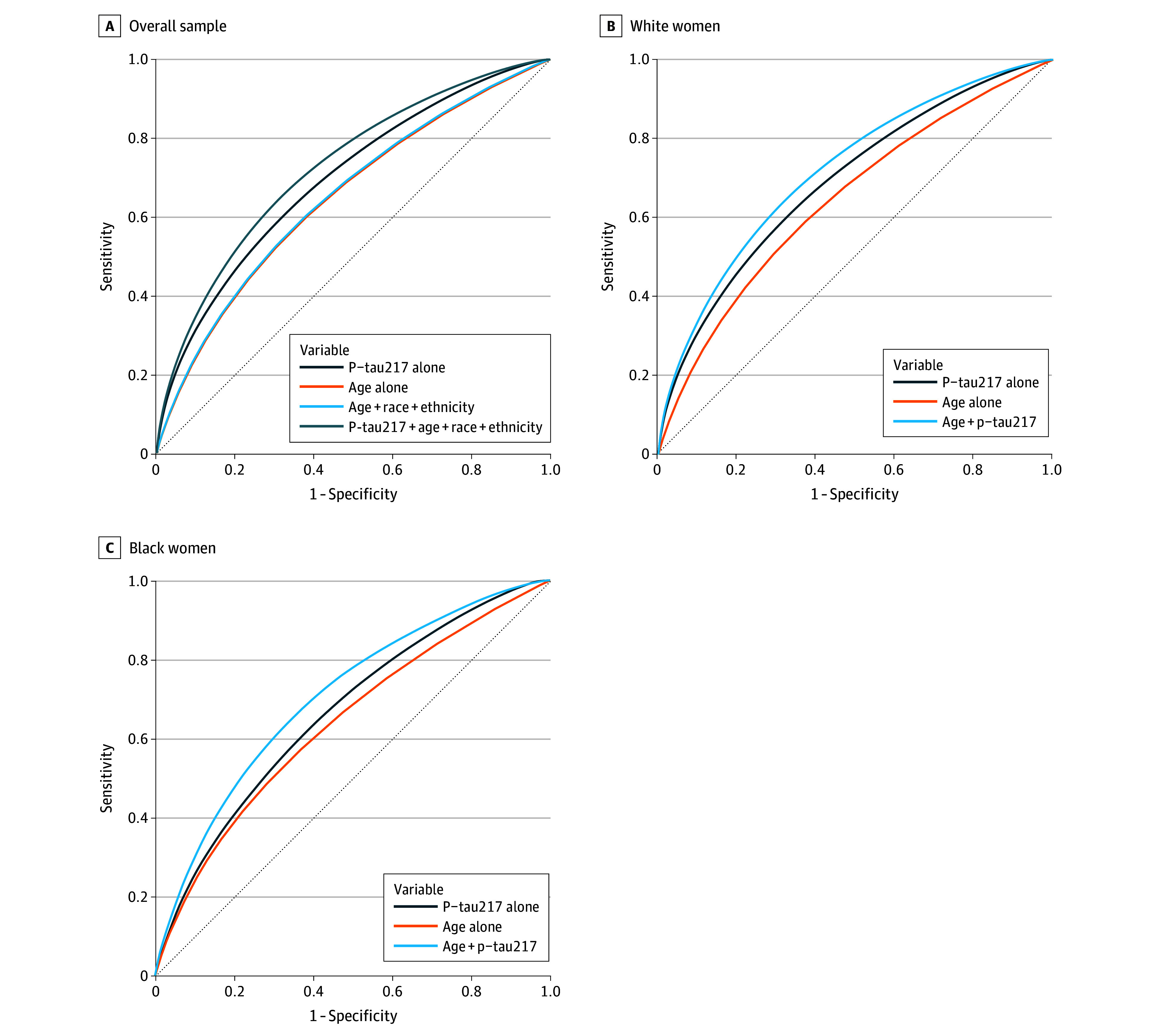 Figure 4
Peer Reviews
No public reviews on file for this paper yet. If you reviewed it on a platform where reviews are public (OpenReview, ICLR, NeurIPS, ICML), you can paste yours below so the community can read it here.
Videos
No videos yet. Explain this paper in a talk, walkthrough, or lecture? Add one.
Taxonomy
TopicsDementia and Cognitive Impairment Research · Alzheimer's disease research and treatments · Cancer-related cognitive impairment studies