Ventriculoperitoneal (VP) Shunt-Associated Calcified Chronic Subdural Hematoma: Armored Brain Management With Shunt Revision
Hajar Hamadi, Oumaima Monadi, Yassine Ait M'Barek, Lamia Benantar, Khalid Aniba

TL;DR
A 14-year-old with a VP shunt developed a rare armored brain condition, which was managed successfully with shunt revision.
Contribution
This case highlights the management of calcified chronic subdural hematoma following VP shunting in a pediatric patient.
Findings
A 14-year-old male with cerebral palsy and a VP shunt presented with calcified chronic subdural hematoma.
Shunt revision led to asymptomatic recovery over two years of follow-up.
Individualized management based on clinical and imaging findings is crucial for such cases.
Abstract
Calcified chronic subdural hematoma (CCSDH) or "armored brain" is a rare, late-stage complication that has been reported more often in children and young adults and may arise after ventriculoperitoneal (VP) shunting. We present a case of a 14-year-old male patient with cerebral palsy and a VP shunt presenting with intermittent headache. A non-contrast CT scan was consistent with bilateral CCSDH. The patient underwent shunt revision and remained asymptomatic during a follow-up period of two years. Through this case, we illustrate the importance of individualized management guided by clinical and imaging findings.
Genes, proteins, chemicals, diseases, species, mutations and cell lines named across the full text — each resolved to its canonical identifier and authoritative record.
Click any figure to enlarge with its caption.
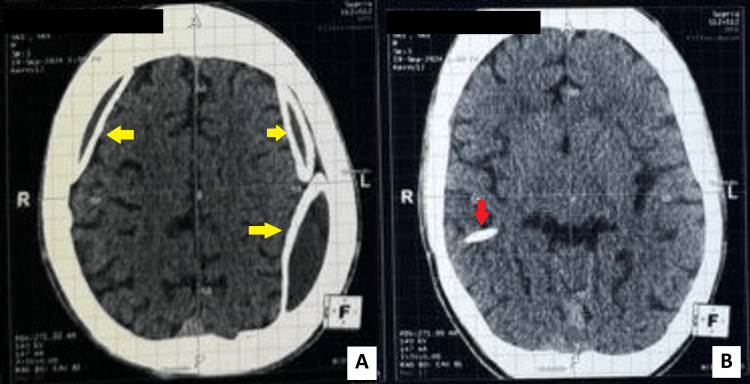 Figure 1
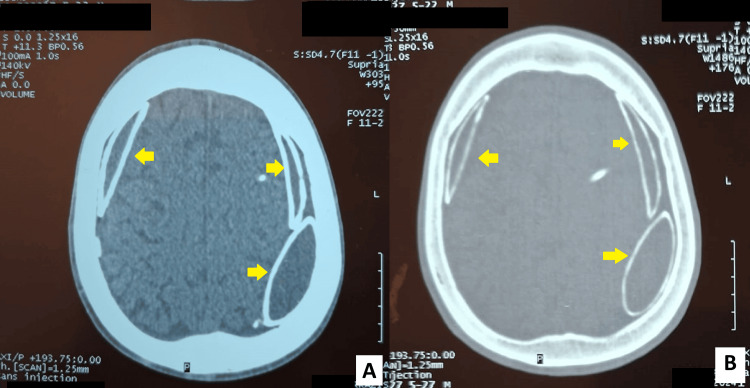 Figure 2
Peer Reviews
No public reviews on file for this paper yet. If you reviewed it on a platform where reviews are public (OpenReview, ICLR, NeurIPS, ICML), you can paste yours below so the community can read it here.
Videos
No videos yet. Explain this paper in a talk, walkthrough, or lecture? Add one.
Taxonomy
TopicsCerebrospinal fluid and hydrocephalus · Neurosurgical Procedures and Complications · Spinal Dysraphism and Malformations