Post-translational modifications of silk proteins
Kota Nomura, Keiji Numata

TL;DR
This paper reviews how chemical changes after silk protein production affect their structure and function, offering insights for designing new materials.
Contribution
The paper systematically reviews key PTMs in silk proteins and their roles in material properties.
Findings
Hydroxylation, glycosylation, phosphorylation, and crosslinking are key PTMs in silk proteins.
PTMs influence structural stability and mechanical properties of silk proteins.
New techniques like proteomics and synthetic biology are uncovering and enabling control over PTMs.
Abstract
Post-translational modifications (PTMs) endow silk proteins with chemical diversity that governs their higher-order assembly, hydration, and covalent connectivity. This review highlights the principal PTMs that define silk protein function, including hydroxylation, glycosylation, phosphorylation, and covalent crosslinking. We also describe their contributions to protein structural stability and mechanical properties. Recent advances in proteomics have begun to reveal low-abundance PTMs, whereas synthetic biology and bioorthogonal chemistry enable the programmed installation of modifications to tune physicochemical properties. Understanding and harnessing these chemistries provides a foundation for the predictive design of next-generation protein-based materials at the interface of chemical biology and materials science. Post-translational modifications (PTMs) endow silk proteins with…
Click any figure to enlarge with its caption.
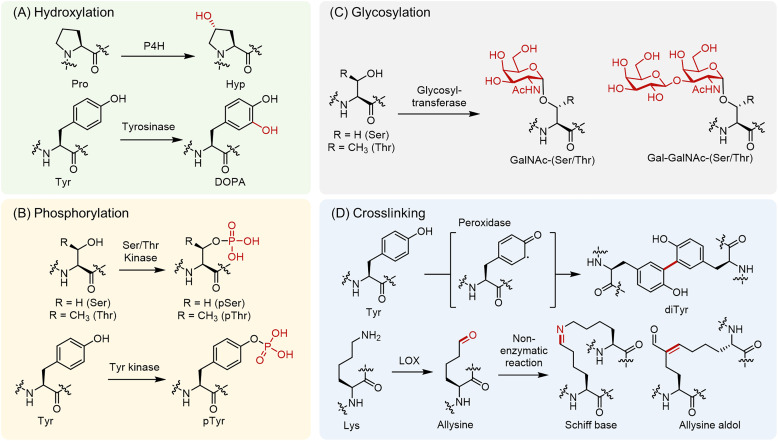 Figure 1
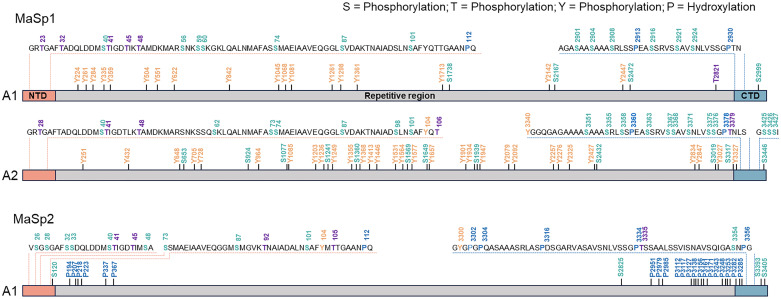 Figure 2
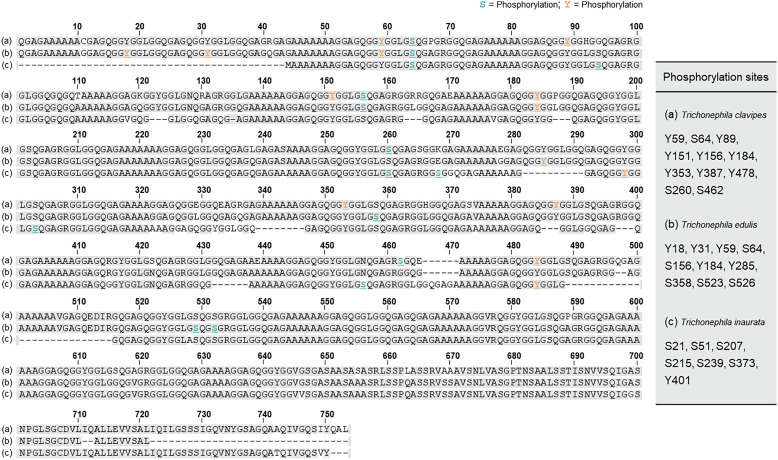 Figure 3
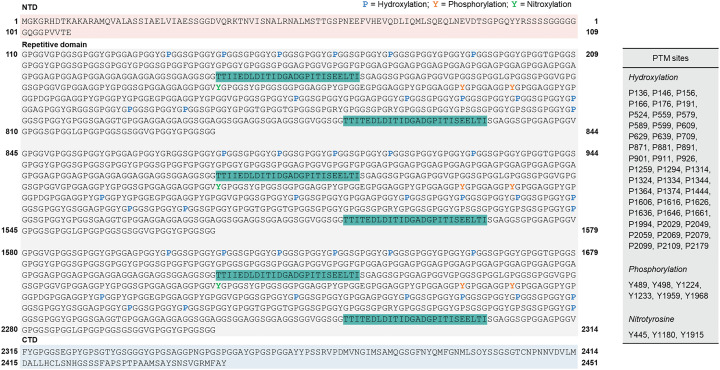 Figure 4
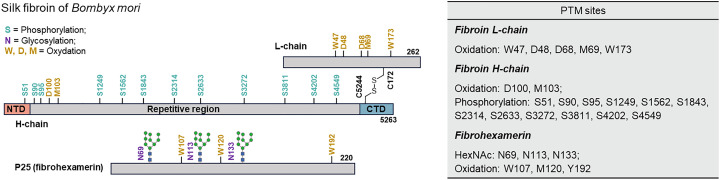 Figure 5
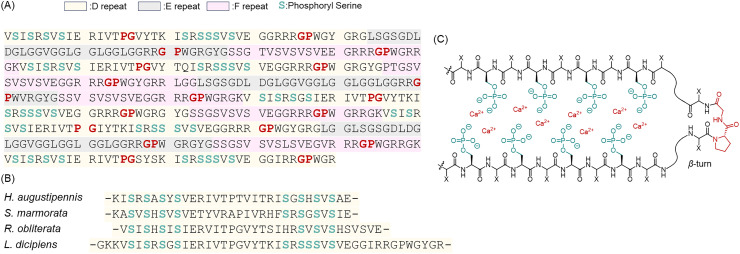 Figure 6
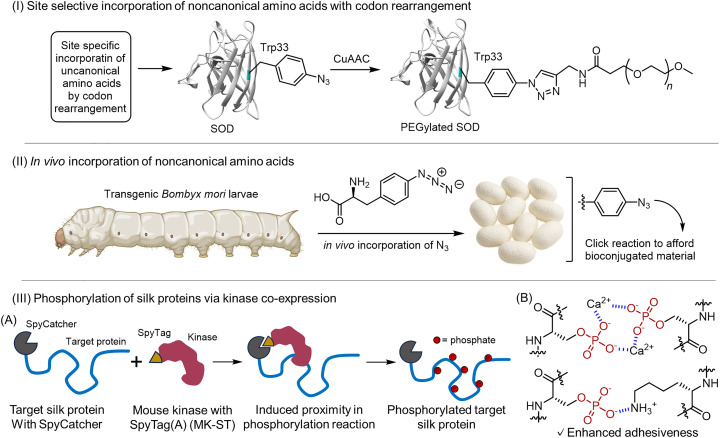 Figure 7
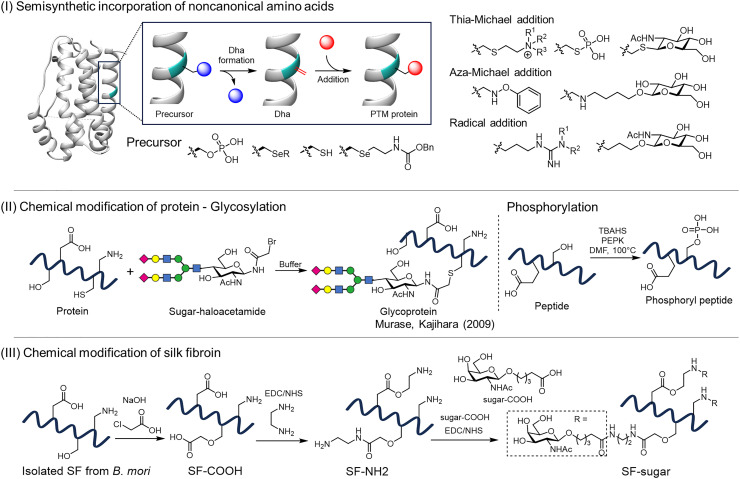 Figure 8
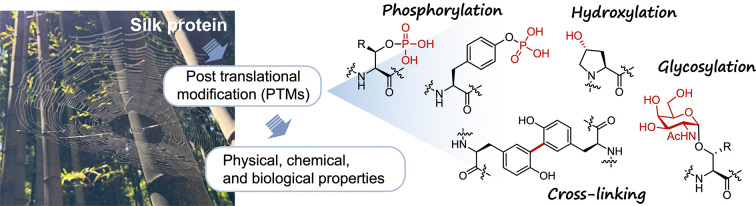 Figure 9
Peer Reviews
No public reviews on file for this paper yet. If you reviewed it on a platform where reviews are public (OpenReview, ICLR, NeurIPS, ICML), you can paste yours below so the community can read it here.
Videos
No videos yet. Explain this paper in a talk, walkthrough, or lecture? Add one.
Taxonomy
TopicsSilk-based biomaterials and applications · RNA Interference and Gene Delivery · Biochemical and Structural Characterization