Diagnostic sensitivity and specificity of metagenomic sequencing and qPCR for detection of viruses associated with bovine respiratory disease estimated using Bayesian latent class models
Emmanuel Donbraye, Lianne McLeod, Zhijian Chai, Stacey R. Lacoste, E. Luke McCarthy, Janet E. Hill, Nathan E. N. Erickson, Matthew G. Links, Simon J. G. Otto, Yanyun Huang, Cheryl L. Waldner

TL;DR
This study compares the accuracy of two methods for detecting viruses in cattle before they show symptoms of respiratory disease.
Contribution
The study introduces Bayesian latent class modeling to evaluate diagnostic tests without a gold standard in bovine respiratory disease detection.
Findings
qPCR had higher sensitivity than sequencing for BCoV and BoHV-1, but sequencing was better for BRSV.
Diagnostic specificity for BCoV was higher with sequencing than with qPCR.
Both methods showed moderate to low sensitivity for most BRD viruses.
Abstract
Very few studies have examined the diagnostic sensitivity and specificity of currently available laboratory tests for detecting respiratory pathogens in cattle, and even fewer have examined test performance on samples from animals before the onset of clinical disease. In this study, Bayesian latent class modeling (BLCM) was used to assess diagnostic test performance in the absence of a gold standard on nasal swabs collected from 19 western Canadian feedlots. Viruses associated with bovine respiratory disease (BRD) were identified using qPCR from a commercial diagnostic laboratory from 760 nasal swabs collected from fall-placed calves (FPC) and yearlings (YRL) at and shortly after feedlot arrival. Using BLCM, the qPCR results were compared to previously reported matching nanopore metagenomic sequencing data for these same samples. Based on BLCM, test sensitivities and specificities were…
Genes, proteins, chemicals, diseases, species, mutations and cell lines named across the full text — each resolved to its canonical identifier and authoritative record.
Click any figure to enlarge with its caption.
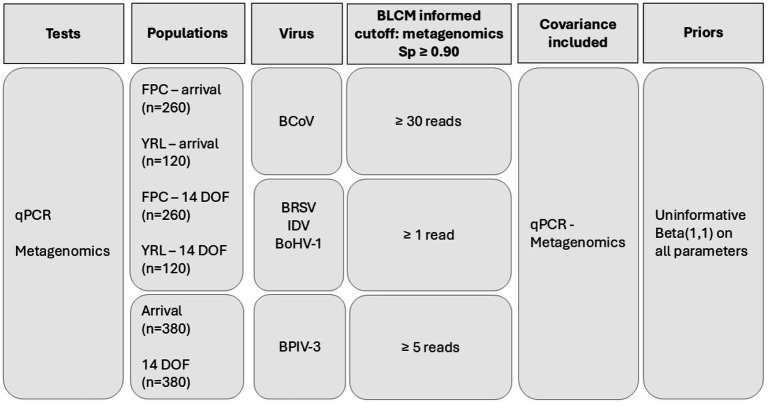 Figure 1
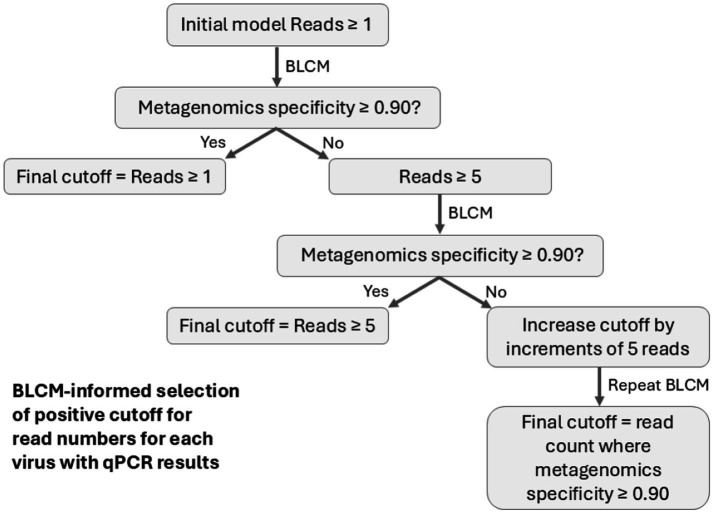 Figure 2
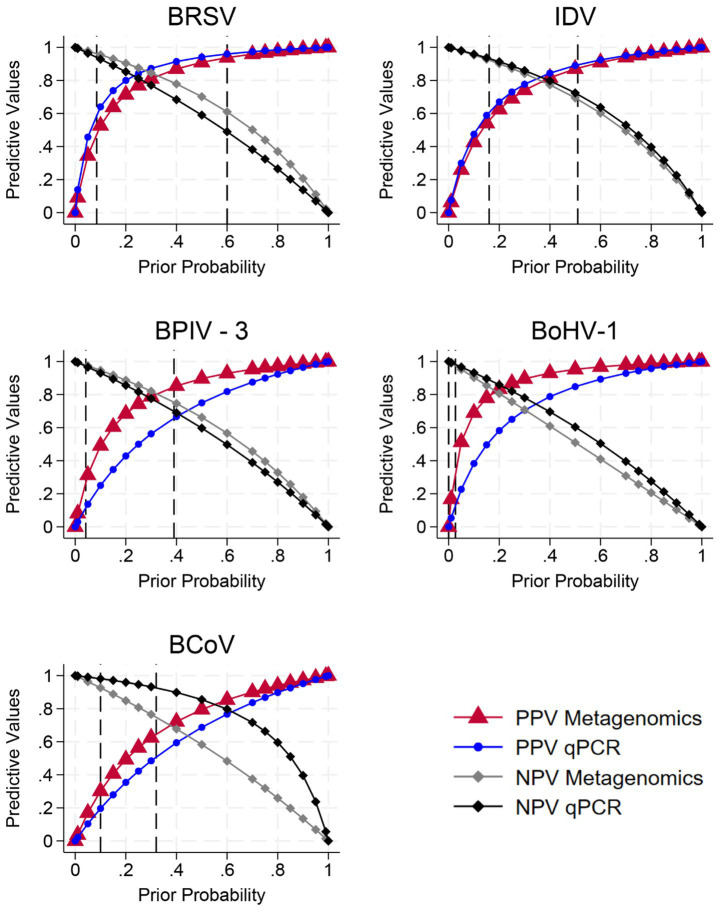 Figure 3
Peer Reviews
No public reviews on file for this paper yet. If you reviewed it on a platform where reviews are public (OpenReview, ICLR, NeurIPS, ICML), you can paste yours below so the community can read it here.
Videos
No videos yet. Explain this paper in a talk, walkthrough, or lecture? Add one.
Taxonomy
TopicsMicrobial infections and disease research · Respiratory viral infections research · Animal Virus Infections Studies