Timing and tempo of pubertal development and substance use in adolescence: a cohort study in the Danish National Birth Cohort
Pernille Jul Clemmensen, Nis Brix, Anne Gaml-Sørensen, Anne Marie Ladehoff Thomsen, Thea Emily Benson, Andreas Ernst, Katrine Strandberg-Larsen, Cecilia Høst Ramlau-Hansen

TL;DR
This study finds that adolescents who develop earlier in puberty are more likely to use substances like cigarettes, alcohol, and drugs, especially girls who develop quickly.
Contribution
The study introduces novel associations between pubertal tempo and substance use, particularly highlighting gender-specific patterns.
Findings
Earlier pubertal development is linked to higher substance use in adolescence, especially in girls.
Faster pubertal progression is associated with increased risks of smoking, drinking, and drug use, mainly among girls.
Associations were observed across various pubertal milestones, reinforcing the link between early development and risk-taking behaviors.
Abstract
Are the age at reaching different pubertal milestones, and the tempo of pubertal progression, associated with cigarette smoking, alcohol intake, or recreational drug use in adolescence? Earlier age at pubertal development was associated with a higher risk of smoking cigarettes, drinking alcohol (only boys), and using recreational drugs in adolescence, and a faster tempo tended to be associated with higher risks, mainly in girls, while any associations in boys appeared less clear. Girls and boys with an earlier age at pubertal development are suggested to have a higher risk of engaging in risk-taking behaviours, which include use of substances, primarily studied for smoking and alcohol. The potential impact of pubertal tempo has been studied less. In this cohort study, 8063 girls and boys born from 2000 to 2003 by mothers in the Danish National Birth Cohort participated. Information…
Genes, proteins, chemicals, diseases, species, mutations and cell lines named across the full text — each resolved to its canonical identifier and authoritative record.
Click any figure to enlarge with its caption.
 Figure 1
 Figure 2
 Figure 3
 Figure 4
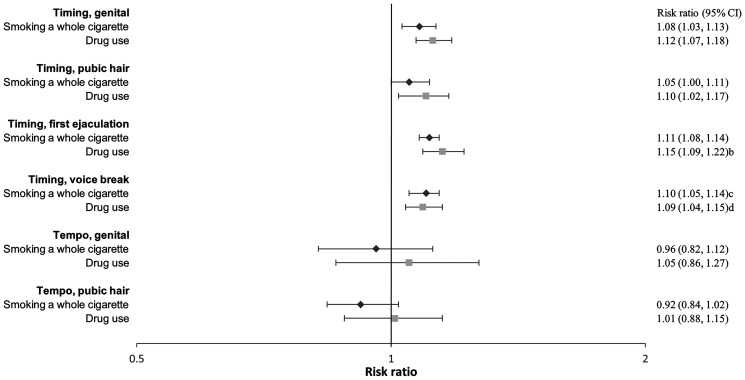 Figure 5
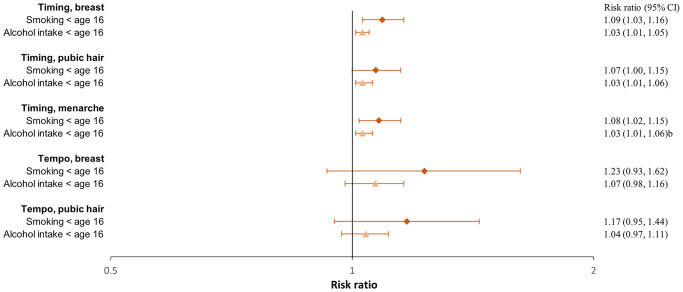 Figure 6
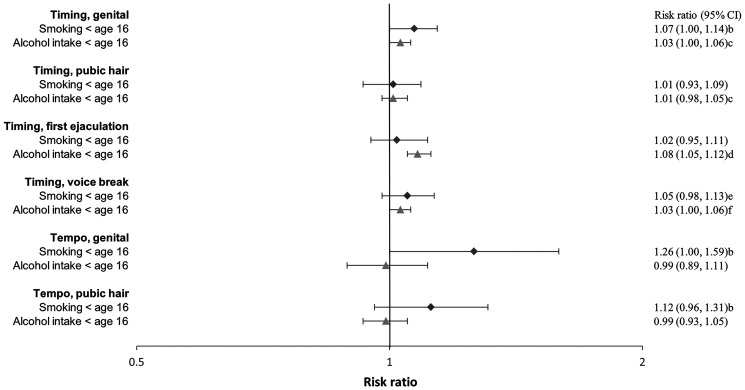 Figure 7
Peer Reviews
No public reviews on file for this paper yet. If you reviewed it on a platform where reviews are public (OpenReview, ICLR, NeurIPS, ICML), you can paste yours below so the community can read it here.
Videos
No videos yet. Explain this paper in a talk, walkthrough, or lecture? Add one.
Taxonomy
TopicsHypothalamic control of reproductive hormones · Prenatal Substance Exposure Effects · Child Abuse and Trauma