Not Every Country Can Absorb a Shock: Unequal Capacity to Withstand World Health Organization Aid Cuts
Animesh Ghimire

TL;DR
This paper shows how sudden cuts in health aid disrupt essential services in vulnerable countries and proposes a framework to make donor exits more predictable and fair.
Contribution
The paper introduces the concept of 'transition discipline' as a new global norm for managing donor exits from essential health services.
Findings
Abrupt aid cuts in Nepal and Afghanistan disrupted family planning, nutrition, and immunization services.
Transition discipline could make donor exits more predictable and reduce harm to vulnerable populations.
Current governance lacks rules for how external actors should exit essential services in fragile settings.
Abstract
External health aid is contracting sharply, and this moment is often framed as a stress test of health system resilience. This perspective argues that it is equally a stress test of global health ethics and governance: When external actors withdraw from essential services, they are not merely responding to fiscal constraints—they are shaping who loses care. In 2025, the World Health Organization (WHO) projected a 30%–40% decline in external health aid to low‐ and middle‐income countries (LMICs) and urged governments to protect essential services, integrate programs into primary healthcare, and improve efficiency. Yet recent developments show that even well‐intentioned national reforms cannot fully absorb abrupt donor exits when core functions have long depended on external finance and coordination. Drawing on up‐to‐date evidence from Nepal and Afghanistan, this article shows how abrupt…
Genes, proteins, chemicals, diseases, species, mutations and cell lines named across the full text — each resolved to its canonical identifier and authoritative record.
Click any figure to enlarge with its caption.
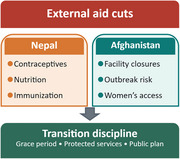 Figure 1
Peer Reviews
No public reviews on file for this paper yet. If you reviewed it on a platform where reviews are public (OpenReview, ICLR, NeurIPS, ICML), you can paste yours below so the community can read it here.
Videos
No videos yet. Explain this paper in a talk, walkthrough, or lecture? Add one.
Taxonomy
TopicsGlobal Maternal and Child Health · Healthcare Systems and Reforms · Global Health and Surgery