Ionic species programmable synaptic plasticity in multimodal nanofluidic devices
Miliang Zhang, Ronghua Lan, Zhixiao Si, Jiqing Dai, Wenchao Liu, Wenbo Chang, Junjun Liu, Guoheng Xu, Kai Xiao

TL;DR
Researchers developed a nanofluidic device that can be programmed to mimic synaptic plasticity by changing ionic species and concentration, enabling tunable circuits for neuromorphic computing.
Contribution
A concentration-dependent transition between capacitive and inductive hysteresis is demonstrated, enabling programmable synaptic plasticity without structural changes.
Findings
A concentration-dependent transition between capacitive and inductive hysteresis was observed in gold-nanoparticle-stacked nanochannels.
Programmable synaptic plasticity (facilitation and depression) is achieved by altering ionic species without structural reconfiguration.
A tunable high-pass filter circuit was implemented using two identical nanofluidic devices.
Abstract
Nanofluidic devices have been widely utilized to simulate electronic functionalities recently, due to their unique ion transport behaviors, such as non-linear ion transport, selectivity etc. However, the correlation between the ion transport behavior and the transitions among various nanofluidic capacitive and inductive hysteresis still remains poorly understood, which impedes the development of nanofluidic systems. Here, we report a concentration-dependent transition between capacitive and inductive hysteresis in gold-nanoparticle-stacked nanochannels. Quantitative analysis reveals that this transition is governed by the interionic distance relative to the Bjerrum length, establishing a universal mechanism for ion transport modulation. Notably, our system enables unidirectional plasticity (both facilitation and depression) by simply altering the ionic species, demonstrating…
Genes, proteins, chemicals, diseases, species, mutations and cell lines named across the full text — each resolved to its canonical identifier and authoritative record.
Click any figure to enlarge with its caption.
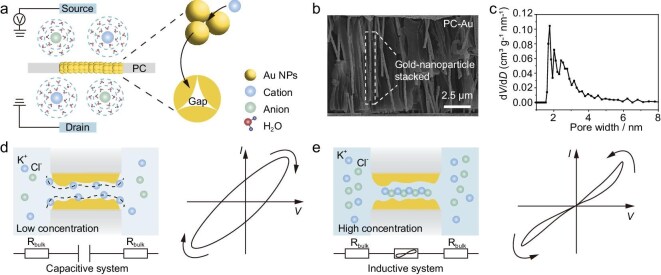 Figure 1
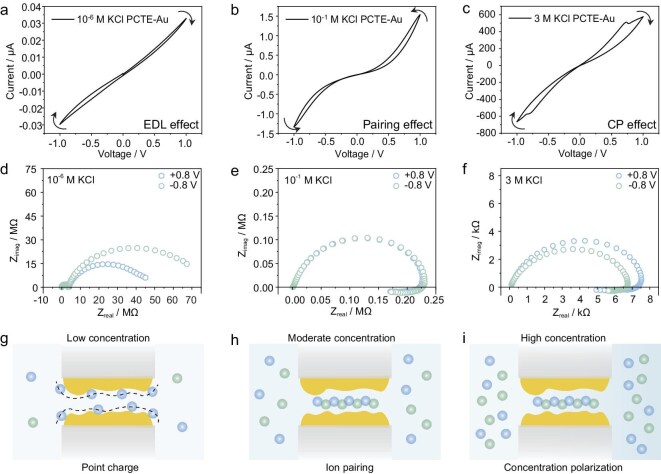 Figure 2
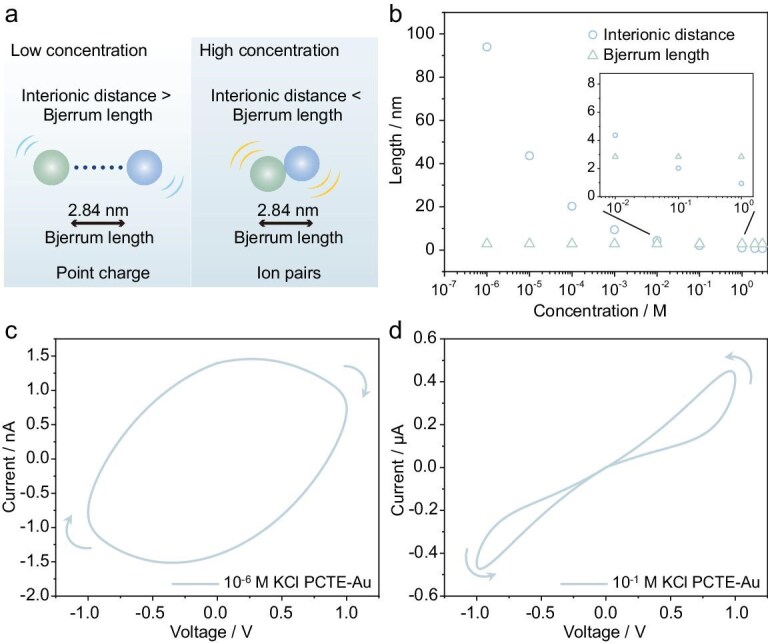 Figure 3
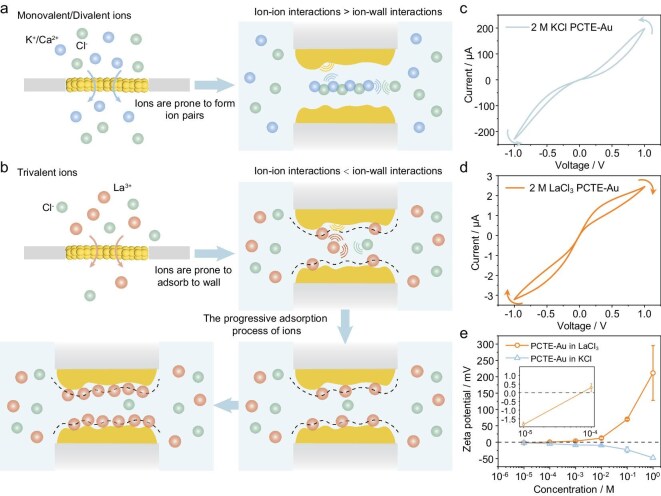 Figure 4
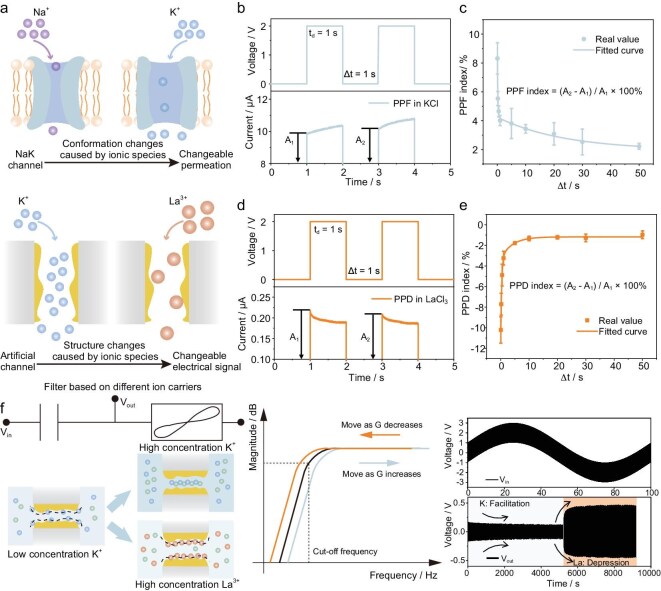 Figure 5
Peer Reviews
No public reviews on file for this paper yet. If you reviewed it on a platform where reviews are public (OpenReview, ICLR, NeurIPS, ICML), you can paste yours below so the community can read it here.
Videos
No videos yet. Explain this paper in a talk, walkthrough, or lecture? Add one.
Taxonomy
TopicsAdvanced Memory and Neural Computing · Nanopore and Nanochannel Transport Studies · Electrocatalysts for Energy Conversion