Current Treatment Patterns and Outcomes of Sex Cord Stromal Tumor Patients in Japan
Takashige Abe, Kosuke Miyai, Toyonori Tsuzuki, Sachiyo Murai, Katsuyoshi Hashine, Shinichi Yamashita, Takashi Kawahara, Naotaka Nishiyama, Hiroshi Kitamura, Hiroshi Kikuchi, Kazutaka Saito, Hatsuki Hibi, Haruka Miyata, Ryuji Matsumoto, Takahiro Osawa, Hiroyuki Nishiyama

TL;DR
This study examines treatment and survival outcomes for patients with sex cord stromal tumors in Japan, highlighting the impact of risk factors and treatment approaches.
Contribution
The study provides new insights into treatment patterns and survival outcomes for sex cord stromal tumors in Japan, emphasizing the role of surgical management in recurrent cases.
Findings
Stage I patients with more than two pathological risk factors had significantly worse recurrence-free survival.
Surgical intervention was the primary treatment for recurrence, with some patients achieving prolonged disease control through repeated surgery.
Patients with metastatic disease at diagnosis had poor survival rates, with only 20.8% five-year overall survival.
Abstract
Sex cord‐stromal tumors (SCSTs) constitute approximately 5% of testicular malignancies. This investigation aimed to elucidate contemporary therapeutic approaches and clinical outcomes for patients with testicular SCSTs in Japan. Participating institutions included Japan Clinical Oncology Group facilities, affiliated centers, and institutions with published cases. Clinical data and histopathological findings were compiled. Central pathological review involved representative tissue sections when available. Kaplan–Meier methodology assessed recurrence‐free survival (RFS) and overall survival (OS). Stage I patients were stratified by cumulative pathological risk factors (tumor diameter ≥ 5 cm, necrosis, moderate to severe nuclear atypia, lymphovascular invasion, infiltrative growth, and ≥ 3 mitoses per 10 high‐power fields). Among 116 patients from 66 institutions, 112 met inclusion…
Genes, proteins, chemicals, diseases, species, mutations and cell lines named across the full text — each resolved to its canonical identifier and authoritative record.
Click any figure to enlarge with its caption.
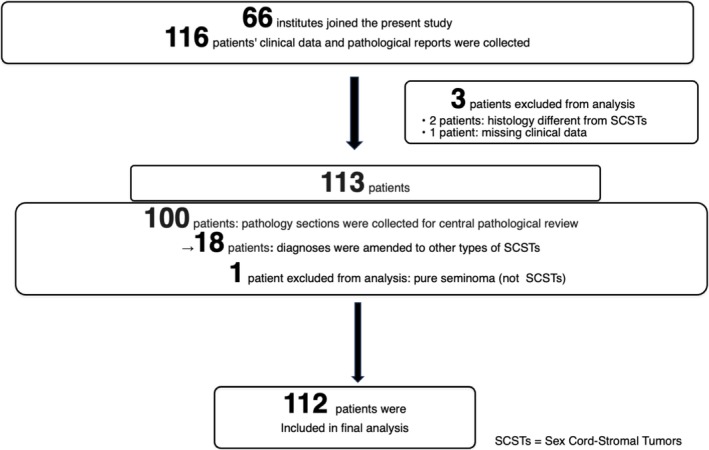 Figure 1
 Figure 2
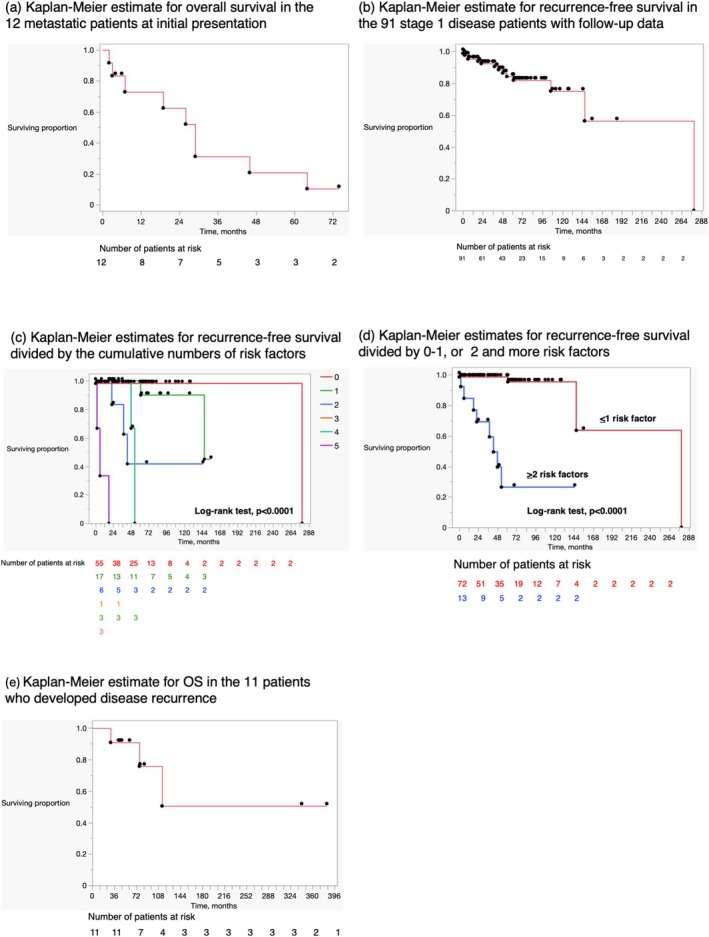 Figure 3
Peer Reviews
No public reviews on file for this paper yet. If you reviewed it on a platform where reviews are public (OpenReview, ICLR, NeurIPS, ICML), you can paste yours below so the community can read it here.
Videos
No videos yet. Explain this paper in a talk, walkthrough, or lecture? Add one.
Taxonomy
TopicsMultiple and Secondary Primary Cancers · Testicular diseases and treatments · Ovarian cancer diagnosis and treatment