Variation in Interactive Gestures by Visual Occlusion and Topic Complexity: Evidence for a Subconscious Theory of Gesture
T. R. Williamson, Kristofer Kinsey, Anna E. Piasecki

TL;DR
The study explores how gestures change with visual occlusion and conversation complexity, suggesting subconscious motivations for gesturing.
Contribution
The paper introduces a new perspective on gesture function by analyzing interactive gestures in naturalistic conversations.
Findings
Occluding gesture visibility significantly decreases interactive gestures during simple conversations.
Interactive gestures account for nearly 90% of uncodeable gestures and a quarter of all gestures.
Complex topic conversations maintain stable interactive gesture frequency even when gestures are occluded.
Abstract
Gestures are often categorized into types: iconics, metaphorics, and pantomimes (having representational relationships with spoken semantics), deictics (i.e., pointing), emblems (having their own conventional meaning), and beats (temporally coinciding with spoken content for emphasis). These originate from research often involving unnaturalistic paradigms where participants’ gestures during responses (e.g., retelling a narrative) are recorded. Approaching these types implicitly requires a stance on why we gesture; a conscious aim to communicate or an unconscious effort to orchestrate speech. Focus on them has led to the understudying of the interactive role gestures can play, where intersubjective acknowledgment and information transfer are central. This paper has two main aims: to profile the interactive role of gesturing as a proportion of all gesturing and to investigate its…
Genes, proteins, chemicals, diseases, species, mutations and cell lines named across the full text — each resolved to its canonical identifier and authoritative record.
Click any figure to enlarge with its caption.
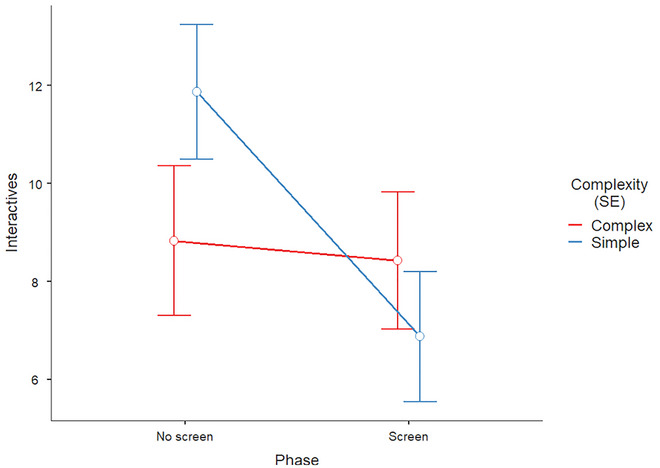 Figure 1
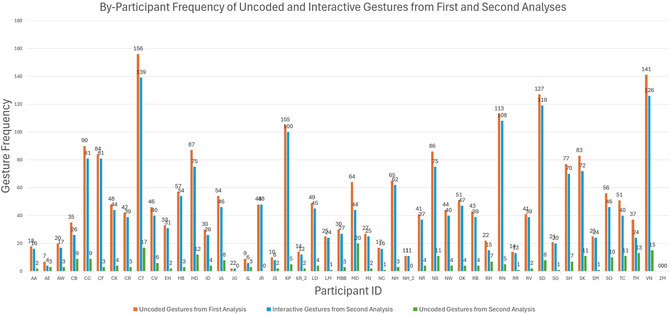 Figure 2
 Figure 3
Peer Reviews
No public reviews on file for this paper yet. If you reviewed it on a platform where reviews are public (OpenReview, ICLR, NeurIPS, ICML), you can paste yours below so the community can read it here.
Videos
No videos yet. Explain this paper in a talk, walkthrough, or lecture? Add one.
Taxonomy
TopicsHearing Impairment and Communication · Action Observation and Synchronization · Hand Gesture Recognition Systems