Comparison of the Efficacy of Two Doses of Intranasal Atomized Dexmedetomidine as Premedication for Parental Separation Anxiety in Children Undergoing Elective Surgery
Devesh Kumar, Jeetendra K Bajaj, Sapna Bathla, Krishika Verma

TL;DR
A study compared two doses of a nasal sedative in children before surgery and found the higher dose more effective at reducing anxiety and improving outcomes.
Contribution
The study provides new evidence that a higher dose of intranasal dexmedetomidine is more effective for preoperative anxiety in children.
Findings
The 2 µg/kg dose showed significantly better sedation and lower separation anxiety scores.
Higher dose improved mask acceptance and reduced postoperative pain and agitation.
Both doses maintained stable hemodynamics without adverse events.
Abstract
Background Preoperative anxiety in children is a common challenge associated with adverse perioperative outcomes, including poor parental separation, difficult mask acceptance, and emergence delirium. Dexmedetomidine, an alpha-2 adrenergic agonist, is increasingly explored as a noninvasive intranasal premedication. Objective This study compared the efficacy of two intranasal doses of dexmedetomidine (1 µg/kg vs. 2 µg/kg) in reducing separation anxiety and improving perioperative conditions in children undergoing elective surgery. Methods A prospective randomized controlled trial was conducted on 50 children aged between one and six years, American Society of Anesthesiologists (ASA) I-II, scheduled for elective surgery under general anesthesia. Participants were randomly assigned to receive either 1 µg/kg (Group I) or 2 µg/kg (Group II) of atomized intranasal dexmedetomidine 30…
Genes, proteins, chemicals, diseases, species, mutations and cell lines named across the full text — each resolved to its canonical identifier and authoritative record.
Click any figure to enlarge with its caption.
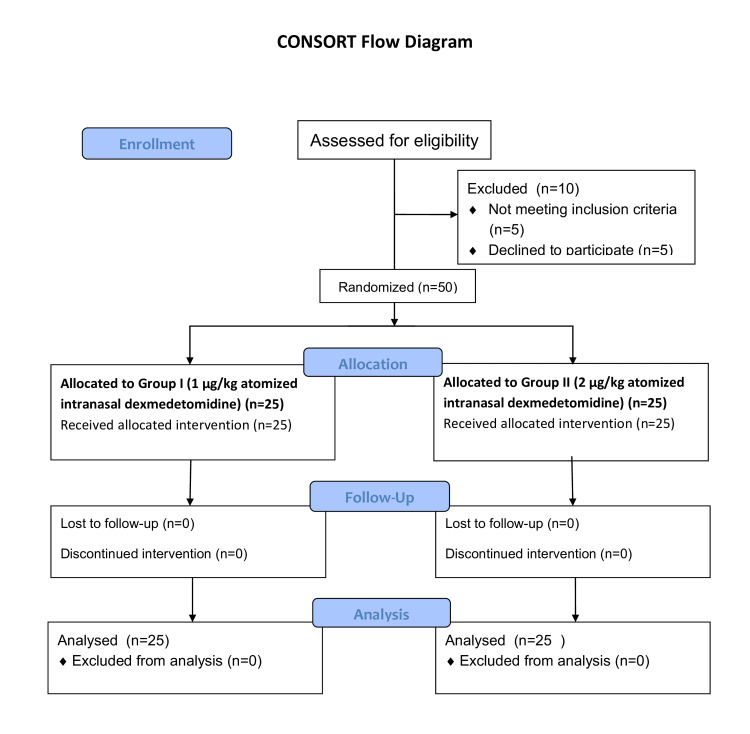 Figure 1
Peer Reviews
No public reviews on file for this paper yet. If you reviewed it on a platform where reviews are public (OpenReview, ICLR, NeurIPS, ICML), you can paste yours below so the community can read it here.
Videos
No videos yet. Explain this paper in a talk, walkthrough, or lecture? Add one.
Taxonomy
TopicsAnesthesia and Sedative Agents · Intensive Care Unit Cognitive Disorders · Pediatric Pain Management Techniques