Towards fully automated synthetic ECV quantification: an open-access machine learning-based approach for fast blood draw-free CMR
Rebecca Elisabeth Beyer, Markus Hüllebrand, Patrick Doeblin, Ann Laube, Maximilian Leo Müller, Christian Stehning, Stefanie Maria Werhahn, Wensu Chen, Anja Hennemuth, Sebastian Kelle

TL;DR
This paper introduces a fast, automated machine learning method to measure heart tissue fibrosis without needing blood samples, showing strong agreement with traditional methods.
Contribution
A fully automated, blood-free machine learning approach for synthetic ECV quantification in CMR is developed and validated.
Findings
Fully-automated synthetic ECV correlated strongly with conventional ECV (r = 0.79, p < 0.001).
Bland–Altman analysis showed minimal mean difference of 0.4% with moderate limits of agreement.
The method supports efficient and consistent assessment of myocardial fibrosis in research settings.
Abstract
Extracellular volume (ECV) quantification involves time-consuming multi-step post-processing and a blood draw for hematocrit analysis. This study aimed to develop a fully automated blood draw-free, machine learning-based approach for synthetic ECV assessment for non-invasive assessment of diffuse myocardial fibrosis. We retrospectively evaluated a large clinical cohort of 1092 patients who underwent CMR and ECV measurement at 1.5T or 3T. Participants were divided into training (n = 767) and validation (n = 325) cohorts. Manual contouring of T1 maps was used to iteratively develop a neural network segmentation model, which was then applied for automated analysis. Fully-automated synthetic ECV was calculated using validated sex- and field strength-specific models. Agreement was assessed using Student’s t-test, Pearson correlation, Bland–Altman analysis, and classification analysis.…
Genes, proteins, chemicals, diseases, species, mutations and cell lines named across the full text — each resolved to its canonical identifier and authoritative record.
Click any figure to enlarge with its caption.
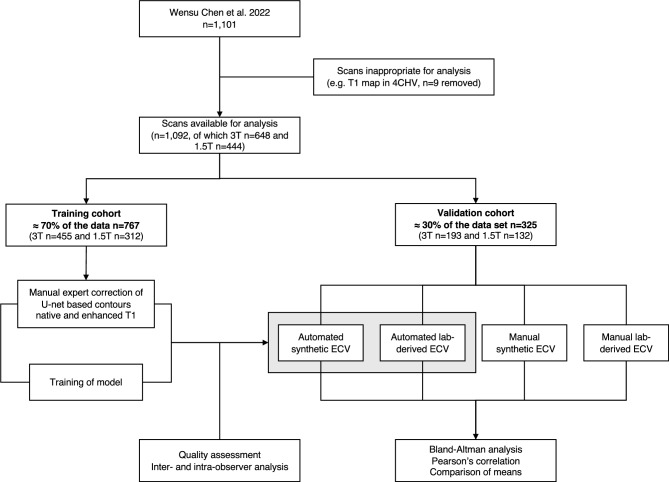 Figure 1
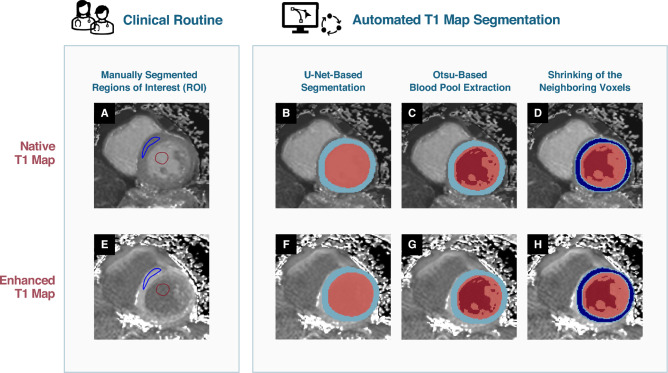 Figure 2
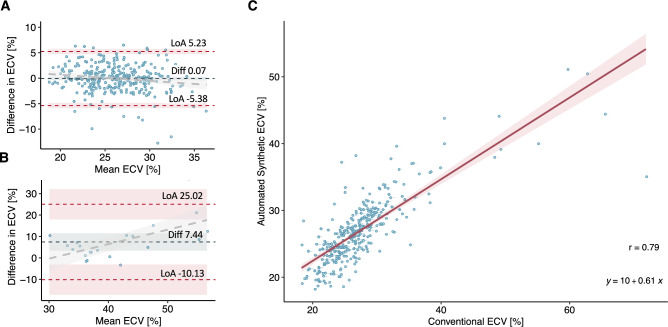 Figure 3
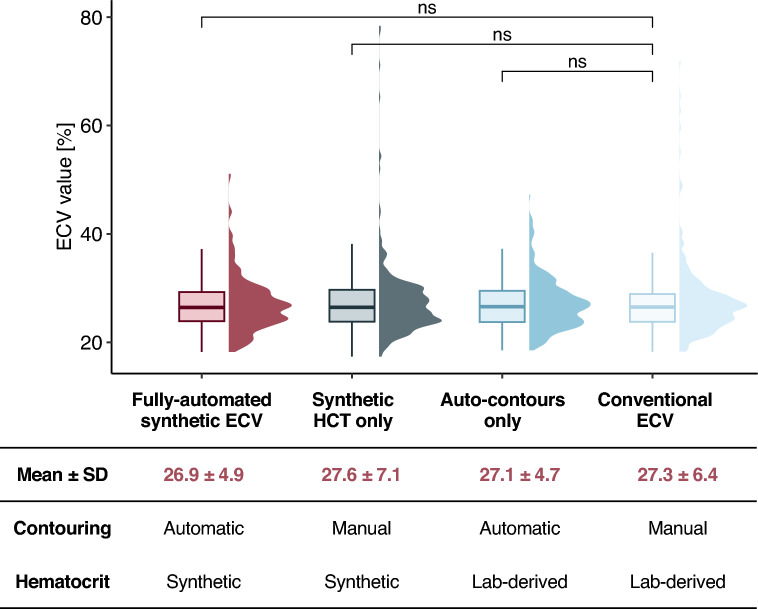 Figure 4
 Figure 5
Peer Reviews
No public reviews on file for this paper yet. If you reviewed it on a platform where reviews are public (OpenReview, ICLR, NeurIPS, ICML), you can paste yours below so the community can read it here.
Videos
No videos yet. Explain this paper in a talk, walkthrough, or lecture? Add one.
Taxonomy
TopicsInflammatory Biomarkers in Disease Prognosis · Blood properties and coagulation · Venous Thromboembolism Diagnosis and Management