Generative models of cell dynamics: from Neural ODEs to flow matching
Till Richter, Weixu Wang, Alessandro Palma, Fabian J. Theis

TL;DR
This paper explores how Neural ODEs can model dynamic processes in single-cell data, offering insights into cellular development and health.
Contribution
The paper reviews and analyzes the suitability of Neural ODEs for modeling single-cell dynamics using Flow Matching and Optimal Transport.
Findings
Neural ODEs can model cellular dynamics despite noisy and sparse single-cell data.
Flow Matching enables efficient cell state transition modeling without explicit simulation.
Neural ODEs provide a framework for approximating population dynamics in computational health.
Abstract
Neural Ordinary Differential Equations (Neural ODEs) have emerged as a prominent framework for modeling complex dynamical systems. Their ability to describe a system’s underlying dynamical law has attracted attention to applications in life sciences. Single-cell data presents challenges due to noise, sparsity, and the inability to explicitly profile single cells across time. However, pioneering works have demonstrated how Neural ODE-based models can overcome these hurdles, aid mechanistic modeling of cellular development, and approximate population dynamics through the lens of Flow Matching. This article studies why Neural ODEs are suited for modeling the dynamic processes in single-cell data and broader computational health fields, from standard time-series parameterizations to generative models based on optimal transport. We first explore the mathematical properties of Neural ODEs and…
Genes, proteins, chemicals, diseases, species, mutations and cell lines named across the full text — each resolved to its canonical identifier and authoritative record.
Click any figure to enlarge with its caption.
 Figure 1
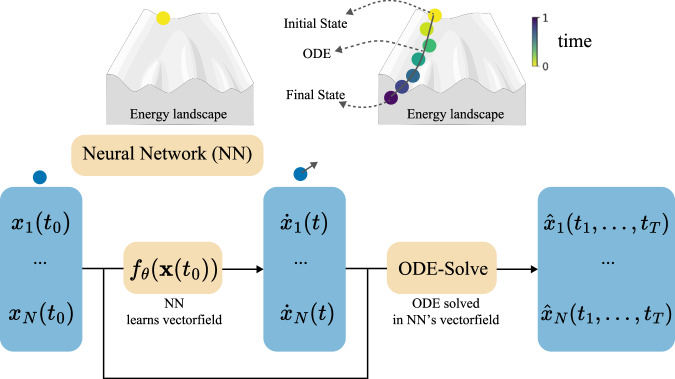 Figure 2
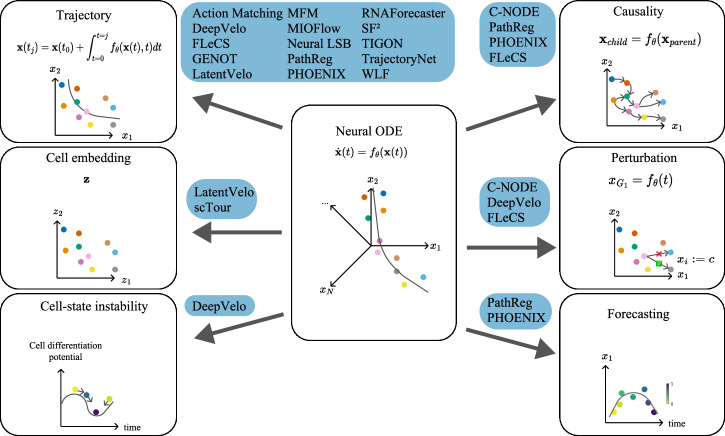 Figure 3
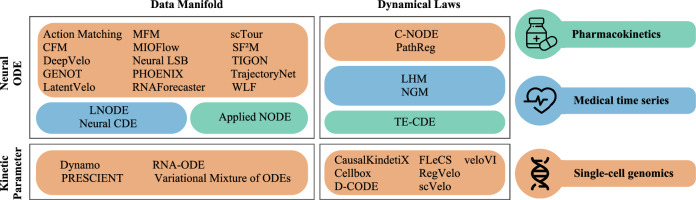 Figure 4
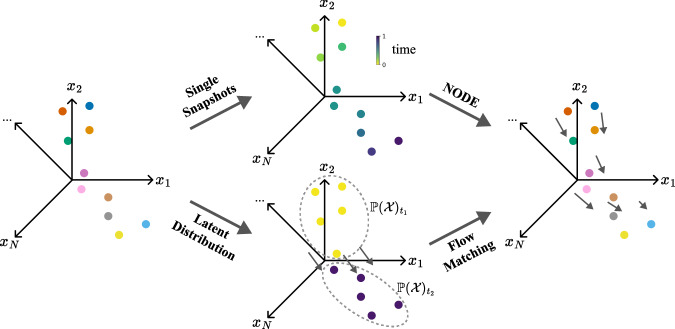 Figure 5
Peer Reviews
No public reviews on file for this paper yet. If you reviewed it on a platform where reviews are public (OpenReview, ICLR, NeurIPS, ICML), you can paste yours below so the community can read it here.
Videos
No videos yet. Explain this paper in a talk, walkthrough, or lecture? Add one.
Taxonomy
TopicsModel Reduction and Neural Networks · Gene Regulatory Network Analysis · Single-cell and spatial transcriptomics