Development and validation of an artificial intelligence-based model for diagnosing benign, borderline, and malignant adnexal masses
Yingnan Wu, Wenli Dai, Xiaoying Li, Shuang Zhang, Liping Gong, Jin Wang, Ailin Cui, Songxue Li, Manning Zhu, Shuang Dong, Yaoting Wang, Lei Zhou, Dexing Kong, Jing Zhao, Litao Sun

TL;DR
This paper introduces Clinical-OMTA, an AI model that helps diagnose ovarian masses and performs as well as experts, with potential benefits in low-resource settings.
Contribution
The novel dual-backbone AI model Clinical-OMTA integrates ultrasound, age, and CA125 for classifying adnexal masses.
Findings
Clinical-OMTA showed comparable performance to ADNEX and expert assessment in diagnosing adnexal masses.
Including age and CA125 did not improve model performance over image-only models.
The model improved radiologists' diagnostic accuracy and agreement when used as a decision support tool.
Abstract
Classification of benign, borderline, and malignant adnexal masses is critical to effective clinical management, but remains a challenge. We developed Clinical-Ovarian Multi-Task Attention (Clinical-OMTA), an artificial intelligence model based on a dual-backbone architecture (benign vs. non-benign, and borderline vs. malignant) that integrates ultrasound, age, and Carbohydrate Antigen 125 (CA125) for multi-class classification. The model’s performance, generalisability, and clinical utility were evaluated. Retrospective data were collected from 23 hospitals (1882 patients for training, validation, and internal testing from 21 hospitals; 340 and 159 patients for external testing from two hospitals). In the external image dataset, Clinical-OMTA demonstrated comparable diagnostic performance to ADNEX (area under the receiver operating characteristic curve [AUC]: 0.950 vs. 0.953, 0.870 vs.…
Genes, proteins, chemicals, diseases, species, mutations and cell lines named across the full text — each resolved to its canonical identifier and authoritative record.
Click any figure to enlarge with its caption.
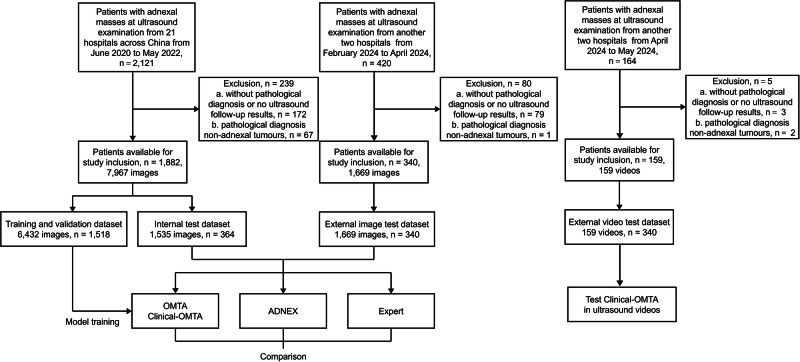 Figure 1
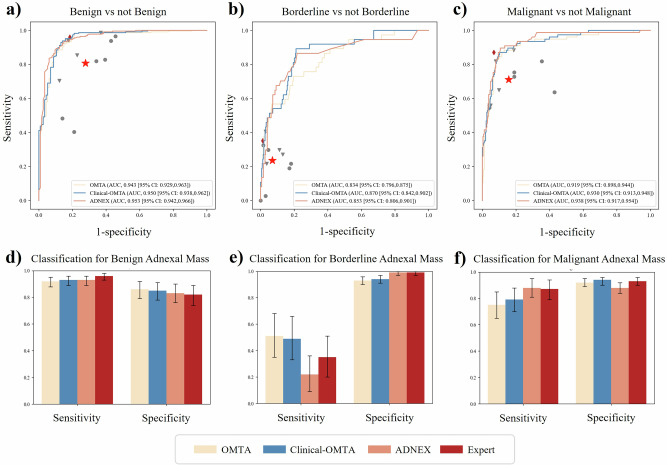 Figure 2
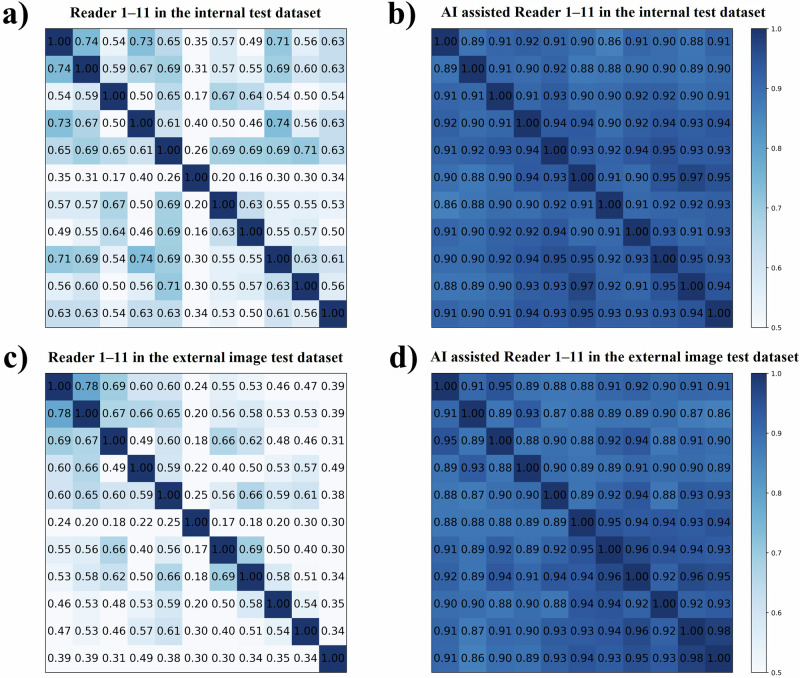 Figure 3
Peer Reviews
No public reviews on file for this paper yet. If you reviewed it on a platform where reviews are public (OpenReview, ICLR, NeurIPS, ICML), you can paste yours below so the community can read it here.
Videos
No videos yet. Explain this paper in a talk, walkthrough, or lecture? Add one.
Taxonomy
TopicsOvarian cancer diagnosis and treatment · AI in cancer detection · Endometrial and Cervical Cancer Treatments